

Why Does My AC Turn On and Off Every 5 Minutes in Winter Haven?
Published September 23, 2026
If you are asking why does my AC turn on and off every 5 minutes, your air conditioner is short cycling because an internal safety switch is cutting power to protect the compressor from dangerous pressure extremes or thermal overheating. In Winter Haven homes, this rapid cycling typically stems from a severely restricted air filter, low refrigerant charge from a line leak, or an overflowing condensate drain pan lifting the safety float switch. Instead of running a healthy 15-to-20-minute cycle to cool and dehumidify your living space, the unit shuts off prematurely after only a few minutes.
Hearing your outdoor unit restart constantly around neighborhoods from Cypress Gardens to downtown Winter Haven brings immediate worry about soaring electric bills and sudden compressor burnout. You shouldn't have to suffer through sticky indoor humidity while wondering whether your cooling system is about to break down completely. You will learn the exact mechanical faults causing these rapid shutdowns, discover four safe troubleshooting steps you can check yourself, and find out how to restore balanced runtimes before permanent motor damage occurs.
Key Takeaways
- Understand why does my AC turn on and off every 5 minutes by identifying how safety controls prevent premature compressor burnout.
- Discover why Central Florida's relentless humidity makes short cycling especially hazardous to indoor comfort and building health.
- Learn a simple, safe four-point DIY checklist to check before booking an on-site service call.
- Identify the critical electrical and refrigerant symptoms that demand certified diagnostic equipment to resolve safely.
- Protect your system's operating lifespan by restoring continuous, efficient cooling cycles across your home.
What Is AC Short Cycling and Why Does It Happen?
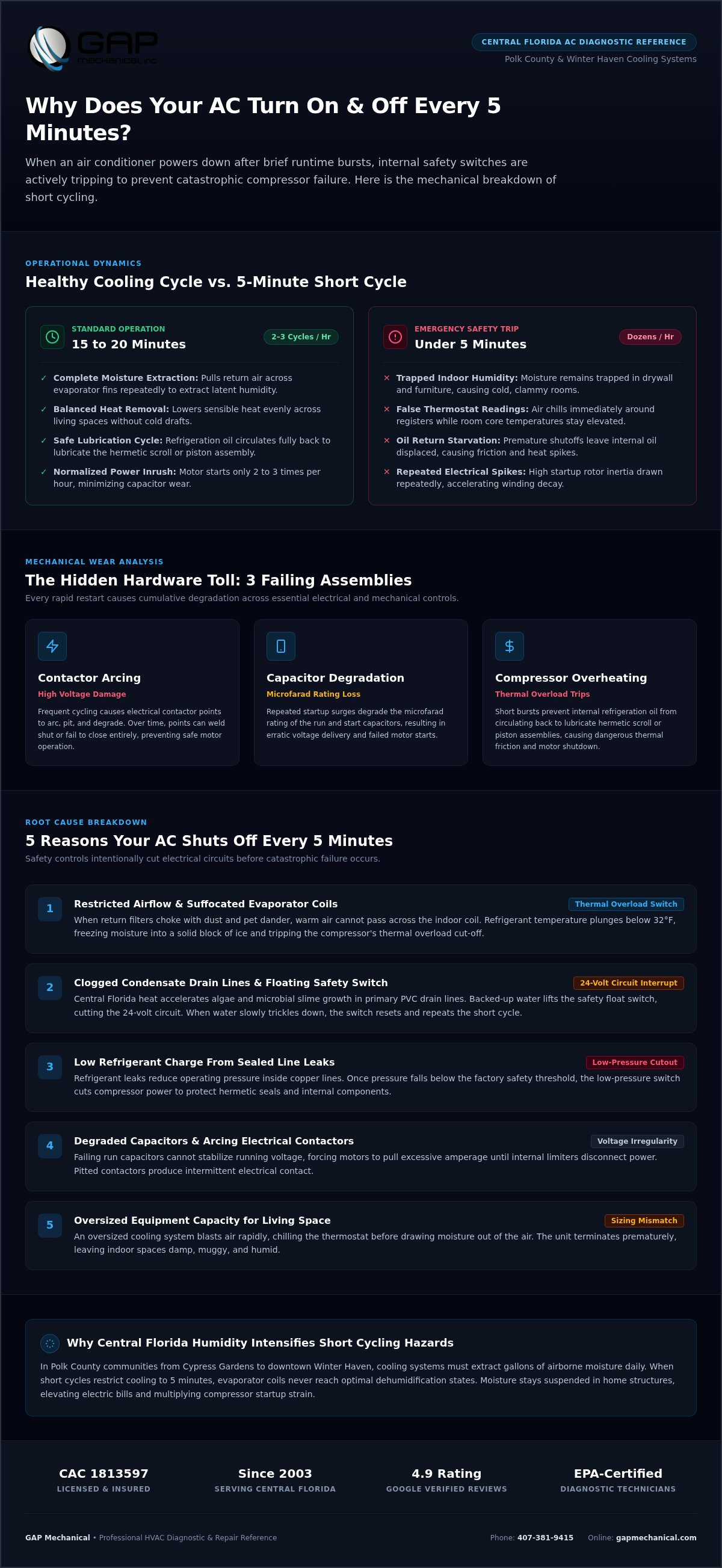
Short cycling occurs when your air conditioner prematurely terminates its operational cycle before completing a full refrigeration run or satisfying the room temperature set on your thermostat. Under standard conditions, a cooling cycle should run continuously for 15 to 20 minutes. When a system powers down after only a few minutes, internal sensors or protective switches are cutting electrical power to stop severe component failure. Understanding the fundamental mechanics of how air conditioning works reveals why these brief runtime bursts fail to cool your living space properly.
Every time your compressor starts, the motor draws a substantial electrical surge to overcome rotor inertia. This power draw relies heavily on the start capacitor and run capacitor. When equipment cycles on and off repeatedly, that startup electrical surge happens dozens of times an hour instead of two or three. If you are asking yourself why does my AC turn on and off every 5 minutes, your unit is operating under extreme thermodynamic stress. In Polk County's damp subtropical climate, these abbreviated runtimes prevent the evaporator coil from pulling latent moisture out of the air, creating a muggy, uncomfortable home.
Normal Cooling Cycles vs. Rapid 5-Minute Bursts
Healthy systems run long enough to pull return air across the chilled evaporator fins multiple times. This extended contact lowers sensible heat and condenses airborne moisture into the drain pan. Five-minute runs, by contrast, briefly drop the air temperature right around the register vents while leaving humidity trapped in your drywall and furniture. You end up with cold, clammy indoor air and a thermostat that registers false temperature drops before your living spaces actually stabilize.
The Hidden Toll on Your System Components
Rapid shutoffs inflict substantial wear across the core electrical and mechanical assemblies of your condensing unit. The damage accumulates quickly through three distinct vulnerabilities:
- Contactor Arcing: Frequent cycling causes electrical contactor points to arc, pit, and eventually weld shut or fail to close entirely.
- Capacitor Degradation: Repeated startup surges degrade the microfarad rating of the run capacitor, leading to erratic voltage delivery.
- Compressor Overheating: Short bursts prevent internal refrigeration oil from circulating back to lubricate the hermetic scroll or piston assembly, causing dangerous thermal buildup.
When you ask why does my AC turn on and off every 5 minutes, remember that repeated starts also spike power demand. The constant mechanical strain quickly wears down significant motor windings long before the unit reaches its expected operating lifespan.
5 Common Reasons Your Air Conditioner Shuts Off Every 5 Minutes
Pinpointing why your cooling system cuts off unpredictably requires checking safety switches designed to interrupt electrical circuits before catastrophic failure occurs. When asking why does my AC turn on and off every 5 minutes, the root cause usually falls into one of five mechanical or electrical categories: airflow restrictions, blocked drainage, refrigerant loss, failing electrical components, or incorrect equipment sizing.
Restricted Airflow and Suffocated Evaporator Coils
When a return air filter fills with dust and pet dander, it chokes intake airflow. Without sufficient warm air passing across the indoor evaporator coil, the refrigerant inside cannot absorb heat properly. The coil temperature plunges below 32 degrees, causing moisture to freeze into a solid block of ice. This airflow restriction triggers the compressor's internal thermal overload switch, cutting power until the unit cools down. If your indoor coil has already accumulated frost, review our action guide for frozen AC units to thaw the system safely without causing water damage.
Clogged Condensate Drain Lines and Safety Float Switches
Central Florida's high humidity forces your air conditioner to pull gallons of water from the air each day. In Winter Haven's heat, algae and microbial slime build up quickly inside the primary PVC drain line. When water backs up into the drain pan, the safety float switch rises and cuts the 24-volt control circuit to the condenser. As water slowly trickles past the blockage, the float drops and resets the circuit. This cycle repeats continuously, killing power every few minutes just as cooling begins.
Refrigerant Leaks and Oversized HVAC Equipment
Low refrigerant levels reduce operating pressure within the sealed copper lines. Once pressure drops below a safe threshold, the low-pressure cutout switch opens the contactor to keep the compressor from burning up. Conversely, oversized equipment cools the indoor air too quickly. An oversized system blasts cold air, satisfies the thermostat in minutes, and shuts down before pulling humidity from the space. If your system runs in brief bursts without lowering indoor humidity, our Orlando AC cooling repair guide details how pressure testing identifies refrigerant leaks.
Failing run capacitors and pitted contactors can also disrupt the electrical signal intermittently. If basic filter checks do not solve the problem, you can schedule a diagnostic visit with an experienced technician to test your safety switches and verify electrical loads safely.
Why Short Cycling Is Worse in Winter Haven and Central Florida
Winter Haven sits surrounded by the Chain of Lakes, creating an environment where summer relative humidity routinely stays above 80 percent. When an air conditioner runs properly, it acts as a whole-home dehumidifier. If you are struggling with why does my AC turn on and off every 5 minutes in Central Florida, the local climate accelerates mechanical strain. Daily afternoon lightning storms across Polk County cause momentary voltage sags, while intense solar radiation drives roofline temperatures to extreme levels.
High Humidity and Mold Growth in the Air Handler
Healthy homes maintain an indoor relative humidity between 30 and 50 percent. When a system shuts down after five minutes, the evaporator coil cannot stay cold long enough to squeeze moisture out of the airstream. Indoor humidity quickly climbs past 60 percent, leaving surfaces feeling damp and clammy. This excess moisture settles inside dark ductwork and drain pans. Combined with warm cabinet temperatures, stagnant moisture fosters rapid microbial growth across the blower wheel and evaporator fins, creating sour odors and degrading overall cooling efficiency. If persistent dampness compromises your distribution system, specialists like Pro Air Cleaners can inspect and clean flexible ductwork to safeguard indoor air quality.
Attic Heat Loads and Electrical Component Strain
Many homes in neighborhoods across Winter Haven place air handlers and refrigerant lines directly inside unconditioned attic spaces. On a standard 92-degree afternoon, Polk County attics frequently exceed 130 degrees Fahrenheit. This intense radiant heat creates several acute operational challenges:
- Electrolyte Breakdown: High ambient heat boils the dielectric fluid inside motor run capacitors, causing premature failure.
- Compressor Thermal Cutouts: The compressor shell absorbs heat from both the outdoor ambient air and returning superheated vapor, tripping internal thermal safety switches.
- Breaker Tripping: Overheated motors draw higher electrical amps during startup, pushing circuit breakers past their rated trip point.
Asking why does my AC turn on and off every 5 minutes during peak afternoon hours often points directly to this thermal buildup. Without steady airflow to cool internal components, critical assemblies overheat rapidly and trigger protective shutdowns.
Troubleshooting Steps: What Homeowners Can Safely Check
Before calling for service, you can run through several straightforward physical inspections. If you are asking why does my AC turn on and off every 5 minutes, checking these four areas will help rule out minor airflow and drainage issues without risking electrical shock or refrigerant loss. Always shut power off at the service disconnect switch before inspecting internal cabinet areas.
Step 1 & 2: Air Filter Inspection and Thermostat Checks
Start by sliding out your return air filter. Whether your home uses standard one-inch pleated filters or four-inch media cabinets, heavy gray dust accumulation chokes static airflow. A clogged filter starves the system within minutes. Replace dirty filters immediately with an appropriately rated MERV 8 to 11 filter to restore airflow across the coil.
Next, inspect your thermostat settings and physical placement:
- Battery Power: Weak AA or AAA batteries cause digital thermostats to drop signals or reset randomly. Install fresh alkaline batteries.
- Fan Configuration: Set the system fan to "Auto" rather than "On." Leaving the fan continuously running can push humid air back into your rooms when the compressor stops.
- Sensory Interference: Make sure direct afternoon sunlight through windows or nearby heat lamps are not striking the thermostat sensor and creating false temperature spikes.
Step 3 & 4: Drain Line Clearances and Outdoor Unit Clearance
Locate the external PVC condensate drain pipe near your foundation outside. When cooling runs, water should drip steadily from this line. If the line is dry while the indoor air handler pan holds standing water, a microbial blockage has engaged your float switch. You can gently vacuum out the exterior line using a wet-dry vacuum to draw out accumulated sludge.
Outside, examine your condenser's aluminum fins. Winter Haven landscapes grow vigorously year-round, but overgrown hedges, palm fronds, or yard debris within two feet of the cabinet choke heat rejection. Clean away loose foliage to let the condenser fan discharge heat freely. Explore our residential HVAC service page to learn more about comprehensive preventative maintenance protocols.
If changing the filter and clearing the drain does not stabilize your cycles, stop troubleshooting. Repeatedly resetting tripped breakers when an AC short cycles can permanently burn out the compressor windings. When basic checks fail to clear the error, schedule an immediate diagnostic inspection with our local team to uncover hidden mechanical faults.
When to Call GAP Mechanical for Professional AC Repair
Certain HVAC failures cannot be resolved with basic maintenance steps. When troubleshooting filters and drain lines does not solve why does my AC turn on and off every 5 minutes, continuing to run the system risks total motor burnout. Precision diagnostic meters, manifold pressure gauges, and certified safety handling are essential to isolate internal system faults without guessing.
Signs of Electrical and Mechanical Failure
Mechanical emergencies often produce distinct warnings before shutting down completely. Shut off the circuit breaker and schedule professional AC repair if you notice any of these severe operational red flags:
- Rapid Clicking or Buzzing: Loud metallic chatter from the outdoor unit indicates a failing contactor or a motor that is drawing locked-rotor amperage.
- Acrid Burning Smells: Pungent electrical odors point to melting insulation, failing relay boards, or motor windings that have overheated.
- Instant Circuit Breaker Trips: If the circuit breaker trips immediately upon motor engagement, a direct ground fault or locked compressor exists. Never reset a breaker more than once under these conditions.
- High-Pressure Cutouts: Non-condensable gasses, defective expansion valves (TXVs), or fan motor failure can push head pressures to unsafe levels, tripping factory pressure limits.
Our Professional Diagnostic and Repair Process
Accurate troubleshooting requires methodical testing rather than part-swapping. A qualified technician will measure start and run capacitor capacitance against manufacturer microfarad tolerances, inspect contactor silver-alloy points for pitting, and verify operating amperage. If pressure switches cause the shutdown, electronic leak detectors identify micro-fractures along copper joints. Using digital gauges to calculate exact refrigerant subcooling and superheat ensures the circuit operates within manufacturer specifications.
GAP Mechanical has provided dependable cooling service to Winter Haven and communities across Central Florida since 2003. Our team of EPA-certified technicians operates under Florida state license CAC 1813597, backed by a 4.9-star Google customer rating built on honest assessments and dependable workmanship. We isolate the exact mechanical trigger causing your short cycling, protecting your compressor from significant premature replacement. If your cooling system cuts off unpredictably, call 407-381-9415 or request an inspection directly through the GAP Mechanical contact page to restore steady comfort to your home.
Restore Dependable Cooling and Protect Your Compressor
Addressing why does my AC turn on and off every 5 minutes quickly protects your equipment and restores balanced indoor humidity. While swapping a clogged return filter or vacuuming a blocked drain line can resolve simple airflow restrictions, rapid shutoffs often indicate deeper electrical imbalances or low refrigerant pressure. Leaving these safety cutoffs unaddressed invites premature compressor failure under Florida's heavy cooling loads.
Returning your system to steady 15-to-20-minute runs eliminates clammy indoor air and spares critical start components from extreme wear. When basic checks do not resolve the issue, schedule professional AC repair in Winter Haven with GAP Mechanical. Our EPA-certified technicians have served Central Florida since 2003 under license CAC 1813597, earning a 4.9-star Google rating by delivering honest, accurate assessments that keep your home cool and dependable.
Frequently Asked Questions
Can a dirty air filter cause my AC to turn on and off every 5 minutes?
Yes, a clogged air filter is the most common reason homeowners ask why does my AC turn on and off every 5 minutes. Restricted airflow chokes the evaporator coil, causing surface temperatures to plunge until frost accumulates. This condition triggers internal thermal overload safety switches that cut off electrical power to the compressor. Replacing the filter restores proper airflow and stops rapid system cycling.
Is it dangerous to let my air conditioner continue short cycling?
Yes, allowing your air conditioner to cycle repeatedly risks permanent motor destruction. Every startup draws intense inrush current that strains start capacitors and overheats motor windings. In Winter Haven's humid climate, short runs also fail to pull moisture from living spaces, causing indoor humidity to spike. Unchecked short cycling eventually causes locked-rotor compressor failure, resulting in an significant system replacement.
Why does my AC turn off after 5 minutes and blow warm air?
This problem happens when the outdoor compressor shuts down on a safety switch while the indoor air handler fan continues to operate. Low refrigerant levels, a failing run capacitor, or high head pressure will trip the outdoor condenser offline. Because the indoor blower keeps pulling warm room air across an unchilled coil, your supply registers blow uncooled air until safety switches reset.
How does a clogged drain line make my AC shut off repeatedly?
A blocked condensate line trips the primary float switch in the drain pan, which immediately interrupts the 24-volt control voltage powering the condenser. As water slowly trickles past algae buildup, the float drops back down and restarts the cooling cycle. If you notice your AC cutting off after running briefly, inspecting the drain pan for standing water usually reveals the culprit.
Frequently Asked Questions
Can a dirty air filter cause my AC to turn on and off every 5 minutes?
Yes, a clogged air filter is the most common reason homeowners ask why does my AC turn on and off every 5 minutes. Restricted airflow chokes the evaporator coil, causing surface temperatures to plunge until frost accumulates. This condition triggers internal thermal overload safety switches that cut off electrical power to the compressor. Replacing the filter restores proper airflow and stops rapid system cycling.
Is it dangerous to let my air conditioner continue short cycling?
Yes, allowing your air conditioner to cycle repeatedly risks permanent motor destruction. Every startup draws intense inrush current that strains start capacitors and overheats motor windings. In Winter Haven's humid climate, short runs also fail to pull moisture from living spaces, causing indoor humidity to spike. Unchecked short cycling eventually causes locked-rotor compressor failure, resulting in an significant system replacement.
Why does my AC turn off after 5 minutes and blow warm air?
This problem happens when the outdoor compressor shuts down on a safety switch while the indoor air handler fan continues to operate. Low refrigerant levels, a failing run capacitor, or high head pressure will trip the outdoor condenser offline. Because the indoor blower keeps pulling warm room air across an unchilled coil, your supply registers blow uncooled air until safety switches reset.
How does a clogged drain line make my AC shut off repeatedly?
A blocked condensate line trips the primary float switch in the drain pan, which immediately interrupts the 24-volt control voltage powering the condenser. As water slowly trickles past algae buildup, the float drops back down and restarts the cooling cycle. If you notice your AC cutting off after running briefly, inspecting the drain pan for standing water usually reveals the culprit.