

AC Not Cooling House Below 80 Degrees Orlando: Repair Guide
Published September 21, 2026
When your AC is stuck at 80 degrees, it usually means the system has reached its maximum cooling capacity or is suffering from a mechanical failure like a clogged condenser or low refrigerant. In the intense Orlando heat, a properly functioning unit should maintain a 20-degree difference between the outdoor temperature and your indoor air. If your AC not cooling house below 80 degrees is running constantly without relief, you're likely facing a capacity battle where the heat entering your home equals the cooling your system can produce.
It's a common scene from the older bungalows in College Park to the newer estates in Lake Nona. You watch the thermostat hover at 80 while the afternoon sun bakes your roof and your FPL bill skyrockets. We understand the anxiety of wondering if you're facing a simple repair or a total system replacement. GAP Mechanical has helped Central Florida homeowners break through this 80-degree wall since 2003. As a licensed and insured team (CAC 1813597) with a 4.9-star Google rating, we provide the technical expertise needed to restore your comfort. This guide explains how to diagnose the cause of your cooling plateau and the specific steps to get your home back to a crisp, livable temperature.
Key Takeaways
- Understand how the 20-degree differential rule and extreme Orlando heat loads can prevent even healthy systems from cooling below a certain point.
- Identify whether your AC not cooling house below 80 degrees is due to mechanical issues like refrigerant leaks or dirty condenser coils.
- Recognize the impact of restricted airflow from clogged filters and leaky attic ductwork on your home's ability to stay cool.
- Learn immediate troubleshooting steps you can perform to improve efficiency and lower indoor temperatures during a heatwave.
- Determine when it is time to contact an EPA-certified professional to perform a deep diagnostic and protect your system from a total breakdown.
Why Your AC Can’t Break the 80-Degree Barrier in Orlando
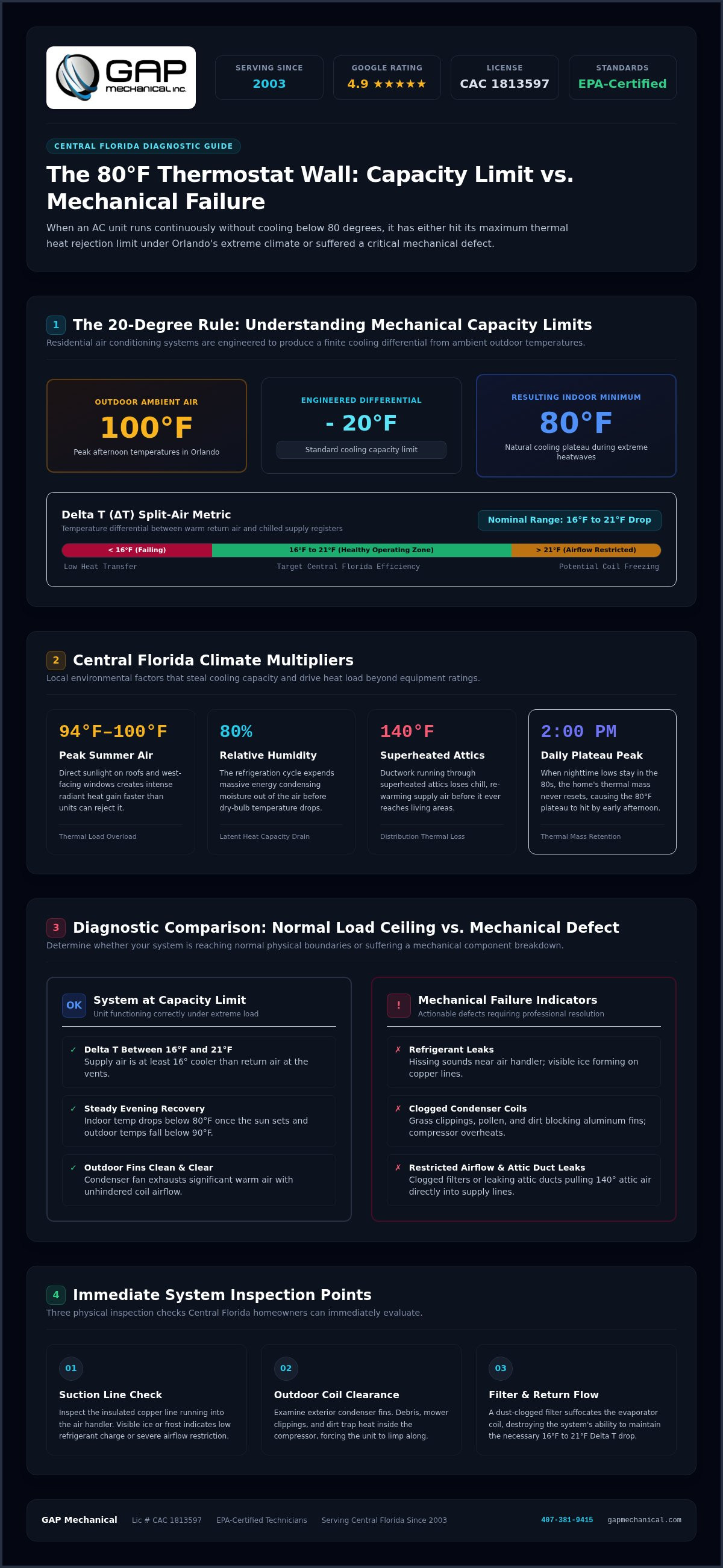
When your thermostat is set to 72 but the display won't budge past 80, you're likely witnessing a battle between your home’s heat gain and your system’s cooling capacity. In Central Florida, this is often the result of the "20-degree rule." Most residential air conditioners are engineered to lower the air temperature by approximately 20 degrees from the ambient outdoor air. When Orlando temperatures climb toward 100 degrees during a July afternoon, a perfectly functional system might naturally bottom out at 80 degrees indoors. This doesn't always mean the unit is broken; it might simply be overwhelmed by the extreme thermal load of the Florida sun.
Understanding the 20-Degree Rule (Delta T)
Delta T is the temperature difference between the warm air entering your return vent and the chilled air blowing out of your supply registers. A healthy system should maintain a temperature drop of 16 to 21 degrees under nominal conditions. This limit is governed by the physics of the air conditioning refrigeration cycle, which can only absorb and move a finite amount of heat per hour. When 94-degree Orlando air is paired with 80% humidity, your AC spends a massive amount of energy removing moisture before it can even begin to lower the dry-bulb temperature. This effectively "steals" cooling capacity, making it difficult for the AC not cooling house below 80 degrees to reach your desired setpoint.
The Impact of the Central Florida Climate
The local environment plays a massive role in how hard your system has to work. Afternoon thunderstorms in Winter Park or Maitland often provide a brief temperature drop, but they immediately spike the humidity. This damp air enters your home through every tiny gap, forcing the evaporator coil to work overtime. Homes along the US-192 corridor or in the western subdivisions of Dr. Phillips often face punishing direct sunlight on west-facing windows during the hottest part of the day. This radiant energy turns your home into a greenhouse, often adding heat faster than a standard-sized unit can remove it.
Nighttime recovery is another local challenge. When Orlando lows stay in the 80s, your home’s "thermal mass"—the slab, walls, and furniture—retains heat from the day. If the system can't get a head start in the early morning, it will likely hit that 80-degree wall by 2:00 PM. In many cases, an AC not cooling house below 80 degrees is a sign that your attic has reached 140 degrees, and your ductwork is struggling to transport cold air through that superheated space without losing its "chill."
Mechanical Failures Preventing Your System from Cooling Below 80
While heat load is a major factor, specific mechanical failures often cause an AC not cooling house below 80 degrees. When a component fails or loses efficiency, the system can't remove heat as fast as the Florida sun adds it. This leaves you stuck in a humid, uncomfortable environment despite the unit running all day. Identifying these mechanical bottlenecks is the first step toward restoring your home’s climate control.
Refrigerant Issues and Low Cooling Capacity
Refrigerant is the lifeblood of your cooling system. A small leak might seem minor, but it leads to a gradual decline in performance over several Orlando summers. Eventually, the system lacks the capacity to reach lower temperatures. You might notice hissing sounds near the air handler or visible ice forming on the copper lines. Simply "topping off" the gas is a temporary fix that ignores the underlying leak. A professional AC repair involves finding the leak and sealing it to ensure long-term stability. Following the ENERGY STAR maintenance checklist helps technicians identify these issues before they lead to a total compressor failure.
The Role of the Outdoor Condenser
The outdoor unit is responsible for releasing the heat collected from inside your home. In Winter Haven and surrounding areas, grass clippings, pollen, and dirt frequently clog the delicate aluminum fins of the condenser. If the coils are dirty, the heat has nowhere to go. This causes the compressor to overheat and "limp" along, resulting in an AC not cooling house below 80 degrees. You should check for the following signs of condenser distress:
- Visible debris or thick dust coating the outdoor coils.
- The outdoor fan motor spinning slowly or making grinding noises.
- Plants or storage items blocking the 2-foot clearance zone around the unit.
- Hot air not blowing out of the top of the unit while it runs.
The "Frozen Coil" paradox is another common failure. When refrigerant is low or airflow is restricted, the evaporator coil drops below freezing. Moisture from the humid Orlando air turns to ice, eventually blocking all airflow. This creates a situation where the unit runs constantly but produces no cooling. If you see ice on your lines, turn the system off immediately and speak with a technician to prevent permanent compressor damage. Running a frozen system can lead to a catastrophic failure that requires a full replacement.
Airflow and Insulation: The Hidden Culprits of the 80-Degree Wall
Your cooling system depends on high-volume airflow to transfer heat effectively. If your AC not cooling house below 80 degrees is struggling, the problem might not be the compressor at all. It could be a simple restriction in the path the air takes through your home. When air cannot move freely, the evaporator coil cannot absorb heat. This leads to a system that runs non-stop without making a dent in the indoor temperature. The heat has to go somewhere; if it can't be moved, it stays in your living room.
The Critical Importance of Airflow
Many Orlando homeowners choose high-MERV filters to combat seasonal allergies and pollen. However, these dense filters can act like a wall, choking your system. If the blower motor has to fight against a clogged or overly restrictive filter, the volume of cold air reaching your rooms drops significantly. This creates a capacity deficit that prevents the home from cooling down. You might also have a dirty blower wheel. Over years of service, dust builds up on the curved blades, reducing the "push" of the fan. Another common culprit is ductwork leakage. In Central Florida, most ducts run through attics that reach 140 degrees. If a return plenum has a gap, it pulls that superheated air directly into your system. This instantly negates the cooling process and puts an impossible load on the unit.
Watch for these signs of airflow failure:
- Weak air coming from the registers even when the fan is on high.
- Dust buildup around the edges of your ceiling vents.
- Hot and cold spots in different rooms of the house.
- A whistling or humming sound coming from the return air grille.
Heat Gain and the Building Envelope
Even a perfectly sized AC will fail if your home’s "envelope" is leaking. In historic Winter Park neighborhoods or older downtown Orlando homes, insulation levels often fall below modern R-38 standards. Poor attic insulation allows radiant heat from the roof deck to soak through your ceilings. This creates a constant downward pressure of heat that your AC must fight. Single-pane windows common in older Central Florida homes also allow massive solar gain. Finally, the "stack effect" can undermine your comfort. As hot air rises in your attic, it creates a vacuum that pulls conditioned air out of your living space. It draws hot air in through recessed light fixtures and unsealed top plates. If your AC not cooling house below 80 degrees, these structural gaps are often the invisible reason why the system feels overwhelmed.
Immediate Steps to Lower Your Indoor Temperature Today
If your AC not cooling house below 80 degrees is leaving you in a sweat, you need immediate relief. Before calling a technician, perform these quick checks. They could save you from an unnecessary service call or at least stabilize the temperature until a pro arrives. When the heat index in Central Florida exceeds 105 degrees, every small adjustment to your home’s thermal load helps the system catch up.
DIY Troubleshooting Checklist
Start with the most basic components to ensure the system has the power and path it needs to function. A surprising number of cooling issues stem from simple oversights that a homeowner can address in minutes.
- Thermostat Settings: Verify the unit is set to "Cool" and the fan is set to "Auto" rather than "On." When the fan runs constantly, it pulls moisture off the evaporator coil and back into your home, spiking humidity.
- Circuit Breakers: Check your electrical panel. If the outdoor condenser trips a breaker, the indoor fan will continue to blow warm air, making it feel like the system is working when it isn't.
- Condensate Drain Line: Locate your drain line, usually near the outdoor unit. If the line is clogged with algae, the safety float switch will cut power to the compressor to prevent water damage in your home.
- Air Filter: As discussed previously, a grey, dusty filter is the leading cause of a system hitting the 80-degree wall. Replace it immediately if it looks restricted.
Reducing the Thermal Load
Management of solar gain is vital during peak afternoon hours. Close all blinds and curtains in East-facing rooms during the morning and West-facing rooms after 1:00 PM. This blocks radiant heat before it penetrates your windows and raises the indoor temperature. You should also avoid using heat-producing appliances like the oven, dishwasher, or clothes dryer between 2:00 PM and 7:00 PM. These machines add significant sensible heat and latent humidity that an already struggling AC cannot handle.
Ensure your ceiling fans are rotating counter-clockwise. This creates a downdraft that provides a wind-chill effect on your skin, making 80 degrees feel significantly cooler. Also, walk through your home to ensure no supply vents are blocked by heavy curtains or furniture. Keeping the air moving is the best way to help your AC not cooling house below 80 degrees finally break through that temperature barrier. If these steps don't lower the temperature within two hours, it's time to schedule a professional inspection to prevent further mechanical strain.
Professional Solutions to Restore Your Central Florida Comfort
Professional intervention is required when an AC not cooling house below 80 degrees continues to run without cycling off after DIY steps are completed. If you've replaced the filter and cleared the outdoor unit but the temperature remains stagnant, you're likely facing a complex mechanical issue or a critical capacity deficit. Continuing to run a struggling system risks burning out the compressor motor, leading to a much more disruptive replacement. A licensed residential HVAC specialist can identify the specific failure point that DIY checks often miss.
The Value of a Professional Diagnostic
A professional diagnostic involves much more than just hooking up gauges to check pressure. Our EPA-certified technicians perform a comprehensive analysis of the system’s health. We measure subcooling and superheat to determine the exact refrigerant charge. This precision is vital because even a minor deviation in charge can significantly reduce cooling capacity. Whether you're in Winter Park or Winter Haven, you can expect a technician who understands the specific humidity challenges of our region. GAP Mechanical brings over 25 years of experience to every call. We look for the root cause, such as a failing TXV valve or a micro-leak in the evaporator coil, rather than just treating the symptoms. Our 4.9-star Google rating reflects this commitment to technical accuracy and transparency.
Long-Term Comfort Strategies
Restoring comfort often involves looking beyond the immediate repair. For older systems in Orlando, there comes a point where repair needs no longer make sense. If your unit is over 12 years old and frequently hits the 80-degree wall, a high-efficiency replacement might be the best path forward. Modern systems are designed to meet strict SEER2 standards, which helps in lowering monthly FPL bills. We use Manual J load calculations to ensure any new system is perfectly sized for your home’s square footage and insulation levels. An oversized unit will cool too quickly without removing humidity, while an undersized one will never break the 80-degree barrier during a heatwave.
Regular maintenance is the best way to prevent summer emergencies. Our technicians clean the coils, check electrical connections, and verify airflow during every visit. This proactive approach keeps your system running at peak efficiency even when the Florida sun is at its worst. If you're tired of a warm home and rising bills, GAP Mechanical is ready to help. You can reach our team at 407-381-9415 to schedule a professional evaluation and get your home back to the temperature you deserve. We've served Central Florida since 2003 and remain committed to providing dependable, expert service (CAC 1813597).
Reclaim Your Home’s Comfort and Efficiency
Living with a home that won't cool down is more than an inconvenience; You've learned that while the intense Orlando heat pushes systems to their thermodynamic limits, mechanical failures or airflow restrictions are often the real culprits behind the 80-degree wall. Managing solar gain and maintaining clean filters are vital first steps for every Central Florida resident looking to stay cool.
If your AC not cooling house below 80 degrees persists after basic troubleshooting, professional intervention is the safest way to prevent a total system breakdown. GAP Mechanical has served the local community since 2003 with a 4.9-star Google rating. As a licensed and insured contractor (CAC 1813597), we provide the technical precision needed to handle Florida’s extreme climate challenges with confidence.
Don't let a struggling unit lead to soaring utility bills or sleepless nights. Contact GAP Mechanical for Fast AC Repair in Orlando to restore your peace of mind. Our experienced technicians are ready to help you reclaim a cool, comfortable home today.
Frequently Asked Questions
Is it normal for my AC to stay at 80 degrees when it’s 100 degrees outside?
It is often normal when outdoor temperatures hit triple digits because residential air conditioners are engineered for a 20-degree temperature drop. If it is 100 degrees in Orlando, a system maintaining 80 degrees is likely operating at its engineered limit. However, if your home feels excessively humid or the air from vents is warm, you may still have a mechanical issue or airflow restriction that requires a professional diagnostic.
Should I turn my AC off if it won’t go below 80 degrees?
You should turn your AC off immediately if you notice ice on the refrigerant lines or if the unit is making loud, metallic noises. If the system is simply struggling with the afternoon sun, try raising the thermostat to 78 or 80 degrees to reduce the mechanical load. Running a system that cannot reach its setpoint for hours puts immense strain on the compressor, which can lead to an significant premature failure.
What is the most common cause of AC failure in Orlando summers?
The most common cause of cooling failure during an Orlando summer is a failed dual-run capacitor. The intense heat causes these electrical components to degrade, eventually preventing the compressor or fan from starting. Other frequent local issues include clogged condensate drain lines due to rapid algae growth and dirty condenser coils that can't release heat. Regular professional inspections help identify these weak points before the hottest days of the year arrive.
Why does my AC work fine at night but struggle during the day?
Your AC struggles during the day because it has to overcome both high ambient temperatures and solar heat gain from the sun hitting your roof and windows. At night, the absence of solar radiation and lower outdoor temperatures allow the system to finally remove the heat stored in your home's thermal mass. If the system only fails during the day, it indicates it is either slightly undersized or losing efficiency due to age.
Can a dirty air filter cause my AC to stop cooling at 80 degrees?
A dirty air filter is a leading cause of cooling plateaus. When airflow is restricted, the system cannot move enough heat out of your living space, causing an AC not cooling house below 80 degrees to run constantly without results. In Central Florida, we recommend checking your filter every 30 days. High-pollen seasons in Orlando can clog filters faster than expected, leading to frozen coils and total system shutdowns if left unaddressed.
Frequently Asked Questions
Is it normal for my AC to stay at 80 degrees when it’s 100 degrees outside?
It is often normal when outdoor temperatures hit triple digits because residential air conditioners are engineered for a 20-degree temperature drop. If it is 100 degrees in Orlando, a system maintaining 80 degrees is likely operating at its engineered limit. However, if your home feels excessively humid or the air from vents is warm, you may still have a mechanical issue or airflow restriction that requires a professional diagnostic.
Should I turn my AC off if it won’t go below 80 degrees?
You should turn your AC off immediately if you notice ice on the refrigerant lines or if the unit is making loud, metallic noises. If the system is simply struggling with the afternoon sun, try raising the thermostat to 78 or 80 degrees to reduce the mechanical load. Running a system that cannot reach its setpoint for hours puts immense strain on the compressor, which can lead to an significant premature failure.
What is the most common cause of AC failure in Orlando summers?
The most common cause of cooling failure during an Orlando summer is a failed dual-run capacitor. The intense heat causes these electrical components to degrade, eventually preventing the compressor or fan from starting. Other frequent local issues include clogged condensate drain lines due to rapid algae growth and dirty condenser coils that can't release heat. Regular professional inspections help identify these weak points before the hottest days of the year arrive.
Why does my AC work fine at night but struggle during the day?
Your AC struggles during the day because it has to overcome both high ambient temperatures and solar heat gain from the sun hitting your roof and windows. At night, the absence of solar radiation and lower outdoor temperatures allow the system to finally remove the heat stored in your home's thermal mass. If the system only fails during the day, it indicates it is either slightly undersized or losing efficiency due to age.
Can a dirty air filter cause my AC to stop cooling at 80 degrees?
A dirty air filter is a leading cause of cooling plateaus. When airflow is restricted, the system cannot move enough heat out of your living space, causing an AC not cooling house below 80 degrees to run constantly without results. In Central Florida, we recommend checking your filter every 30 days. High-pollen seasons in Orlando can clog filters faster than expected, leading to frozen coils and total system shutdowns if left unaddressed.