

AC Repair Orlando: Troubleshooting Checklist
Published June 9, 2026
When your air conditioning stops cooling in the oppressive humidity of Central Florida, professional troubleshooting is essential because the symptoms are often misleading. A certified HVAC expert doesn't just fix the visible problem; they diagnose the underlying systemic failure caused by unique environmental stressors like high humidity and intense afternoon storms.
At GAP Mechanical, we understand that living in Orlando requires more than just a machine that blows air—it requires a robust system that withstand the relentless Central Florida climate. Our comprehensive diagnostic approach ensures that the solution addresses the root cause, not just the temporary symptom.
The Unique Environmental Stress of Central Florida
Central Florida presents a specific set of challenges that standard HVAC systems face across the country do not. The heat, combined with extreme humidity, creates a constant battle for your unit. This is particularly true in older homes found in neighborhoods like Winter Park or the established communities of Dr. Phillips.
The high moisture content in the air places an immense load on your AC, forcing the system to run longer and harder than it would in drier climates. This constant overwork accelerates wear on components like compressors, capacitors, and refrigerant lines.
Furthermore, the frequency of afternoon thunderstorms and tropical weather means that your system is often put through rapid on-and-off cycles. These rapid fluctuations are detrimental to the lifespan of electrical components. A professional knows how to differentiate between a simple clog and a complex electrical issue exacerbated by these conditions.
Another factor to consider is the corrosive nature of the local air. While not as severe as coastal salt air, the high humidity and airborne particulates in areas like Kissimmee or Orlando itself can lead to premature deterioration of external condensers and internal coils. This requires a meticulous inspection that goes far beyond simply checking the thermostat.
Differentiating Symptoms from Root Causes
Many homeowners try to self-diagnose based on a few visible signs, but these symptoms are often just indicators of a deeper, more critical system failure. A proper professional troubleshooting process requires isolating the symptom from the cause.
Consider these common signs you might observe, and understand what they could actually indicate:
- Weak or lukewarm air: This is the most common symptom, but it doesn't always mean the compressor has failed. It could indicate low refrigerant, a clogged filter, or an issue with the metering device.
- Strange noises (grinding, rattling, squealing): While a simple belt issue is possible, these noises can also point to bearing failure in the blower motor or compressor, which are very significant components to replace.
- Ice buildup on the lines: If you see ice forming on the copper lines, it is a serious sign of low airflow or severely restricted refrigerant flow. Ignoring this can lead to catastrophic compressor failure.
- System shuts off suddenly: Sudden shutdowns can be due to thermal overload switches tripping, but they can also signal a major electrical failure, requiring specialized diagnostic tools.
A skilled technician, such as those at GAP Mechanical—a company serving Central Florida since 2003—uses advanced diagnostic equipment to go beyond these basic observations. We prioritize identifying the exact point of failure before recommending any corrective action.
The Professional Diagnostic Process: A Step-by-Step Look
When you call for AC repair in Orlando, you aren't just getting someone to change a part; you are getting a structured, scientific diagnostic evaluation. Our process is designed to be thorough, efficient, and focused entirely on achieving long-term system reliability for your home.
Here is a simplified overview of how a professional diagnostic service operates:
- Initial Assessment and History: The technician first asks detailed questions about the unit's history, when the symptoms started, and if any recent weather events (like severe thunderstorms) coincided with the failure.
- Visual and Auditory Inspection: A thorough physical inspection of the indoor unit, outdoor condenser, and visible piping. This includes checking for signs of corrosion or physical damage specific to the Florida climate.
- Electrical System Testing: Using specialized meters, the technician tests voltage, amperage, and capacitor health. This confirms if the issue is electrical or mechanical.
- Pressure and Refrigerant Analysis: The system is put under pressure to check refrigerant levels and look for leaks. This is critical because simply topping off refrigerant without finding the leak is a temporary fix that guarantees future failure.
- Component Isolation: Based on the data gathered, the technician isolates the primary point of failure—be it a faulty motor, a clogged coil, or an electrical relay.
This meticulous process ensures that when a repair is necessary, the solution is permanent. We adhere to industry best practices, utilizing knowledge that is often shared across the sector, much like the content found on resources such as Repair-CRM.
Preventative Maintenance: Your AC’s Best Defense
While emergency repair is necessary when things go wrong, the most effective strategy for dealing with the intense heat and humidity of Orlando is preventative maintenance. Viewing your HVAC system as a complex machine requires regular tune-ups to manage the unique strains of Central Florida living.
Regular professional servicing allows us to catch small issues—like a slightly low refrigerant charge or a slightly dirty coil—before they escalate into major, system-threatening failures. This proactive approach is especially vital for homes in areas like Lake Nona or the rapidly growing sections of Orlando.
Here are key preventative steps that a professional service addresses:
- Coil Cleaning: Removing accumulated dirt and humidity residue from both the evaporator and condenser coils to ensure maximum heat transfer efficiency.
- Refrigerant Level Checks: Not just checking the level, but verifying the system's overall performance under load to ensure no hidden leaks are forming in the high-stress environment.
- Airflow Optimization: Ensuring the blower motor is running at peak efficiency and that all filters are properly sized and replaced to maximize air movement.
- Electrical System Checks: Inspect and test all connections, wiring, and control boards to prevent failure caused by humidity and minor power fluctuations.
A reliable HVAC partner, like RMI Heating and Air Conditioning, understands the local climate and tailors its maintenance programs to combat the specific wear and tear placed on systems in the Orlando area.
When to Call a Specialist in Orlando
It is important to know when a problem is beyond the scope of a simple DIY fix and requires the expertise of a licensed, professional HVAC technician. While changing a simple air filter is a common homeowner task, complex issues demand professional intervention.
You should always contact a certified expert if you encounter any of the following:
- The system runs constantly but the temperature never drops significantly.
- You notice a strong odor of burning plastic or electrical components.
- The outdoor unit is vibrating excessively or making loud, metallic noises.
- You suspect a refrigerant leak and cannot locate the source.
- The system’s performance has noticeably declined over the last few months, indicating gradual component degradation.
The difference between a temporary patch and a durable repair lies in the diagnostic depth of the technician. We focus on providing long-term climate comfort and system longevity, allowing you to focus on enjoying the beautiful Central Florida weather, regardless of the season.
If you are experiencing any of the symptoms outlined above, or if you simply want a professional assessment of your system's health before the peak summer heat arrives, the next logical step is to consult with a licensed professional. We are here to guide you through the complexities of your AC system.
Frequently Asked Questions
Q: How does Central Florida humidity affect my AC system?
A: High humidity forces your AC to work significantly harder to remove moisture from the air, not just cool it. This increased workload puts greater strain on the compressor and increases the overall operating time, leading to faster component wear.
Q: Can I tell if my AC needs repair just by looking at it?
A: While you can observe signs like ice buildup or strange noises, a visual inspection alone is rarely enough for a definitive diagnosis. A professional uses specialized meters and gauges to test electrical performance and refrigerant pressures, which are often invisible to the naked eye.
Q: How often should I have my AC professionally inspected in Orlando?
A: For optimal performance and longevity in Central Florida's demanding climate, a professional tune-up is highly recommended at least twice per year—once in the spring and once in the fall—to ensure the system is ready for the intense summer load.
Q: What is the difference between a minor AC issue and a major system failure?
A: A minor issue is usually correctable with simple maintenance, like a clogged filter or minor refrigerant top-off. A major failure often involves complex electrical components, such as a failed compressor or a major control board failure, requiring detailed diagnostics and specialized repair expertise.
Frequently Asked Questions
Visual and Auditory Warning Signs
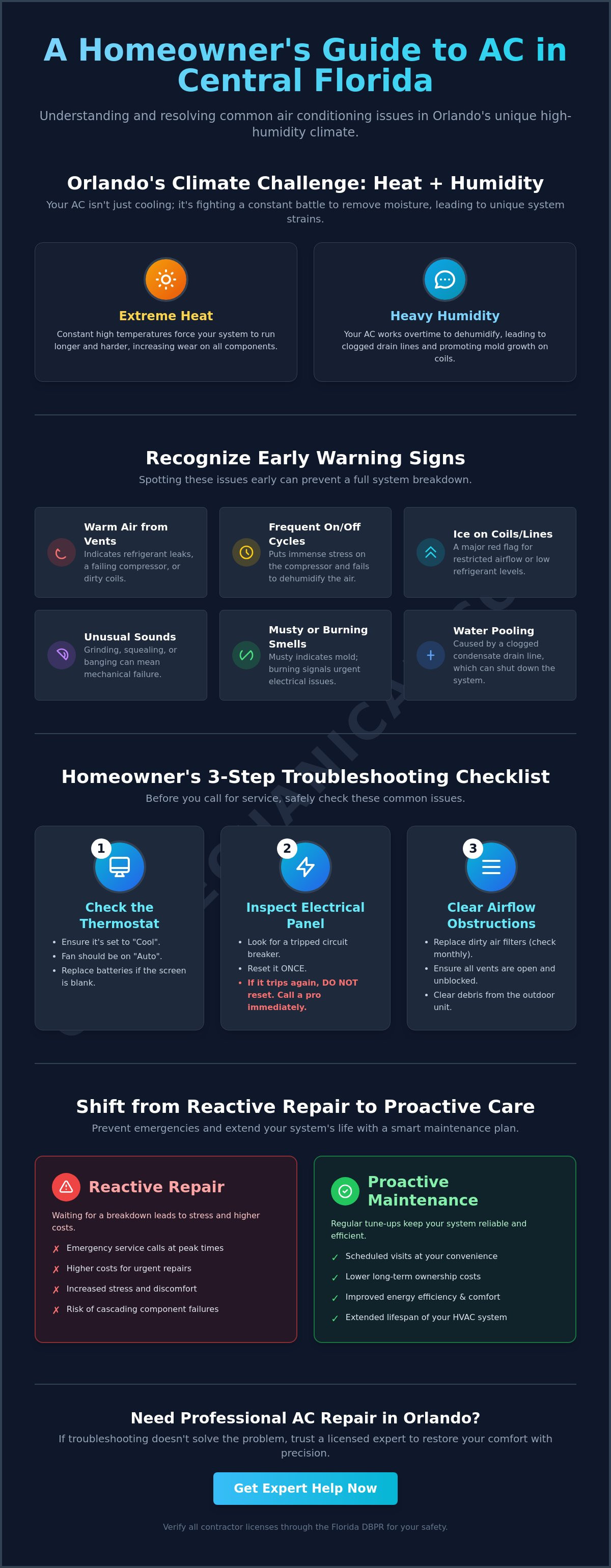
Regularly inspecting your unit can prevent minor issues from becoming major expenses. Ice buildup on the evaporator coils or refrigerant lines is a major red flag. It usually indicates restricted airflow or low refrigerant levels. You should also listen for unusual sounds. A healthy system has a steady, predictable hum. Grinding, squealing, or loud banging suggests mechanical failure in the motor or blower fan. Finally, check for water pooling around the indoor unit. A clogged condensate drain line causes water to back up, which can damage your home or trigger an automatic safety shut-off.
Odors and Air Quality Indicators
Your nose is often a powerful diagnostic tool. "Dirty Sock Syndrome" refers to a musty, moldy odor caused by bacteria buildup on the coils. This is common in Orlando because the damp environment promotes organic growth. Burning smells are more urgent. They typically signal overheating wires or a failing blower motor that requires immediate attention. If your indoor humidity feels higher than usual despite the AC running, the system’s dehumidification capacity has likely failed. Reliable AC repair Orlando focuses on restoring this dehumidification to ensure your home stays healthy and comfortable. A sudden loss of cooling doesn't always require a major intervention. Before calling for professional assistance, you can perform a safe, methodical diagnostic check. This process helps rule out simple user errors or minor obstructions that don't necessitate a full service call. Following a structured approach ensures you don't miss the obvious while protecting your system from further damage. It's about being thorough and safe.
Thermostat and Electrical Basics
Start with your thermostat. It is common to find the unit accidentally switched to "Heat" or "Off" during routine cleaning. Ensure the setting is on "Cool" and the fan is set to "Auto." Setting the fan to "On" can actually increase indoor humidity because the blower runs even when the cooling cycle is off. If the screen is blank, replace the batteries immediately. A simple calibration error or power loss at the thermostat can mimic a total mechanical breakdown. It's a quick fix that saves time. Next, check your electrical panel. Orlando's frequent lightning strikes can trip a circuit breaker without you realizing it. Look for any switch that is in the middle or "Off" position. You may reset a tripped breaker once. If it trips again immediately, do not attempt a second reset. This signals a deeper electrical fault or a failing compressor that requires professional AC repair Orlando to diagnose safely. Repeatedly resetting a breaker can lead to permanent motor damage or electrical fires.
Airflow and Drainage Maintenance
Airflow restrictions are the most common cause of cooling loss. Inspect your air filter. A standard 1-inch pleated filter can become clogged in as little as 30 days in a high-use environment like Central Florida. This restriction increases system pressure and can cause the evaporator coils to freeze. According to the U.S. Department of Energy, maintaining your air conditioner by replacing filters is the single most effective way to ensure efficiency. It keeps the air moving and the coils clean. Finally, examine the outdoor condenser and the indoor drain line. Your outdoor unit needs at least 2 feet of clear space for proper heat exchange. Remove any overgrown brush or storm debris that might be blocking the aluminum fins. Inside, check the condensate drain line for standing water. Most modern systems feature a float switch that cuts power if a clog is detected. If you see water in the emergency pan, clearing the drain line is the only way to restore operation. If these steps don't resolve the issue, contact the experts at GAP Mechanical for a comprehensive diagnostic. When you schedule AC repair Orlando, you should expect more than a technician who simply replaces a part and leaves. A professional service call is a systematic investigation into the health of your entire HVAC system. At GAP Mechanical, our technicians follow a rigorous diagnostic protocol designed to identify both the immediate failure and any underlying stresses that could cause future breakdowns. This methodical approach ensures transparency and provides you with a clear understanding of your system's condition. A comprehensive diagnostic begins with an interview to understand the system's recent behavior. The technician then moves to the physical inspection, using precision tools like manifold gauges to check refrigerant pressures. These gauges tell the story of how well the heat exchange process is functioning. We also test critical electrical components, including capacitors, contactors, and fan motors, to ensure they are operating within their specified ranges. Before any work begins, it's always wise to verify your contractor's license to ensure they meet Florida's strict technical standards.
Precision Diagnostic Testing
Efficiency is measured through data, not guesswork. Our technicians calculate the "temperature split," which is the difference between the air entering the return and the air exiting the supply vents. A healthy system typically shows a 15 to 20-degree difference. We also perform amp-draw testing on the compressor. By measuring how much electricity the compressor pulls, we can predict a potential failure before it leaves you in the heat. If refrigerant levels are low, we use electronic leak detectors to find the exact source of the breach, rather than just "topping off" the system and ignoring the root problem.
Common Component Replacements in Orlando
The intense Central Florida heat places extreme demands on electrical parts. Capacitors are the most frequent failure point we encounter. These components act like batteries to start the motors; when they overheat or age, they often bulge or "pop," stopping the system instantly. We also inspect the contactor, which is the switch that sends power to the compressor. In our region, ants or "pitting" on the metal points often prevent the contactor from making a solid connection. Finally, we address blower motor issues. If your indoor fan isn't moving air effectively, it can lead to frozen coils and a total loss of cooling. Restoring these components with high-quality replacements is essential for professional AC repair Orlando. Choosing the right company for AC repair Orlando is a decision that impacts your home's safety and your long-term planning. A "handyman" might offer a lower initial consideration, but they often lack the specialized training required for modern, high-efficiency HVAC systems. Licensed professionals undergo rigorous background checks and technical examinations. This ensures they understand complex electrical circuits and high-pressure refrigerant cycles. Hiring unlicensed labor isn't just a risk to your equipment; it can also void your manufacturer’s warranty and leave you without recourse if the repair fails. General liability and workers’ compensation insurance are non-negotiable requirements for any legitimate contractor. If an uninsured worker is injured on your property, you could be held liable for their medical expenses and lost wages. A truly professional contractor carries these policies to protect both their team and your peace of mind. When evaluating a local company, look beyond the 5-star rating. Read the detailed reviews to see how they handle complex problems and whether they stand behind their work when things don't go as planned. Reliability is proven through consistent, transparent service over time.
Verification of Credentials
NATE certification serves as the gold standard for technical excellence in the industry. It proves the technician has mastered the real-world application of heating and cooling principles. Additionally, every technician handling refrigerant must hold a Section 608 certification from the U.S. Environmental Protection Agency (EPA). This is a nationwide requirement for safety and environmental protection. You can easily verify a company's standing by visiting the Florida Department of Business and Professional Regulation (DBPR) website. This step confirms their license is active and free of major disciplinary actions before they arrive for your AC repair Orlando.
Experience and Local Expertise
Orlando’s unique environment requires a specific set of skills. Contractors with decades of experience in the region understand how local drainage patterns and frequent power fluctuations affect system longevity. They know which neighborhoods struggle with specific humidity issues and how to calibrate systems for maximum efficiency in the Florida sun. Transparent, upfront details models are another hallmark of a dependable guide. You should receive a clear explanation of the work required before any tools are touched. If you need a team that combines technical precision with deep local roots, contact GAP Mechanical to schedule your service today. Completing a successful repair is only the first step toward lasting home comfort. The moment a technician restores your cooling is the ideal time to transition from reactive fixes to a proactive maintenance plan. Many homeowners wait for a total breakdown before calling for AC repair Orlando, but this approach often leads to higher considerations and unnecessary stress. Establishing a routine service schedule ensures that minor wear doesn't escalate into a major mechanical failure during the peak of summer. Regular professional maintenance also protects your financial asset. Most HVAC manufacturers require documented annual service to keep the equipment warranty valid. If a critical component like the compressor fails, the manufacturer may request service records before honoring a part replacement claim. By staying consistent with your maintenance, you ensure that your warranty remains a reliable safety net for years to come.
The Preventive Maintenance Advantage
A professional maintenance visit goes far beyond a simple filter change. It involves technical tasks that directly impact system longevity and energy consumption. Our technicians focus on several key areas:
Affording Quality Service at GAP Mechanical
We understand that an unexpected system failure can be a significant financial burden. To help you manage these considerations, we offer flexible support options that allow you to address critical repairs immediately without depleting your savings. This ensures you never have to choose between your family's comfort and your financial stability. We also take great pride in supporting those who serve our country. Special discounts and considerations are available for military personnel and veterans as a token of our appreciation for their service to the community. Don't wait for the next heatwave to discover a problem with your cooling system. Taking action now prevents emergency calls and extends the life of your HVAC unit. Schedule your professional AC repair with GAP Mechanical today to restore your peace of mind and ensure your home stays cool regardless of the Florida humidity. Managing a cooling failure in Central Florida doesn't have to be a stressful experience. By recognizing the early warning signs of high-humidity strain and following a structured troubleshooting checklist, you can often identify issues before they lead to a total system shutdown. When professional intervention becomes necessary, verifying technical credentials and insurance ensures your home remains protected. Choosing a partner who understands the specific environmental demands of our region is the most effective way to guarantee long-term reliability for your HVAC system. With over 25 years of local experience and a 4.9-star Google rating, GAP Mechanical provides the technical precision you need for dependable AC repair Orlando. We are fully licensed and insured under Florida License #CAC1817557, offering you the security and transparency that comes with seasoned expertise. Our team is ready to restore your indoor climate and help you implement a maintenance plan that prevents future emergencies. Don't let the heat take over your home. Contact GAP Mechanical for Fast, Licensed AC Repair in Orlando and get back to enjoying a cool, comfortable environment today.
How much does a typical AC repair service call consideration in Orlando?
The consideration of a service call depends on the complexity of the diagnostic and the specific parts required for the fix. Minor issues like a blown fuse or a faulty thermostat are generally more practical than major repairs involving the compressor or evaporator coils. We provide a transparent diagnostic process so you understand the necessary work before any repairs begin.
Why is my AC running but not blowing cold air into the house?
This issue often indicates a refrigerant leak, a failing compressor, or heavily soiled coils. If the fan is moving air but the temperature isn't dropping, the heat exchange process has failed. Dirty evaporator coils can also prevent the system from cooling the air effectively, requiring a professional cleaning to restore performance.
Is it worth repairing an AC unit that is over 10 years old in Florida?
Florida's high humidity and heat accelerate the aging process of HVAC components. If a unit is over 10 years old and requires a major repair like a compressor replacement, investing in a new system is often more efficient. A new installation can increase your home's value by 5% to 7% while significantly lowering monthly energy bills.
How long does a standard AC repair appointment usually take?
A standard appointment for AC repair Orlando typically lasts between one and three hours. Simple diagnostic tasks and part swaps, such as replacing a capacitor or contactor, are often completed quickly. More complex issues involving refrigerant leaks or blower motor failures may require additional time to ensure the system is calibrated correctly.
Can a clogged air filter really cause my entire AC system to shut down?
Yes, a heavily soiled air filter can cause your entire system to freeze up and eventually shut down. Restricted airflow prevents the evaporator coil from absorbing heat, causing the temperature to drop below freezing. This leads to ice formation and triggers safety switches that cut power to the unit to prevent permanent motor damage.
What are the most common reasons for an AC to leak water inside?
Water leaks are usually caused by a clogged condensate drain line or a cracked drain pan. In our humid climate, algae and debris can quickly block the narrow PVC pipes used for drainage. When the water has nowhere to go, it overflows the pan and leaks into your home, potentially causing structural damage to your ceiling or floors.
Should I turn off my AC if I notice ice forming on the copper pipes?
You should turn off your air conditioner immediately if you notice ice on the copper lines. Running a frozen system puts extreme stress on the compressor and can lead to a total mechanical failure. Switch the unit to "Off" and leave the fan in the "On" position to help the ice melt before a technician arrives for your AC repair Orlando.
Does GAP Mechanical offer emergency AC repair services in Orlando?
GAP Mechanical provides reliable scheduling for all your cooling needs during our standard operational hours. While we do not offer 24/7 emergency service, we prioritize efficiency and clear communication to restore your home's comfort as quickly as possible. We focus on providing stable, long-term repairs that prevent future breakdowns and ensure system stability.