

AC Blowing Warm Air in Orlando? Causes, Fixes, and Local Expert Advice
Published September 18, 2026
An air conditioner blows warm air in Orlando primarily due to incorrect thermostat fan settings, a clogged air filter suffocating system airflow, a tripped circuit breaker shutting off the outdoor condenser, or frozen evaporator coils caused by refrigerant leaks. In Central Florida's persistent humidity, a backed-up condensate drain line triggering an overflow safety switch will also shut down the outdoor compressor while the indoor air handler continues circulating room-temperature air.
When outdoor temperatures surge past 90°F near downtown Orlando, Lake Eola, or Baldwin Park, an AC blowing lukewarm air quickly turns an indoor space into an oven. Understanding what is causing your system to fail helps you address simple DIY fixes immediately and determine when to call a professional technician.
Why Is Your AC Blowing Warm Air? Immediate Steps for Orlando Homeowners
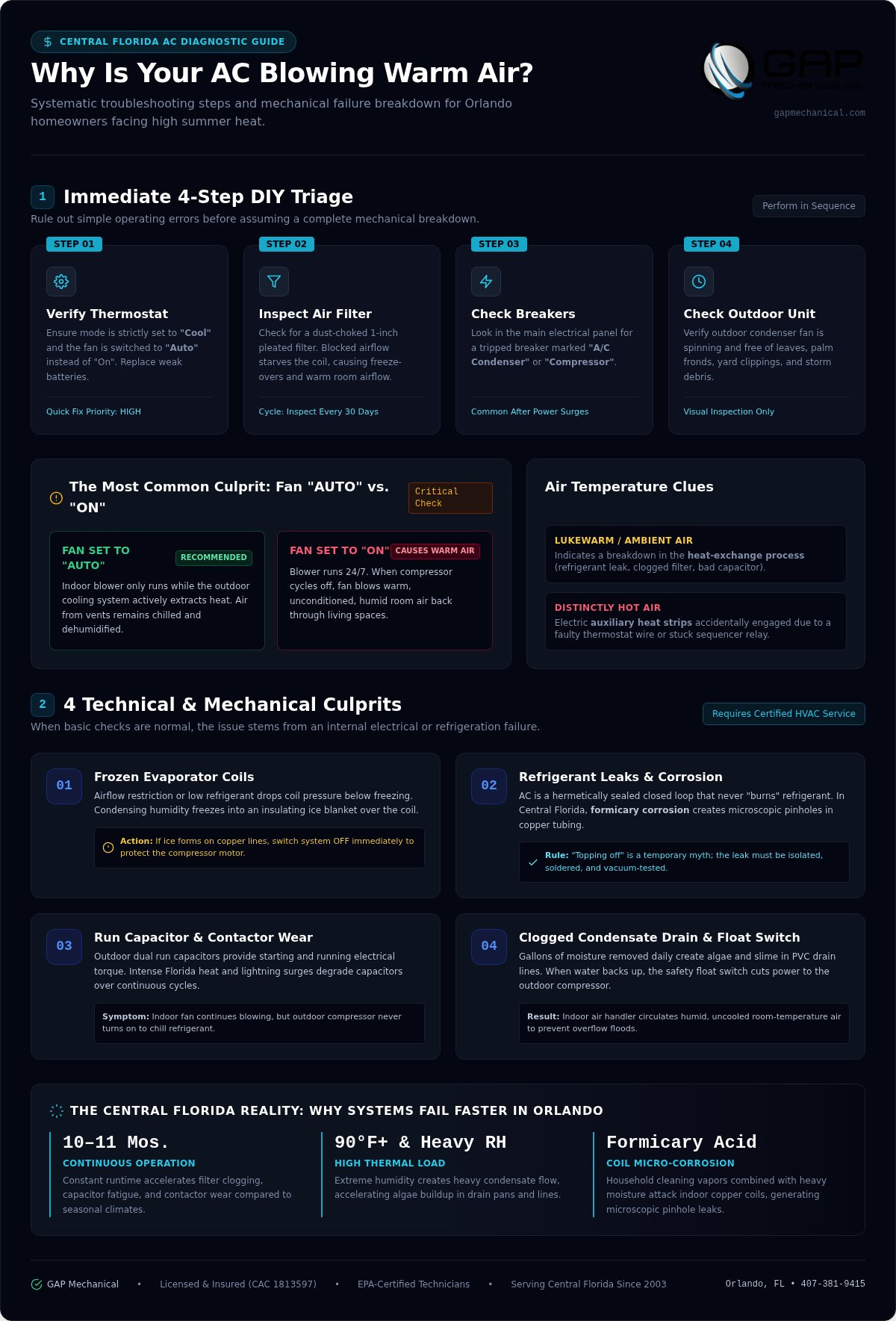
Before assuming your system has suffered a catastrophic mechanical breakdown, perform these immediate troubleshooting steps to isolate the issue:
- Verify Thermostat Settings: Ensure your thermostat is set to "Cool" and the fan is switched to "Auto" rather than "On."
- Inspect the Air Filter: Check if a dust-choked pleated filter is blocking supply air from circulating through your indoor air handler.
- Check the Circuit Breakers: Look for a tripped breaker in your main electrical panel labeled for the "A/C Condenser" or "Compressor."
- Examine the Outdoor Unit: Walk outside to verify that the condenser fan is spinning and the unit is free of leaves, yard clippings, and storm debris.
The Thermostat Check: Simple Settings Often Overlooked
The distinction between "Fan On" and "Fan Auto" is the single most common reason an AC blows warm air periodically. When set to "Fan On," the indoor blower motor runs continuously 24 hours a day, even when the outdoor compressor shuts off after reaching the set temperature. This blows warm, unconditioned, humid air back into your living room between cooling cycles.
Switching your thermostat to "Auto" ensures the fan only circulates air while the cooling system actively extracts heat. Additionally, check the batteries on digital or smart thermostats. Weak batteries can prevent the thermostat from sending the low-voltage signal required to engage the outdoor compressor contactor.
Note on warm vs. hot air: If the air feels slightly warm or matches your room's ambient temperature, the issue is typically a failure in the heat-exchange process. However, if the air blowing out of your supply registers feels distinctly hot, your air handler's electric auxiliary heat strips may have accidentally engaged due to a faulty thermostat wire or a stuck sequencer relay.
Airflow Obstructions: The Role of the 30-Day Filter
Central Florida homes run their cooling systems nearly 10 to 11 months out of the year. Because air conditioners circulate indoor air constantly, standard 1-inch filters clog far faster in Orlando than in northern climates. High ambient humidity causes airborne dust, pet hair, and drywall particles to stick together, quickly forming a dense barrier on the filter face.
A severely clogged filter suffocates the heat exchange process by starving the evaporator coil of the warm air it requires to absorb heat safely. When restricted airflow drops the coil temperature below freezing, the system creates an insulating blanket of ice that completely blocks cooling, leaving your vents blowing warm, stagnant air.
Common Technical Culprits: From Tripped Breakers to Refrigerant Leaks
If simple thermostat adjustments and clean filters do not resolve the issue, the cooling failure is likely mechanical or electrical.
Frozen Evaporator Coils: The Counter-Intuitive Cooling Failure
It surprises many homeowners to learn that an air conditioner can freeze solid while it is 95°F outside. When indoor airflow is restricted, or when the system is low on refrigerant, the pressure inside the evaporator coil drops significantly. As moisture from humid Orlando air condenses over the cold coil, it freezes on contact instead of draining away as liquid water.
If you see frost or ice forming on the brass copper line set leading into your indoor air handler, immediately switch the system to "Off" at the thermostat. Running an iced system strains the compressor motor and can cause irreversible mechanical damage. Allow the coil to thaw completely before running the fan or scheduling a service visit.
Refrigerant Leaks and the Myth of "Topping Off"
Air conditioning systems are hermetically sealed closed loops. Under normal operating conditions, an AC unit never consumes, burns, or "runs out" of refrigerant. If your system is low on refrigerant, there is an active leak in the tubing, service valves, or coil assemblies.
In Florida, formicary corrosion frequently attacks copper evaporator coils. Organic acids found in household cleaning vapors combine with heavy indoor moisture, creating microscopic pinholes in the metal. Merely adding refrigerant without identifying and soldering the leak is a temporary, non-compliant measure that leads to recurring cooling failures. A licensed technician must pinpoint the leak, repair the breached component, evacuate the system with a vacuum pump, and recharge it to factory specifications.
Capacitor and Contactor Failures
The outdoor condensing unit relies on a dual run capacitor to supply the electrical torque required to start and run the compressor and the condenser fan motor. Florida's intense summer heat, coupled with near-constant operating cycles, degrades these capacitors over time.
When a run capacitor weakens or bursts, the indoor fan continues blowing air inside your home, but the outdoor compressor never turns on to chill the refrigerant. If you experienced a brief summer lightning surge or sudden brownout, check our guide on troubleshooting common AC problems after a power outage to see if electrical components were affected.
Clogged Condensate Drain Lines
An air conditioner removes several gallons of moisture from your home each day. In Central Florida, dark, damp drain pans and PVC lines create the ideal breeding ground for algae, slime, and mold. If the drain line clogs, water backs up into the primary drain pan.
Modern building codes require an inline float switch (safety switch) on the drain line. When water levels rise, this switch trips, cutting power to the outdoor condenser to prevent water from overflowing onto ceilings and drywall. The indoor blower often stays running, blowing warm, clammy air throughout the house. For a closer look at resolving drainage backups, review our resource on AC leaking water in Orlando.
The Central Florida Factor: How Humidity and Debris Impact Cooling
Cooling a home in Orlando poses mechanical challenges unique to our subtropical climate. Standard troubleshooting advice often overlooks these regional factors.
Humidity and the "Wet-Bulb" Reality
Your AC is designed to dehumidify your home first and cool the air temperature second. When outdoor humidity levels hover near 80%, the system expends enormous amounts of energy simply condensing airborne moisture from gas to liquid before it can lower the actual sensible temperature. If system efficiency drops even slightly, the system struggles to complete the heat exchange cycle, resulting in weak, lukewarm airflow.
An improperly sized or aging unit will run continuous cycles without ever satisfying the thermostat, leading to a clammy indoor environment where moisture hangs in the air and surfaces feel slick.
Local Debris: Oak Tassels, Sand, and Lake-Area Air
Neighborhoods like Winter Park, College Park, and Conway feature lush canopies of mature live oaks. In the spring and early summer, falling catkins, pollen strings, and lawn clippings get pulled directly into the exterior condenser fins by the high-velocity fan. This debris blankets the condenser coil, preventing heat from escaping into the outside air. Over time, heat builds up in the compressor until the internal thermal overload switch trips, cutting off cold air delivery indoors.
Routine maintenance keeps these coils free of organic growth, sand, and fine grit. Learn more about optimal scheduling by reading how often to service your AC in Florida.
Troubleshooting vs. Professional Repair: When to Call an Expert
Before booking a technician, review this reference table to see whether you can safely resolve the issue yourself or require licensed service.
| Observed Symptom | Likely Cause | Recommended Action |
|---|---|---|
| Thermostat fan set to "On" | Air circulation without cooling cycle | DIY: Switch thermostat setting to "Auto." |
| Dirty, discolored air filter | Suffocated airflow and restricted heat transfer | DIY: Replace with a clean, properly sized filter. |
| Float switch tripped in drain pan | Algae or sludge clog in condensate PVC line | DIY / Pro: Clear line with wet/dry vac; call a pro if line remains blocked. |
| Ice on line set or indoor coil | Refrigerant leak or severe airflow block | Pro: Turn AC to "Off" to thaw coil; schedule licensed repair. |
| Humming sound outside; fan not spinning | Failed run capacitor or seized fan motor | Pro: Requires high-voltage component testing and replacement. |
| Hissing or bubbling noises near unit | High-pressure refrigerant leak | Pro: Requires EPA-certified leak detection and system evacuation. |
The "Before You Call" Checklist
Work through these final verification steps before picking up the phone:
- Confirm the outdoor electrical disconnect box (the metal switch box next to the condenser) is set securely to "On."
- Check your circuit breaker panel for any breakers that are resting between the "On" and "Off" positions; reset them firmly.
- Ensure that indoor supply registers and return air grilles are completely unobstructed by curtains, rugs, or furniture.
Restoring Comfort with GAP Mechanical
When basic troubleshooting does not resolve warm airflow, you need a dependable, local HVAC contractor to diagnose the root issue accurately. GAP Mechanical is a fully licensed and insured Florida contractor (CAC 1813597) featuring EPA-certified technicians. Serving Central Florida homeowners since 2003 with an established 4.9-star Google rating, we prioritize honest diagnostics, transparent repairs, and dependable service throughout Orlando, Winter Park, and surrounding communities.
We treat your home with care, respect your time, and deliver permanent cooling solutions designed for Florida's demanding climate. If your system is failing to cool your living space, explore our comprehensive residential AC repair services or contact GAP Mechanical directly at 407-381-9415 to schedule an inspection.
Frequently Asked Questions About Warm Air from AC Units in Orlando
Is it safe to run my AC if it is blowing warm air?
No. If your air conditioner is running but circulating warm air, shut the system off at the thermostat. Continuing to run the unit when the indoor coil is frozen or when the outdoor compressor is overheating can cause permanent mechanical damage to the compressor motor.
Can a dirty air filter really cause my AC to blow warm air?
Yes. A severely clogged air filter restricts airflow across the evaporator coil. Without sufficient warm air passing over it, the refrigerant cannot absorb heat properly, causing the coil to freeze into a solid block of ice that blocks cooling entirely.
Why is my outdoor AC compressor running, but the air inside is still warm?
If the compressor is actively running outside but your indoor vents blow warm air, the system likely suffers from a low refrigerant charge due to a leak, a damaged compressor valve, or heavily coated condenser coils that prevent the system from releasing heat outside.
What does a tripped float switch do to my air conditioner?
A float switch detects water backing up in your condensate drain line. When water levels rise, the safety switch opens the low-voltage control circuit, shutting down the outdoor cooling unit while allowing the indoor fan to keep circulating unchilled air to prevent home water damage.
Frequently Asked Questions
Is it safe to run my AC if it is blowing warm air?
No. If your air conditioner is running but circulating warm air, shut the system off at the thermostat. Continuing to run the unit when the indoor coil is frozen or when the outdoor compressor is overheating can cause permanent mechanical damage to the compressor motor.
Can a dirty air filter really cause my AC to blow warm air?
Yes. A severely clogged air filter restricts airflow across the evaporator coil. Without sufficient warm air passing over it, the refrigerant cannot absorb heat properly, causing the coil to freeze into a solid block of ice that blocks cooling entirely.
Why is my outdoor AC compressor running, but the air inside is still warm?
If the compressor is actively running outside but your indoor vents blow warm air, the system likely suffers from a low refrigerant charge due to a leak, a damaged compressor valve, or heavily coated condenser coils that prevent the system from releasing heat outside.
What does a tripped float switch do to my air conditioner?
A float switch detects water backing up in your condensate drain line. When water levels rise, the safety switch opens the low-voltage control circuit, shutting down the outdoor cooling unit while allowing the indoor fan to keep circulating unchilled air to prevent home water damage.