← Back to Blog
Troubleshooting Common AC Problems After a Power Outage: An Orlando Homeowner’s Guide

Troubleshooting Common AC Problems After a Power Outage: An Orlando Homeowner’s Guide

Published September 20, 2026

Did you know the I-4 corridor spanning Orlando and Tampa registers up to 100 lightning strikes per square kilometer every year? This data makes our region the lightning capital of the country, putting your home's most expensive appliance at constant risk. When the lights flicker and die during a typical afternoon storm, the immediate concern isn't just the dark; it's the thick humidity that begins to settle indoors. Mastering the steps for troubleshooting common AC problems after power outage events is a vital skill for every Central Florida homeowner.

It's natural to feel a sense of dread as the temperature rises, wondering if a permanent electrical surge just destroyed your compressor. You're likely stuck between the urge to act immediately and the fear of making a costly mistake. We'll walk you through exactly how to safely restart your system and determine if you're facing a simple lockout or a genuine mechanical failure. You'll learn the specific 30-minute reset sequence required by most modern units and how to identify the signs of a blown capacitor before you consider calling for professional help. By following these local expert tips, you can protect your equipment and restore your home's comfort without unnecessary stress.

Key Takeaways

  • Master a systematic approach to troubleshooting common AC problems after power outage events to quickly restore cooling and avoid unnecessary repair fees.
  • Learn why the "Double-Flip" breaker reset is essential for clearing high-voltage errors that standard thermostat resets often miss.
  • Identify the critical difference between a simple safety lockout and actual hardware damage using the "burning smell" and audible clicking tests.
  • Understand the role of internal delay timers and why waiting 30 minutes is often the most effective way to protect your compressor from high-pressure starts.
  • Explore long-term protection strategies, including the installation of Type 2 Surge Protective Devices specifically designed for Central Florida's extreme lightning density.

Why Power Outages Cause AC Issues in Orlando Homes

Central Florida experiences some of the most intense lightning activity in the country, with the Orlando area recording between 80 and 100 strikes per square kilometer annually. These storms don't just knock out the lights; they create massive electrical transients that target your HVAC system's sensitive control boards. When the grid goes down in a neighborhood like Winter Park or College Park, the indoor humidity begins to climb almost instantly. Within an hour, your home can transform from a sanctuary into a swampy environment, making the process of troubleshooting common AC problems after power outage events a race against the clock.

Surges vs. Brownouts: What Happened to Your Unit?

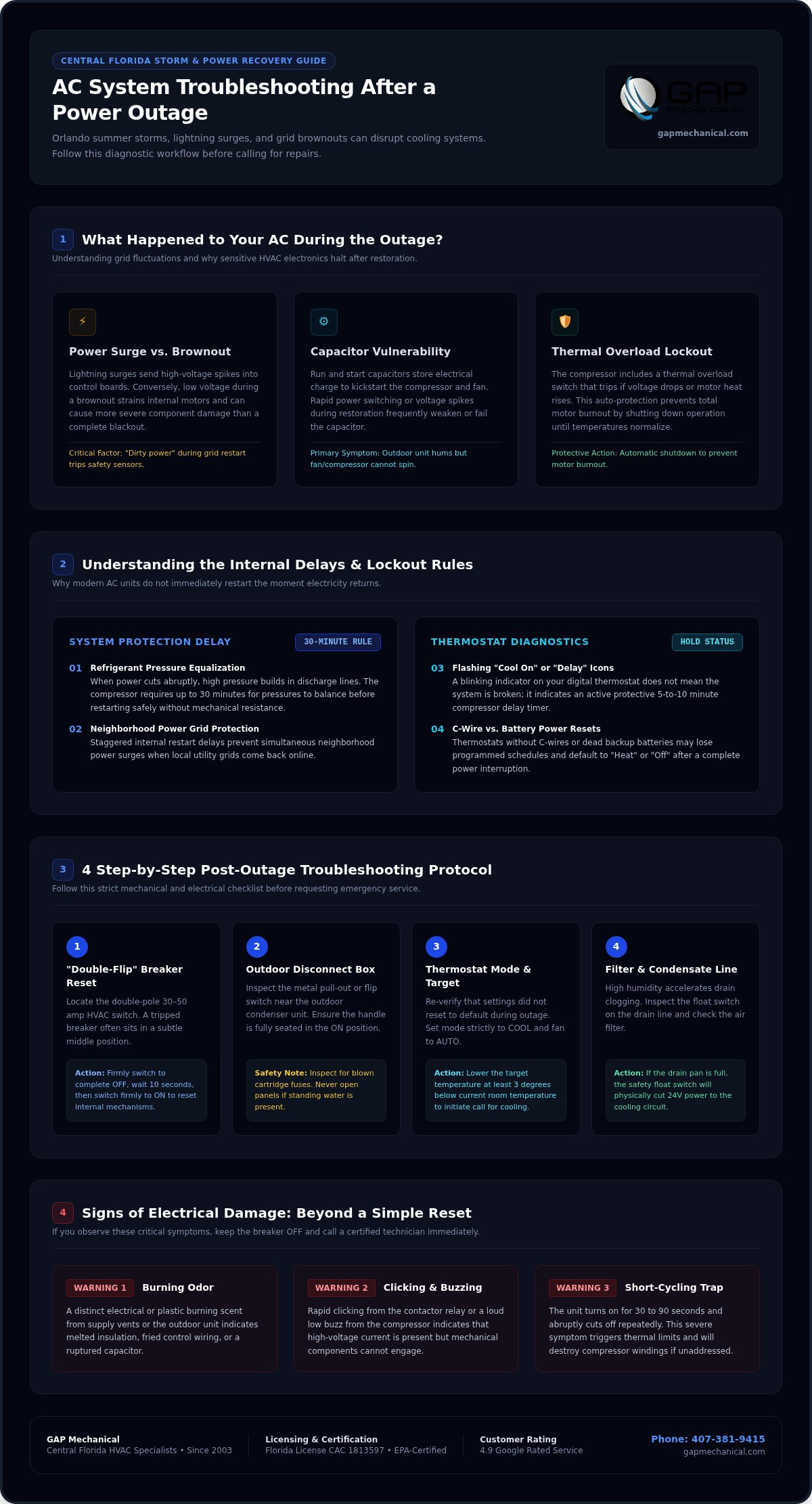
A total blackout is often less dangerous to your equipment than a brownout or the moment power is restored. A power surge occurs when a massive spike of voltage enters the system, often caused by lightning or utility grid switching. To mitigate this risk, many homeowners install surge protective devices to divert excess voltage away from the compressor. Conversely, a brownout is a drop in voltage. This "dirty power" forces the AC motor to draw more current to compensate, which generates excessive heat and can melt internal insulation.

Older Orlando homes with dated 100-amp or 150-amp electrical panels are particularly vulnerable. These systems often lack the modern safety buffers required to handle the "inrush current" that occurs when every appliance in the neighborhood tries to start simultaneously after the grid resets. This sudden demand can trip your AC’s safety sensors or, worse, pop the capacitor.

The capacitor acts like a high-energy battery that gives your compressor the "push" it needs to start. HVAC field reports across Central Florida show that failed capacitors account for nearly 50% of storm-related service calls. When a surge hits during power restoration, these components often fail physically, leaving the indoor fan blowing warm air while the outdoor unit sits silent.

The Thermal Overload Protection Mechanism

If you hear a faint humming sound coming from your outdoor unit but the fan isn't spinning, your system might be in a state of thermal overload. This happens when the compressor becomes too hot due to low voltage or rapid power cycling. Thermal overload is a safety feature designed to prevent motor permanent failure. When this switch trips, it breaks the electrical circuit to protect the motor windings from melting. You cannot force the system to start during this phase; you must wait for the internal components to cool down. Troubleshooting common AC problems after power outage situations requires patience, as this cooling period can take anywhere from 30 minutes to several hours depending on the outdoor temperature.

Understanding the AC 'Safety Lockout' and Internal Delays

One of the most confusing parts of troubleshooting common AC problems after power outage events is the intentional silence that follows grid restoration. You expect the familiar hum of cooling immediately. Instead, you get nothing. This is usually the AC "Safety Lockout" in action. It's a protective state designed to prevent your compressor from attempting a "hard start" against unequal pressures. This delay is a feature, not a failure, but it requires patience to navigate correctly.

While a total blackout is inconvenient, repetitive power flickering is the worst-case scenario for your compressor. In Central Florida, utility grids often struggle to stabilize immediately after a storm, leading to rapid on-off-on cycles. Each time the power blinks, the compressor motor attempts to kick on. If this happens multiple times in a few seconds, it creates extreme heat within the motor windings. This repetitive stress is what leads to permanent electrical failure, making the internal delay timer your system's most important defense mechanism.

According to federal guidelines on safeguarding appliances during power outages, turning off major equipment during a blackout is the best way to prevent damage from these restoration surges. If you didn't flip the breaker before the lights went out, your system's internal logic takes over. Most digital thermostats incorporate a 5-minute delay; however, a hard lockout on the control board may require a full 30 minutes of inactivity to reset. This delay also helps utility providers by staggering the electrical load as power returns to your Orlando neighborhood.

The Reset Sequence for Thermostats

Your thermostat might need manual intervention to resume cooling. Battery-powered models often stay on during an outage but can lose their connection to the AC unit if the power cycle was particularly violent. Systems using a "C-wire" for power are generally more reliable, but they can get stuck in a boot loop if the grid voltage was unstable during restoration. Look for a flashing "Cool On" icon or an hourglass symbol on the display. These are visual indicators that the thermostat is waiting for the safety period to end.

If the display remains blank or shows an error code after the grid has stabilized, you may need to perform a full system power cycle at the breaker. Should you find that the system still refuses to engage after the full 30-minute window, you can reach out to a qualified HVAC technician to diagnose whether a surge damaged the low-voltage transformer or the control board.

Troubleshooting common AC problems after power outage

4 Step-by-Step Troubleshooting Fixes for Post-Outage Cooling

When the grid stabilizes, your priority is getting the air moving again. If you've waited the recommended 30 minutes and the system remains unresponsive, you should begin a systematic check of the hardware. Following a specific sequence for troubleshooting common AC problems after power outage events ensures you don't miss simple fixes before assuming the worst about your compressor. These four steps cover the most frequent points of failure in Central Florida homes.

Resetting the Circuit Breaker Properly

Locate your home's main electrical panel. You are looking for a double-pole switch, usually rated for 30 to 50 amps, labeled "AC" or "HVAC." During a surge, this breaker might not move all the way to the "Off" position. It often gets stuck in a middle "tripped" state that can look deceptively like it is still "On."

Use the "Double-Flip" technique. Firmly push the switch to the "Off" position until you hear a distinct click. Wait for ten seconds to allow the internal mechanism to reset. Then, flip it back to the "On" position. This physical reset is often the only thing standing between you and a cool home. If the breaker immediately snaps back to the middle position, do not force it. This indicates a dead short or a grounded component that requires professional attention.

Checking the Outdoor Unit Disconnect

Every outdoor condenser in Orlando has a dedicated disconnect box mounted on the exterior wall. This box contains either a pull-out handle or a large flip-switch. Its job is to provide a local point to cut high-voltage power for maintenance. A significant power spike can blow the cartridge fuses located inside this box.

Exercise extreme caution here. Never open this electrical compartment if you see standing water near the unit or if the ground is saturated from a recent tropical storm. If conditions are dry, you can inspect the fuses. If they appear burnt or the pull-out handle is melted, the surge was powerful enough to bypass your main panel's protection. Replacing these fuses is a standard part of troubleshooting common AC problems after power outage spikes, but it must be done with the main breaker turned off.

Beyond the electrical checks, verify your thermostat settings. Ensure the mode is set to "Cool" and the target temperature is at least five degrees below the current indoor reading. Finally, check your condensate drain line. In our local humidity, a stalled condensate pump during an outage can cause the drain pan to overflow. This triggers the float switch, which automatically cuts the 24V control circuit to prevent water damage to your ceiling.

If these manual steps do not restore airflow, the issue likely involves a failed capacitor or a damaged control board. You can consult our AC Repair Orlando: Professional Troubleshooting and Service Checklist for a deeper look at technical failures. When DIY fixes are exhausted, professional diagnostics are the next logical step to protect your system from further electrical damage.

Identifying a Blown Capacitor

The capacitor is a small, silver, cylinder-shaped component that provides the electrical "jumpstart" for your motors. It is the most common storm casualty in Central Florida, accounting for nearly half of all post-storm service calls. A failed capacitor often looks "swollen" or has a bulging top. Symptoms include the outdoor fan running while the compressor remains silent, or a unit that hums but refuses to kick on. Capacitors hold a high-voltage charge even when power is off; do not attempt DIY replacement.

When the Compressor is the Culprit

A severe power surge can "ground" the compressor motor. This means the internal electrical windings have fused to the metal casing, creating a dead short. If your unit is older, a grounded compressor often makes AC installation in Winter Park a more logical choice than a repair. Replacing a compressor requires specialized refrigerant handling and extensive labor. In many cases, the cost of this repair on a legacy system is better invested in a modern, high-efficiency replacement that meets current SEER2 standards.

If you detect any of these warning signs, contact our licensed technicians for a professional diagnostic to ensure your system is safe to operate.

While mastering the basics of troubleshooting common AC problems after power outage events helps in the moment; preventing the damage entirely is a smarter investment for Central Florida residents. Our region's electrical grid faces constant stress from extreme humidity and intense lightning activity. Taking proactive steps now ensures your system survives the next major storm cycle without a catastrophic failure. A layered defense strategy is the most effective way to maintain long term reliability.

Whole-Home vs. Point-of-Use Surge Protection

Effective electrical defense requires a multi-tiered approach. A whole-home surge protector, known as a Type 2 SPD, is installed directly at your main electrical panel. This device is now a requirement under the 8th Edition Florida Building Code for all new service panels and upgrades. It diverts massive voltage spikes from the utility grid before they can reach your indoor appliances. This is your primary shield against the "dirty power" often seen during grid restoration.

A secondary "firewall" should be installed at the outdoor condenser. This point-of-use protector handles smaller, localized transients that the main panel might miss. You should consult with a licensed HVAC contractor in Orlando to ensure these devices are sized correctly for your specific equipment. This combination offers the highest ROI by shielding the expensive inverter boards found in modern high-efficiency systems; which are far more sensitive to voltage fluctuations than older models.

The Role of Preventive Maintenance

Electrical failures often start with small, overlooked issues. Frayed wiring, loose contactor points, or corroded terminals increase electrical resistance. This makes your unit more susceptible to burning out during a voltage dip or a restoration surge. Investing in regular AC maintenance service in Orlando allows a professional to tighten these connections and verify the health of your capacitor before the storm season peaks.

Technicians use specialized meters to check if a capacitor is drifting out of its manufacturer-specified microfarad range. Catching a weak capacitor in the spring prevents the unit from failing when the grid is most unstable in the summer. Prevention is significantly cheaper than paying for a compressor replacement or a complex repair during a heatwave. Consistent maintenance ensures your system is physically prepared for the stress of rapid power cycling.

Finally, develop a "Storm Shutdown" routine. If a severe thunderstorm is approaching, proactively flip the AC breaker at the panel. This physically disconnects the unit from the grid, eliminating the risk of a surge entering the system. Smart thermostats also provide a layer of safety by allowing you to set automatic restart delays. By combining these habits with troubleshooting common AC problems after power outage spikes, you can protect your investment and maintain home comfort throughout the year.

Restoring Your Comfort and Protecting Your HVAC Investment

Dealing with a sudden lack of cooling after an Orlando storm is stressful, but understanding the difference between a safety lockout and a hardware failure gives you back control. Remember that a 30-minute wait period is often all your system needs to equalize pressure and restart safely. By mastering the "Double-Flip" breaker technique and checking for visible signs of surge damage, you've taken the right steps in troubleshooting common AC problems after power outage events. These simple checks can prevent unnecessary service fees and protect your compressor from premature wear.

If your system still refuses to engage or if you detected a burning smell during your inspection, it's time to bring in the experts. With 25+ years of local service and a 4.9-star Google rating, our team knows exactly how to handle Central Florida's unique electrical challenges. Still sweating? Contact GAP Mechanical for fast, expert AC repair in Orlando and Winter Park. As licensed and insured Orlando HVAC experts, we're here to ensure your home stays cool and your equipment remains reliable for years to come.

Frequently Asked Questions

How long should I wait for my AC to turn on after a power outage?

You should wait at least 30 minutes before attempting a manual reset of your system. Most modern air conditioners have built in delay timers that prevent the compressor from starting until the internal refrigerant pressures have equalized. This safety period protects the motor from "hard starting" against high pressure. If you are troubleshooting common AC problems after power outage events, patience is your first line of defense to avoid tripping the breaker again.

Why is my AC blowing warm air after the power came back on?

Warm air usually indicates that the indoor blower fan is running, but the outdoor compressor has failed to engage. This often happens because the outdoor circuit breaker tripped during a power surge while the indoor unit remained powered. You should check both the main electrical panel and the outdoor disconnect box for blown fuses. If the breaker is on but you still have no cooling, a technician may need to inspect for a failed capacitor.

Can a power outage break my air conditioner permanently?

A severe electrical surge can cause permanent damage to your air conditioner's compressor or electronic control boards. Lightning strikes or utility grid switching can "ground" the motor windings, which effectively destroys the unit. While many post-outage issues are simple resets, a catastrophic spike can melt internal insulation. This is why we recommend installing a Type 2 surge protective device at your main panel to safeguard your equipment from Central Florida's intense storm activity.

What does it mean if my thermostat is blank after a power outage?

A blank thermostat usually means the device has lost its 24V power supply from the indoor air handler. This can happen if the indoor unit's circuit breaker tripped or if a surge blew the low voltage transformer. If your thermostat uses batteries, try replacing them first to see if the display returns. In many Orlando homes, a blank screen also points to a tripped float switch caused by a backed up condensate line during the outage.

Should I turn off my AC before a storm hits Orlando?

Yes, flipping your AC breaker to the "Off" position before a major storm hits is a smart preventive measure. This physically disconnects your sensitive HVAC electronics from the grid, eliminating the risk of damage from lightning strikes or erratic power restoration surges. Once the storm passes and the grid stabilizes for at least 30 minutes, you can safely restore power. This simple routine is the most effective way to avoid costly repairs during hurricane season.

Is there a reset button on my outdoor AC unit?

Most residential air conditioners do not have a dedicated "reset" button on the outdoor cabinet. Instead, the reset process occurs at your home's main electrical panel or the outdoor disconnect box near the condenser. To reset the system, you must flip the breaker to "Off," wait for several minutes, and then flip it back to "On." If your unit still won't start, the internal safety lockout may require a longer cooling period to clear.

Will my homeowners insurance cover AC repair after a power surge?

Homeowners insurance policies often cover AC repair or replacement if the damage was caused by a verifiable lightning strike or a sudden power surge. However, every policy in Florida is different, and some may have high deductibles for storm related claims. You should document any soot marks or visible electrical damage and contact your insurance agent to verify your coverage. We can provide the professional diagnostic report required by most adjusters to process these claims.

How do I know if my AC capacitor is blown?

A blown capacitor often shows physical signs like a bulging or swollen top, or it may leak a small amount of oil. Audibly, you might hear a loud humming or buzzing sound coming from the outdoor unit while the fan remains still. If the fan spins but the compressor won't kick on, the capacitor has likely lost its ability to provide the necessary starting torque. These components are the most frequent casualties of Orlando's summer power fluctuations.

Frequently Asked Questions

Surges vs. Brownouts: What Happened to Your Unit?

A total blackout is often less dangerous to your equipment than a brownout or the moment power is restored. A power surge occurs when a massive spike of voltage enters the system, often caused by lightning or utility grid switching. To mitigate this risk, many homeowners install surge protective devices to divert excess voltage away from the compressor. Conversely, a brownout is a drop in voltage. This "dirty power" forces the AC motor to draw more current to compensate, which generates excessive heat and can melt internal insulation. Older Orlando homes with dated 100-amp or 150-amp electrical panels are particularly vulnerable. These systems often lack the modern safety buffers required to handle the "inrush current" that occurs when every appliance in the neighborhood tries to start simultaneously after the grid resets. This sudden demand can trip your AC’s safety sensors or, worse, pop the capacitor. The capacitor acts like a high-energy battery that gives your compressor the "push" it needs to start. HVAC field reports across Central Florida show that failed capacitors account for nearly 50% of storm-related service calls. When a surge hits during power restoration, these components often fail physically, leaving the indoor fan blowing warm air while the outdoor unit sits silent.

How long should I wait for my AC to turn on after a power outage?

You should wait at least 30 minutes before attempting a manual reset of your system. Most modern air conditioners have built in delay timers that prevent the compressor from starting until the internal refrigerant pressures have equalized. This safety period protects the motor from "hard starting" against high pressure. If you are troubleshooting common AC problems after power outage events, patience is your first line of defense to avoid tripping the breaker again.

Why is my AC blowing warm air after the power came back on?

Warm air usually indicates that the indoor blower fan is running, but the outdoor compressor has failed to engage. This often happens because the outdoor circuit breaker tripped during a power surge while the indoor unit remained powered. You should check both the main electrical panel and the outdoor disconnect box for blown fuses. If the breaker is on but you still have no cooling, a technician may need to inspect for a failed capacitor.

Can a power outage break my air conditioner permanently?

A severe electrical surge can cause permanent damage to your air conditioner's compressor or electronic control boards. Lightning strikes or utility grid switching can "ground" the motor windings, which effectively destroys the unit. While many post-outage issues are simple resets, a catastrophic spike can melt internal insulation. This is why we recommend installing a Type 2 surge protective device at your main panel to safeguard your equipment from Central Florida's intense storm activity.

What does it mean if my thermostat is blank after a power outage?

A blank thermostat usually means the device has lost its 24V power supply from the indoor air handler. This can happen if the indoor unit's circuit breaker tripped or if a surge blew the low voltage transformer. If your thermostat uses batteries, try replacing them first to see if the display returns. In many Orlando homes, a blank screen also points to a tripped float switch caused by a backed up condensate line during the outage.

Should I turn off my AC before a storm hits Orlando?

Yes, flipping your AC breaker to the "Off" position before a major storm hits is a smart preventive measure. This physically disconnects your sensitive HVAC electronics from the grid, eliminating the risk of damage from lightning strikes or erratic power restoration surges. Once the storm passes and the grid stabilizes for at least 30 minutes, you can safely restore power. This simple routine is the most effective way to avoid costly repairs during hurricane season.

Is there a reset button on my outdoor AC unit?

Most residential air conditioners do not have a dedicated "reset" button on the outdoor cabinet. Instead, the reset process occurs at your home's main electrical panel or the outdoor disconnect box near the condenser. To reset the system, you must flip the breaker to "Off," wait for several minutes, and then flip it back to "On." If your unit still won't start, the internal safety lockout may require a longer cooling period to clear.

Will my homeowners insurance cover AC repair after a power surge?

Homeowners insurance policies often cover AC repair or replacement if the damage was caused by a verifiable lightning strike or a sudden power surge. However, every policy in Florida is different, and some may have high deductibles for storm related claims. You should document any soot marks or visible electrical damage and contact your insurance agent to verify your coverage. We can provide the professional diagnostic report required by most adjusters to process these claims.

How do I know if my AC capacitor is blown?

A blown capacitor often shows physical signs like a bulging or swollen top, or it may leak a small amount of oil. Audibly, you might hear a loud humming or buzzing sound coming from the outdoor unit while the fan remains still. If the fan spins but the compressor won't kick on, the capacitor has likely lost its ability to provide the necessary starting torque. These components are the most frequent casualties of Orlando's summer power fluctuations.

Call NowGet Quote