

Orlando Commercial HVAC Maintenance: A Business Guide
Published September 4, 2026
Orlando commercial HVAC maintenance is about protecting uptime, comfort and equipment life, not just cleaning filters. For businesses in Central Florida, a failed rooftop unit or air handler can close a sales floor, disrupt a kitchen or send customers home. A planned maintenance program keeps systems dependable through the long cooling season.
Why Orlando Buildings Stress HVAC Systems
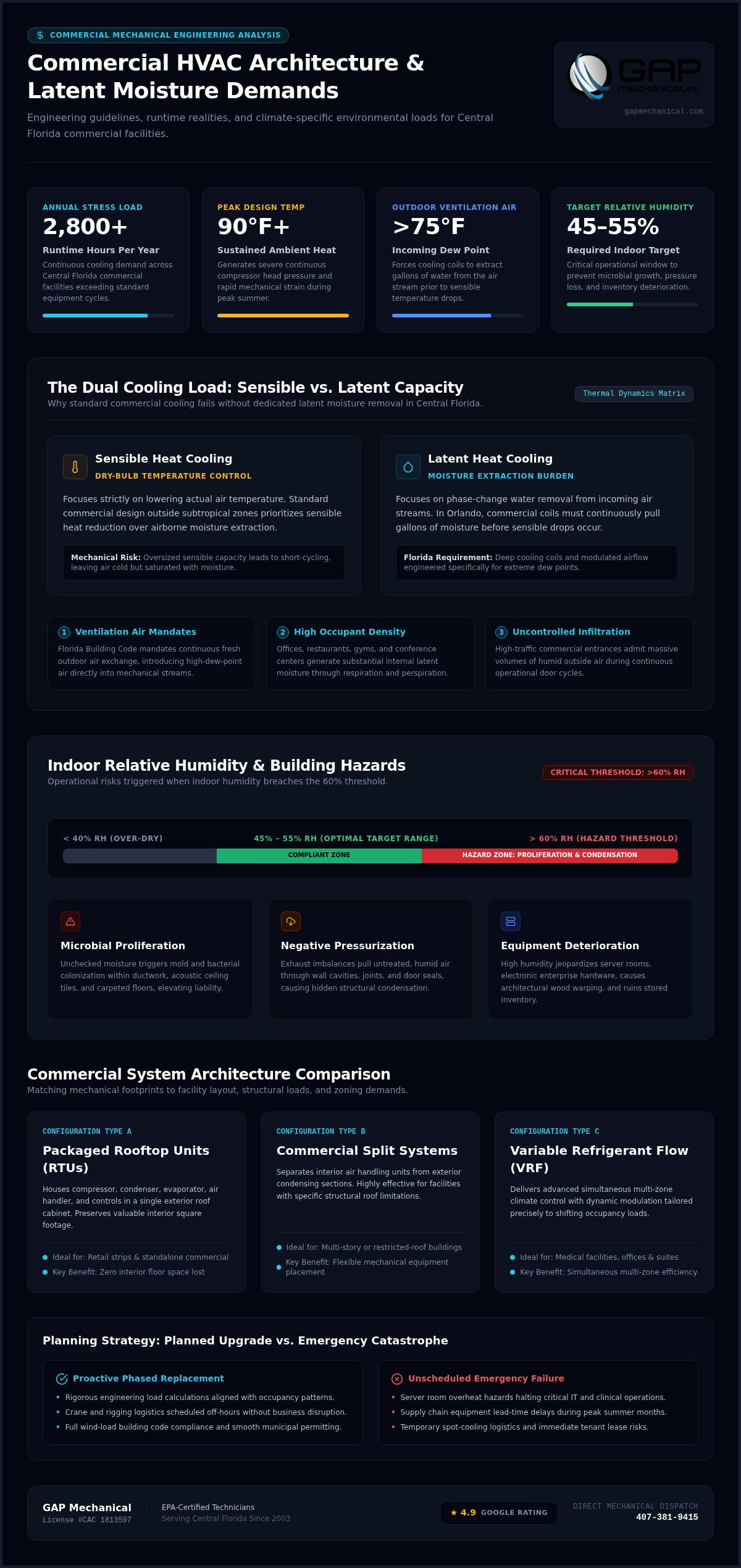
Central Florida's climate is unusually demanding. Humidity is high, summer temperatures routinely exceed 90 degrees, and afternoon storms arrive without warning. Commercial systems contend with heavy latent loads as they remove moisture as well as heat, and rooftop equipment bakes in direct sun. Over a season, that adds up to far more runtime than the same equipment would see in a milder region.
Occupancy patterns add to the load. Restaurants, retail spaces and offices open and close doors constantly, and each opening draws in humid outside air that the system must condition. Buildings that host public traffic often run cooling well beyond normal business hours.
What a Maintenance Program Covers
- Filter and belt replacement on a set schedule.
- Coil cleaning to restore heat exchange and airflow.
- Refrigerant charge and pressure checks.
- Electrical inspection of contactors, connections and controls.
- Condensate drain clearing to prevent water damage and mold.
- Thermostat and controls verification, including scheduling.
These tasks are straightforward individually. Performed together on a calendar, they prevent the small faults that escalate into failures during the hottest weeks.
Reducing Unplanned Downtime
The clearest argument for maintenance is downtime. A unit that fails on a Friday afternoon in July forces emergency service, disrupts staff and customers, and can damage inventory or equipment. Preventative visits identify weak components, such as a failing capacitor or a pitted contactor, before they cause a shutdown.
Maintenance also improves efficiency. Clean coils and correct refrigerant charge let a system reach setpoint with less runtime, which reduces wear and keeps spaces consistently comfortable. In a lease or multi-tenant building, that consistency matters to tenants and customers alike.
Building a Maintenance Calendar
A workable program follows the Florida seasons. A spring visit prepares systems for the peak load of summer: coils are cleaned, drains cleared, belts replaced and controls checked. A fall visit confirms the system survived the cooling season and preps it for the milder months. High-usage sites, such as restaurants and gyms, benefit from quarterly attention.
Documenting each visit creates a history. Over time that record shows which units are nearing the end of their life, so replacements can be planned rather than forced by a mid-summer failure.
Signs Your System Needs Attention Before the Next Visit
Between scheduled visits, staff are your best sensors. Report anything unusual early. Warm spots that persist despite the thermostat setting, rising humidity indoors, strange odors, water near an air handler, or a unit that runs constantly are all worth a call. One unit that never shuts off while others cycle normally is a classic sign of an underlying fault.
Noises matter too. Grinding, rattling or a repeated clicking at start-up often points to a failing motor, loose component or electrical issue. Catching these between visits prevents them from becoming after-hours emergencies.
Maintenance and Refrigeration Together
For food-service and retail businesses, comfort cooling and refrigeration are part of one operation. A proactive program should cover both, because a warm kitchen or a failing display case is just as disruptive as a hot sales floor. When a system reaches the end of its life, coordinating commercial refrigeration installation in Orlando with comfort-system planning avoids two separate disruptions.
Many businesses also run scheduled Orlando commercial AC maintenance alongside refrigeration care so that every unit on site is inspected on the same calendar. That single point of accountability makes it easier to track history and anticipate replacements.
Choosing a Commercial HVAC Partner
Look for a contractor who works on commercial equipment routinely, documents each visit, and stocks common parts. Response time matters: ask what happens when a call comes in after hours, and how quickly a technician can be on site.
GAP Mechanical is licensed and insured (CAC 1813597), EPA-certified, and has served Central Florida businesses since 2003 with a 4.9 Google rating.
What a First Maintenance Visit Looks Like
A well-run first visit begins with a walkthrough of every unit on site. The technician records model and serial numbers, notes the condition of each system, and measures baseline readings so future visits can be compared against real data. Filters and belts are checked, coils assessed, and drains tested. Anything that needs attention is documented and prioritized rather than fixed blindly.
From there, a schedule is built around your operation. Units that carry the heaviest load are serviced before the peak season, while lower-demand equipment can be grouped into a later visit. You leave that first appointment with a clear picture: which systems are healthy, which need watching, and which may need to be replaced in the next year or two. That visibility is what turns maintenance from a routine chore into genuine planning.
Building a Long-Term Plan
Maintenance is most valuable when it is treated as a multi-year plan rather than a series of isolated visits. Equipment rarely fails without warning; it wears in predictable ways. By tracking the condition of each unit over time, a contractor can tell you a year in advance when a rooftop unit is likely to need replacing, so the project can be budgeted and scheduled around your slow season instead of forced by a summer breakdown.
That planning mindset is what separates a reactive relationship from a productive one. You gain predictable scheduling, fewer emergencies, and equipment that lasts closer to its full service life.
Frequently Asked Questions
How often should commercial HVAC systems be serviced in Orlando?
At least twice a year, with an additional visit before the peak cooling season. High-usage sites benefit from quarterly attention.
Does maintenance really prevent breakdowns?
It reduces them significantly by catching worn parts and dirty coils before they cause a failure, though no program can prevent every fault.
Can you service multiple units and locations?
Yes. We maintain multi-unit sites and can coordinate scheduling across a portfolio.
To set up commercial HVAC maintenance in Orlando, call GAP Mechanical at 407-381-9415.
Frequently Asked Questions
How long does a commercial HVAC installation typically take?
The physical changeout of a packaged rooftop unit using a mobile crane is often completed within 4 to 8 hours per unit, frequently scheduled over a single weekend day. However, the comprehensive process—including initial structural engineering, site load calculations, municipal permit acquisition, curb adapter manufacturing, and final air balancing—typically requires 2 to 4 weeks of organized advance planning.
What is the typical lifespan of a commercial HVAC system in Central Florida?
Due to extended operating hours, extreme summer heat, and high humidity, commercial cooling systems in Orlando typically have an operational lifespan of 10 to 15 years. Systems installed within aggressive coastal environments or subjected to neglected maintenance often experience mechanical failures earlier, while units protected by regular preventive service agreements reach their full expected lifecycle.
Can a commercial installation be completed without shutting down my business?
Yes. Professional commercial contractors structure installations to prevent business disruption. By scheduling crane rigging, roof penetrations, and electrical service transitions during evening or weekend hours, and by using temporary spot cooling when needed, your facility remains fully functional and comfortable for employees, clients, and tenants throughout regular operational hours.
Why do commercial installations require structural curb adapters?
Modern commercial packaged units feature internal layouts and cabinet dimensions that differ from legacy systems manufactured years ago. Structural curb adapters are custom-welded transitional steel assemblies that bridge the new unit’s base to your roof’s existing curb opening. This avoids the disruptive, significant requirement of tearing open the roof deck or modifying structural steel joists while ensuring compliance with Florida hurricane wind-uplift codes.
How do I schedule an on-site commercial mechanical evaluation?
You can schedule a comprehensive commercial property audit by visiting our contact page. Our mechanical specialists will review your existing system layout, perform detailed cooling load calculations, inspect structural roof curb fittings, and deliver an actionable engineering plan tailored to your facility's operational requirements.