

Commercial Refrigeration Installation Orlando: 2026 Guide
Published September 6, 2026
Commercial refrigeration installation in Orlando succeeds or fails on the planning, not the equipment alone. The right system, sized to your menu, traffic and space, and installed by a contractor who understands Florida heat and humidity, will hold temperature reliably for years. GAP Mechanical designs and installs commercial refrigeration across Central Florida.
Why Installation Quality Decides Performance
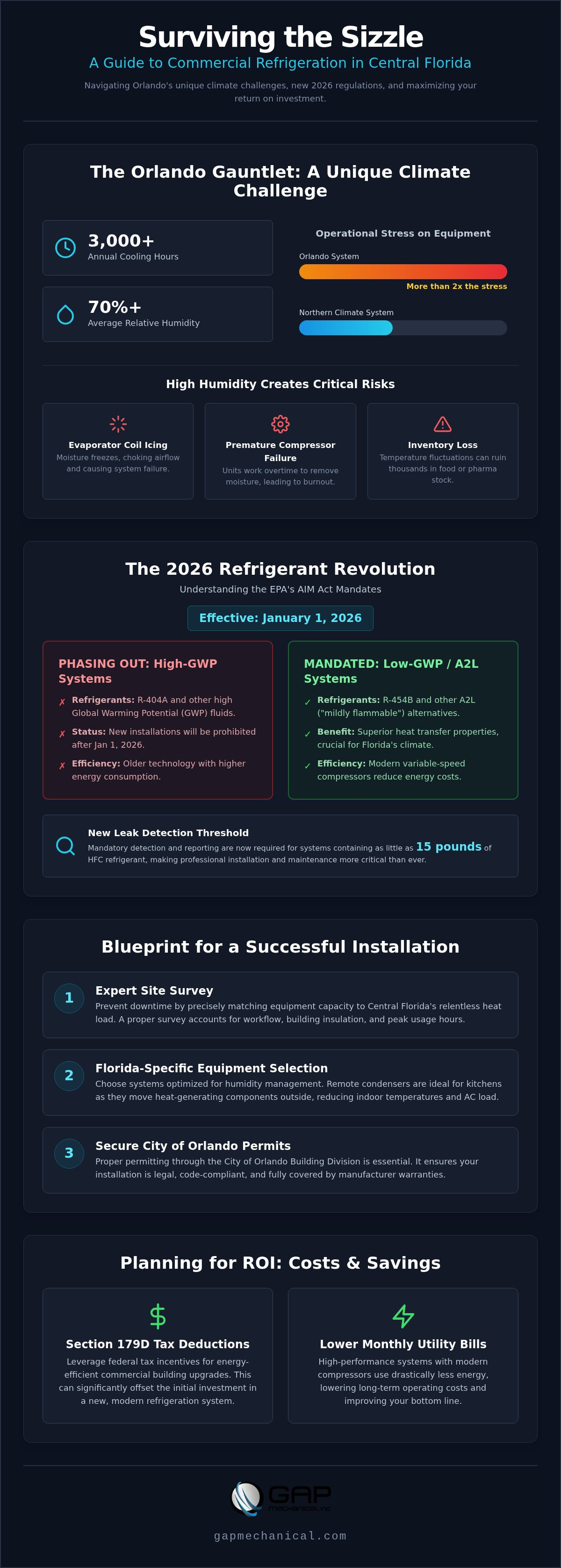
Two identical walk-in coolers can perform very differently depending on how they were installed. Clearances around condensers, correct line sizing, proper insulation and sealed penetrations all affect how hard the system works. In Central Florida, where ambient temperatures and humidity stay high for much of the year, a marginal installation becomes a chronic problem: long run times, icing and premature compressor wear.
Good installation also anticipates the future. A kitchen that adds a prep line next year, or a retail floor that extends its display cases, needs capacity headroom. Planning for that at the outset is far simpler than retrofitting later, when walls are finished and operations are running.
Planning the Right System
Installation starts with a real assessment: what is being stored, at what temperature, how often doors open, and how the space is laid out. From there a contractor can recommend walk-in panels and refrigeration packages, reach-in units, prep tables, ice machines or display cases. Load calculations, not guesswork, determine compressor and evaporator sizing.
Drainage, electrical supply and ventilation all need to be confirmed before equipment arrives. In restaurants, coordinating with kitchen and plumbing trades keeps the project on schedule and avoids rework. Ventilation is often overlooked: a condenser starved of airflow will underperform no matter how good the equipment is.
Choosing Equipment That Fits Your Operation
Equipment should follow the work your team actually does. A high-volume kitchen that opens its walk-in constantly may benefit from a larger evaporator and stronger door hardware. A retail space focused on display may prioritize glass doors and even lighting. A commissary or prep kitchen might need low-temperature freezers alongside medium-temperature coolers.
Efficiency features are worth discussing early. Better door seals, LED lighting inside cabinets, and defrost controls that adapt to real conditions all reduce runtime. The goal is a system that holds safe temperatures without working unnecessarily hard.
What to Expect During Installation
- A site survey and a written scope before work begins.
- Delivery and positioning of equipment with correct clearances.
- Refrigeration piping, evacuation and charging by a certified technician.
- Controls, defrost settings and monitoring configured for your operation.
- Temperature verification and a walkthrough before handover.
A thorough installer tests the system under real conditions rather than simply switching it on. Defrost cycles, door closers and alarms should all be set to match how your team actually uses the equipment. That handover conversation is also the time to confirm cleaning schedules and who to call if temperatures drift.
Common Installation Mistakes to Avoid
The most frequent problems are predictable: undersized condensers, poor airflow around outdoor units, unsealed penetrations that let humid air into walls, and drains that slope the wrong way. Each seems small at the time and each causes trouble later. Insisting on clearances and proper drainage during installation prevents the recurring service calls that follow a rushed job.
Preparing Your Space Before Installation
A smooth installation starts before the truck arrives. Confirm that the area around each unit is clear, that electrical capacity is available, and that the route for moving equipment is wide enough. For walk-ins, verifying panel dimensions against the actual opening avoids a surprise on delivery day.
It also helps to plan around operations. If you cannot close, schedule work in phases, protect nearby product, and set expectations with staff about noise, power interruptions and temporary temperature changes. A contractor who asks these questions up front is thinking about your business, not just the equipment.
Avoiding Downtime During a New Build
For an operating business, installation timing matters as much as quality. Work is often phased so that existing refrigeration keeps running while new units are commissioned. Clear communication about power isolation, water shutoffs and delivery access keeps disruptions short.
Business owners who want to understand how to vet a contractor for a larger project should See our homeowner and business owner hiring checklist for the questions that separate qualified installers from the rest. When a project also involves the building's comfort systems, it helps to Read about commercial AC replacement and ROI so the two projects are coordinated.
Maintenance After Installation
Installation is the beginning, not the end. Coil cleaning, gasket checks and defrost verification are what keep a new system efficient. Scheduling maintenance from day one protects the equipment and keeps warranty coverage intact.
GAP Mechanical is licensed and insured (CAC 1813597), EPA-certified, and has served Central Florida since 2003 with a 4.9 Google rating.
Coordinating With Your Team
Installation touches more than the equipment. Store managers, kitchen leads and front-of-house staff all feel the effects, so keeping them informed pays off. Let them know which areas will be affected, how long the work should take, and where product should be moved if a unit is offline temporarily. A short briefing prevents confusion and protects the operation.
After handover, make sure at least two people know how the new controls work, how to read temperatures, and who to call if something drifts. Simple habits, such as recording morning and evening temperatures, create an early-warning system that catches problems while they are still small. Over time, that discipline protects both the equipment and the inventory it holds.
Frequently Asked Questions
How long does a commercial refrigeration installation take?
Small reach-in or prep-table installations can be completed in a day, while walk-ins and multi-unit projects typically run longer and are phased around your operation.
Do you install walk-in coolers and freezers?
Yes, including panels, refrigeration packages, controls and defrost configuration.
Can you match a new unit to my existing equipment?
Yes. We can integrate new equipment with existing systems where practical, or recommend a full replacement when that is the better path.
To discuss commercial refrigeration installation in Orlando, call GAP Mechanical at 407-381-9415.
Frequently Asked Questions
How much does commercial refrigeration installation consideration in Orlando?
Total considerations are determined by the equipment's capacity, the complexity of the electrical work, and the specific cooling requirements of your inventory. Factors like modular panel thickness, floor insulation for freezers, and the need for remote condensing units all influence the final asset. Because every commercial refrigeration installation Orlando project is unique, we perform a site survey to evaluate your building's infrastructure. This ensures you receive an accurate quote that reflects your actual operational needs.
What is the most efficient refrigerant for commercial systems in 2026?
As of January 1, 2026, the industry has transitioned to lower-GWP refrigerants. A2L options, such as R-454B and R-454A, are currently the most efficient choices for new installations. These fluids offer superior heat transfer properties compared to older HFCs. This efficiency is critical in Central Florida, where high ambient temperatures force compressors to work harder. Using these compliant refrigerants also ensures your system meets the latest federal environmental mandates.
Does GAP Mechanical offer financing for commercial refrigeration?
Yes, we provide flexible financing options to help small businesses manage the capital expense of a new refrigeration system. We understand that equipment failure often happens unexpectedly. Spreading the consideration over monthly payments allows you to upgrade to a high-efficiency model without draining your cash reserves. Our team can discuss specific terms during your site survey to find a plan that fits your business's planning and operational needs.
How long does a typical walk-in cooler installation take?
Most walk-in cooler projects take between one and three days to complete. The timeline depends on the complexity of the site and whether you need electrical panel upgrades or new refrigerant lines. We prioritize logistics to minimize downtime for your business. Our technicians handle the assembly, refrigeration plumbing, and final calibration quickly to ensure your inventory is protected. We provide a specific project timeline before any work begins.
Are there specific maintenance requirements for Florida refrigeration units?
Florida’s high humidity requires more frequent condenser coil cleaning and drain line inspections. Salt air and pollen in Orlando can quickly clog outdoor units, leading to high head pressure and motor failure. You must also check door gaskets and defrost cycles regularly to prevent evaporator icing. A proactive maintenance contract is essential for reaching a 15-year equipment lifespan in our subtropical environment. Regular checks catch small leaks before they cause catastrophic inventory loss.
Should I repair or replace my aging commercial freezer?
If your freezer is over 10 years old or requires frequent refrigerant top-offs, replacement is often the most efficient path. Older units utilize high-GWP refrigerants that are becoming more disruptive to source. When a single repair exceeds a significant portion of the system's value, the energy savings from a modern, 2026-compliant model usually justify the upgrade. A new system eliminates the risk of sudden inventory loss and reduces monthly utility overhead.
Does GAP Mechanical provide military discounts for business owners?
Yes, we proudly offer a military discount to veterans who own businesses in the Orlando and Winter Park area. As a family-owned local company, we believe in honoring those who have served our country. This discount applies to our professional commercial refrigeration installation Orlando services and repair work. Simply mention your veteran status during the initial consultation, and our team will apply the discount to your custom project quote.
What size refrigeration system does my Orlando restaurant need?
Sizing depends on your square footage, insulation quality, and how often doors are opened during peak hours. In Orlando, we must also account for the high latent load from humidity. A standard "rule of thumb" calculation often fails here because it doesn't consider the extreme heat surrounding outdoor condensers. We perform a technical heat load calculation to ensure your system is powerful enough to maintain temperatures without being oversized, which leads to humidity control issues.