

HVAC Installation in Kissimmee: The Homeowner’s Guide
Published September 19, 2026
Proper HVAC installation in Kissimmee is crucial for maintaining comfort and protecting your home from the intense heat and humidity of Central Florida. A professional installation ensures your system is sized correctly and positioned optimally to handle Orlando’s high heat index, guaranteeing reliable cooling throughout your summers and efficient operation when the weather turns.
The Necessity of HVAC Installation in Kissimmee’s Climate
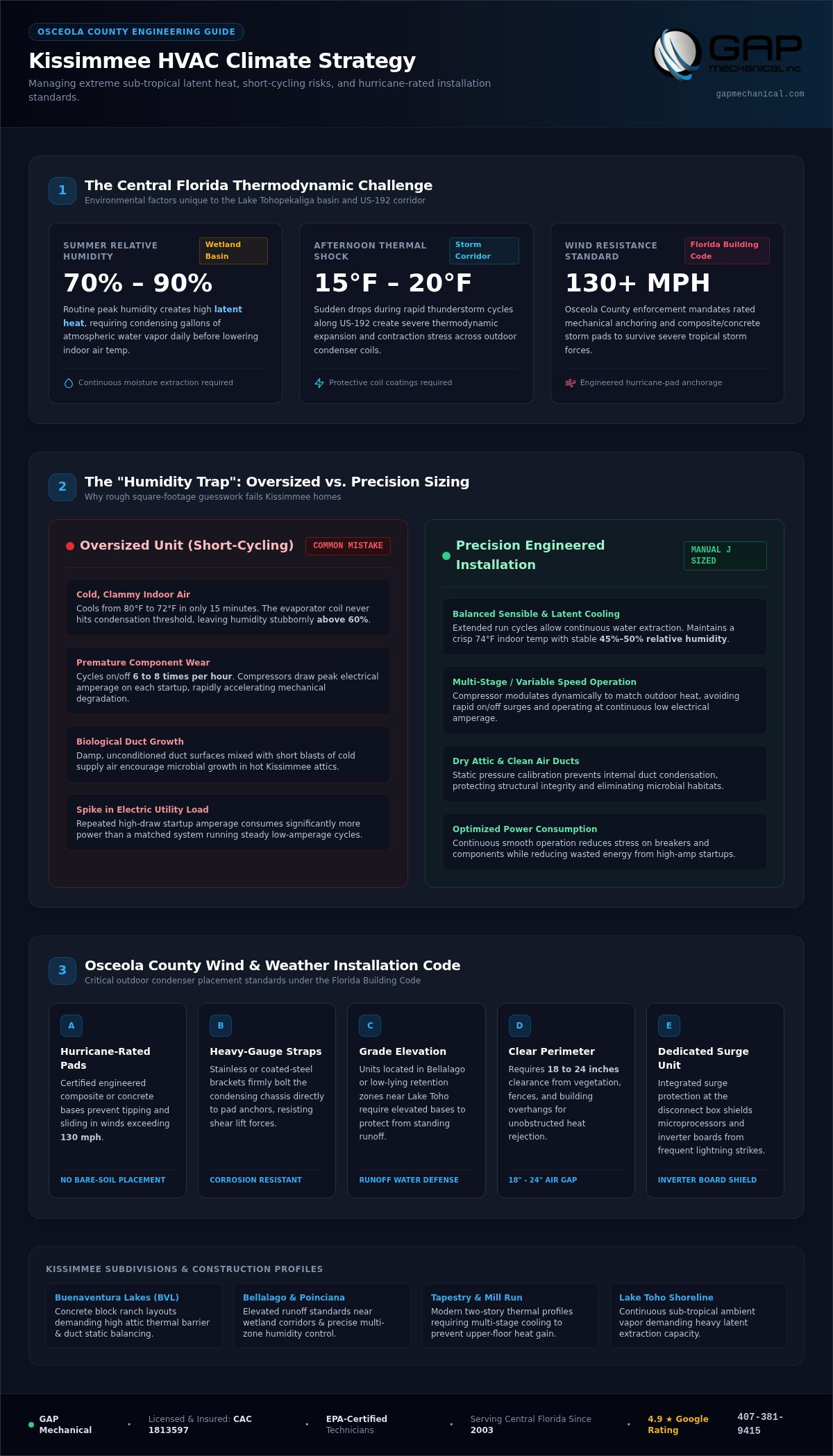
Central Florida weather presents unique challenges for residential HVAC systems. Unlike regions with long, cold winters, Kissimmee experiences brutal summers where temperatures frequently climb well into the 90s, often accompanied by extreme humidity. This humidity doesn't just make the air feel hotter; it significantly increases the workload on your air conditioner, demanding powerful cooling and effective dehumidification to maintain a comfortable indoor environment.
In communities throughout Osceola County, from the established neighborhoods near Osceola Parkway to newer developments, homes are often built with different insulation levels and structures. A standard unit that worked for a home in a cooler climate might be undersized or oversized for the intense solar gain found in a typical Kissimmee residence. This is where a comprehensive installation assessment is vital.
A poorly installed or incorrectly sized unit can lead to several issues:
- High Energy Consumption: The system struggles to keep up with the heat load, running constantly and wasting energy.
- Inefficient Cooling: The air may feel cool but still feel clammy due to high humidity, failing to provide true comfort.
- Short System Lifespan: Overworked components wear out faster, leading to premature replacement needs.
- Potential for Moisture Damage: Improper drainage or venting can lead to structural issues inside your home.
Evaluating Your Home: The Pre-Installation Assessment
Before any installation begins, a thorough inspection of your home is the most critical step. HVAC systems are integrated components; they rely on the structure they serve. For many homes in Kissimmee, particularly those built in the 1970s and 1980s, the structural integrity of the ductwork and insulation must be addressed first.
The installation process should begin with an assessment that goes beyond just the room where the unit will sit. Experts look at the entire building envelope:
- Ductwork Integrity: In older Kissimmee homes, ductwork may have suffered from leaks or degradation. Leaky ducts essentially lose conditioned air before it even reaches the vents, wasting energy and money.
- Insulation Levels: Adequate attic and wall insulation is your first line of defense against the 90°+ summer temperatures. If the attic is poorly insulated, your HVAC system is fighting the heat before it even enters the house.
- Roof and Siding Condition: The roof is the primary barrier against the Florida sun. Any missing shingles, soft spots, or compromised siding allows heat to transfer directly into your living spaces.
- Airflow Dynamics: Professionals analyze how air moves through the house to ensure that the proposed unit can effectively reach every corner, from the quiet rooms in the heart of Kissimmee to the sunniest spots.
Selecting the Right System for Central Florida’s Extremes
Choosing the right equipment is a balance of efficiency, durability, and capacity. In an environment defined by relentless heat and high humidity, the system needs to be robust. Modern HVAC technology offers various options, but the choice depends heavily on your home’s specific needs and your comfort preferences.
While many homeowners initially gravitate toward traditional central air conditioning, exploring modern, high-efficiency options like heat pumps can provide a significant advantage. Heat pumps are designed to work efficiently in both cooling and heating modes, offering a versatile solution for Florida’s fluctuating weather patterns. Understanding the long-term benefits of these systems is essential for long-term comfort. To learn more about the specific ways these units perform in our state, you can read about the benefits of a heat pump in Florida.
When selecting equipment, installers evaluate:
- SEER Rating: This measures the system's efficiency in cooling. Higher ratings generally mean less energy usage.
- Capacity (BTUs): This determines how much cooling power the unit has, ensuring it can handle the maximum heat load of your specific Kissimmee home.
- Humidity Control: Some systems are better equipped to handle the moisture in the air, which is often more important for comfort than just low temperature.
The Professional Installation Process: From Day One to Testing
A quality installation is a meticulous process that involves precise engineering, not just assembly. When an HVAC professional at GAP Mechanical handles your installation, they follow a strict protocol to ensure every detail is covered, from the initial placement of the outdoor condenser to the final flush of the refrigerant lines. We have been serving Central Florida since 2003, maintaining a 4.9 Google rating, and are fully licensed (CAC 1813597) and EPA-certified, ensuring every job meets the highest standards of safety and performance.
The typical installation phases include:
- Site Preparation: Protecting your property and ensuring clear access for equipment placement.
- Equipment Placement: Strategically locating the outdoor unit to maximize airflow and minimize noise.
- Internal Installation: Running lines, installing the indoor air handler, and meticulously connecting the ductwork.
- System Commissioning: This is the critical testing phase. Technicians check refrigerant levels, measure pressure, and fine-tune the system to ensure it is operating at peak efficiency.
- Safety and Education: Explaining how the new system works and providing guidance on how to maximize its performance.
Sustaining Peak Performance with Maintenance
The most significant part of an HVAC system is not the installation; it is the potential for failure if it is neglected. In the Kissimmee area, where high humidity and intense sun are constant, regular maintenance is not optional—it is mandatory to protect your asset and ensure consistent comfort. A well-maintained system runs cooler, uses less energy, and lasts significantly longer.
While the installation is a one-time event, maintaining that performance requires diligence. Key maintenance tasks include cleaning filters, checking refrigerant levels, and ensuring the outdoor unit has adequate airflow. To help you stay on track, we recommend reviewing our guide on HVAC maintenance checklist for Florida.
Even with a brand-new system, routine service is vital. For detailed information on how frequently you should be servicing your AC unit to account for our unique climate, refer to our article on how often to service AC in Florida.
Climate Resilience: Preparedness for Kissimmee’s Weather Events
Living in Central Florida means being prepared for the unpredictable. Whether you are bracing for a severe afternoon thunderstorm, dealing with a sudden spike in humidity, or facing the possibility of a power outage, having a reliable HVAC system and a maintenance plan provides crucial peace of mind. When power is restored after an outage, it is important to ensure your system is ready to handle the sudden demand of cooling a hot, humid home.
Understanding how to manage your system during these transitions can prevent minor issues from becoming major repairs. For comprehensive steps on managing your climate control after a power disruption, please review our guide on troubleshooting common AC problems after a power outage.
Frequently Asked Questions
Why is it important to have a professional assess my home before HVAC installation?
A professional assessment ensures that the new HVAC system is correctly sized and that your home’s existing components (like insulation and ductwork) are in good condition to support the new unit. This prevents costly inefficiencies and premature system failure.
How does Kissimmee’s humidity affect HVAC performance compared to other regions?
High humidity forces HVAC systems to work much harder to dehumidify the air, not just lower the temperature. This requires specific system capabilities to achieve true comfort and energy efficiency.
What is the difference between an AC system and a heat pump in a Florida climate?
An AC system focuses primarily on cooling and dehumidification. A heat pump is a versatile system designed to be highly efficient in both cooling and heating modes, offering flexibility depending on the season.
How often should I schedule professional maintenance for my system?
Given the relentless heat of Central Florida, regular professional maintenance is recommended to keep your system running at peak efficiency, catching potential issues before they lead to costly breakdowns.
Frequently Asked Questions
What Happens on Installation Day?
A professional HVAC installation should be executed cleanly, methodically, and with minimal disruption to your daily routine. Technicians lay heavy protective drop cloths and floor runners across entryways, hallways, and work zones to protect your flooring from dirt and equipment traffic. One of the most critical steps in the entire installation takes place during lineset brazing and evacuation. In Kissimmee’s humid outdoor air, unsealed copper lines rapidly absorb moisture. If a contractor brazes lines without a dry nitrogen purge, copper oxide flakes form inside the tubing. These flakes migrate into the compressor and clog the fine metering orifices of the thermostatic expansion valve (TXV). Similarly, pulling a deep vacuum to below 500 microns is non-negotiable. Atmospheric air contains non-condensable gases and water vapor; failing to boil this moisture out using a dedicated two-stage vacuum pump causes acid formation in the compressor oil, drastically shortening system life. Our certified technicians track micron decay on digital gauges to guarantee total system dehydration before charging refrigerant. Once mechanical connections are secure, the commissioning team runs a full system audit. They test ductwork static pressure to ensure your ductwork does not choke the new blower motor, verify temperature split (the difference in temperature between return air and supply air), and confirm that the primary condensate line drains cleanly to the exterior. Your relationship with an HVAC system does not end when the installation crew drives away. Central Florida’s unrelenting summer heat forces systems to run upwards of 2,500 to 3,300 hours every year—the operational equivalent of driving a vehicle 100,000 miles. Without routine maintenance, system efficiency degrades by 5% to 10% annually, and components experience avoidable thermal stress. Homeowners must follow proactive care routines to safeguard operational efficiency and protect their manufacturer warranties. You can learn more about standard servicing intervals in our detailed guide on how often to service AC in Florida, which breaks down seasonal requirements across Central Florida properties.
Do I need a building permit to replace my HVAC system in Kissimmee?
Yes. The Florida Building Code and Osceola County regulations require a mechanical permit for all residential air conditioning and heat pump replacements. A licensed contractor must pull the permit, perform the installation to current code, and schedule a final municipal inspection to confirm that electrical disconnects, hurricane tie-down straps, and emergency drain overflow float switches are installed correctly.
What is the ideal SEER2 rating for a home in Kissimmee?
While the legal minimum in Florida is 14.3 SEER2, most Kissimmee homeowners achieve the best balance of efficiency and dehumidification with systems rated between 15.2 and 18 SEER2. Systems in this tier frequently incorporate two-stage or variable-speed compressors, which run longer, lower-intensity cycles that remove substantially more moisture from the air than baseline single-stage units.
Should I replace my indoor air handler and outdoor condenser at the same time?
Yes. Modern cooling systems are engineered as matched pairs tested together to achieve specific SEER2 and HSPF2 ratings. Mixing a new outdoor unit with an aging indoor air handler can cause mismatched refrigerant metering, improper oil return, reduced efficiency, and premature compressor breakdown. Most manufacturers will also restrict or void warranty coverage on mismatched components.
How long does a professional HVAC installation take?
A standard residential split-system installation in Kissimmee typically takes between six and ten hours to complete. Complex retrofits involving custom sheet-metal plenum fabrication, electrical service panel upgrades, or attic duct modifications may require additional time. Your installation team should handle mechanical setup, line evacuation, electrical wiring, and full system commissioning within a single working day.
Why does my new air conditioning system need a hurricane tie-down kit?
Osceola County falls within the Florida wind-borne debris design zone. Building codes mandate that all ground-mounted or rooftop mechanical equipment be securely bolted to an approved pad using certified brackets capable of withstanding hurricane-force winds. This anchoring prevents your heavy condenser from shifting, severing high-pressure copper refrigerant lines, or becoming a dangerous projectile during severe storms.