

HVAC for Server Room Cooling in Orlando
Published September 28, 2026
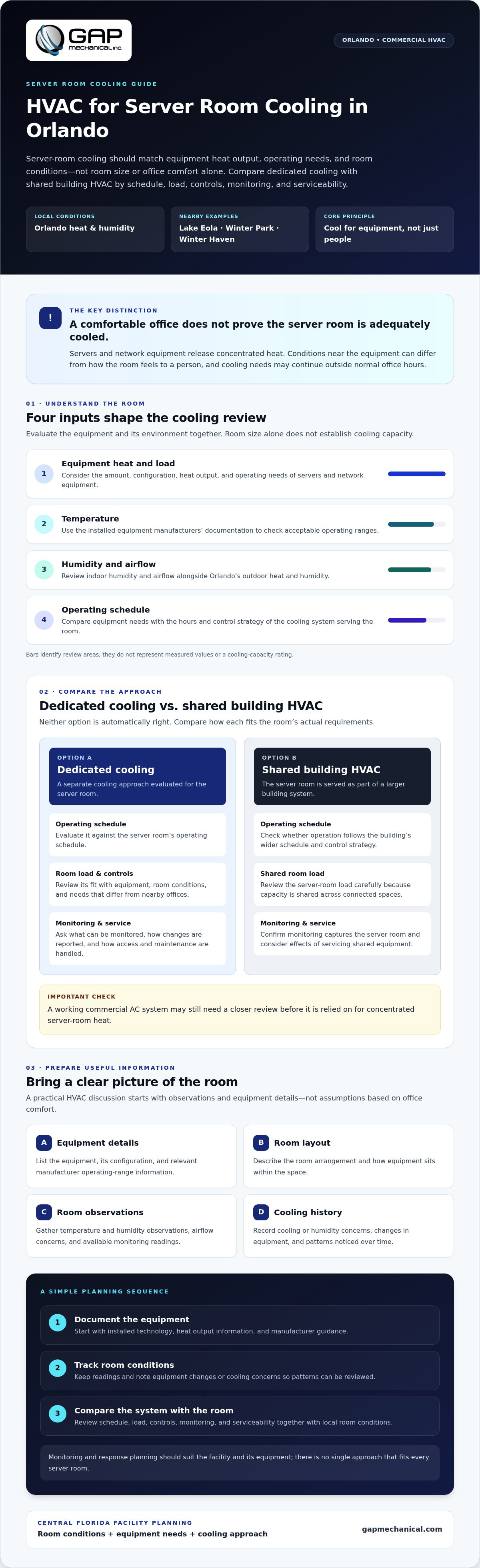
HVAC for server room cooling Orlando should be planned around equipment requirements, room conditions, and the need to manage server heat reliably. A comfortable office temperature alone doesn’t show whether a server room is adequately cooled.
From a tech office near downtown Orlando’s Lake Eola to facilities in Winter Park and Winter Haven, Central Florida heat and humidity make a room-specific review important. Shared building HVAC may be suitable in some facilities, but its schedule, airflow, and controls need to be considered alongside the server room’s requirements.
This guide explains how to compare cooling approaches, identify when existing AC needs a closer look, and prepare useful information for a commercial HVAC discussion. You’ll be better equipped to describe the room’s needs and consider a practical next step.
Key Takeaways
- Match cooling to the server equipment’s heat output and operating needs, not just the room’s size or comfort level.
- Compare dedicated cooling with shared building HVAC based on control, operating schedule, monitoring, and serviceability.
- Don’t assume a working commercial AC system can reliably manage a server room’s concentrated heat load.
- Before a commercial HVAC discussion, gather equipment details, room layout, temperature observations, and any history of cooling or humidity concerns.
- Use HVAC for server room cooling Orlando planning to consider room conditions and the cooling approach together.
What does HVAC for server room cooling in Orlando need to address?
HVAC for server room cooling Orlando should help maintain equipment-appropriate temperature and humidity conditions. The goal is to manage concentrated, ongoing heat from servers and network equipment, not simply to make the room comfortable for people.
That distinction matters in Orlando, where outdoor heat and humidity can affect the conditions an HVAC system must manage. A system serving nearby offices may not account for the server room’s equipment load or airflow needs. A room-specific review helps determine whether the existing setup suits the facility. For broader context on the role of cooling and environmental control in data facilities, see this overview of data center designs.
Server-room cooling means managing equipment heat and room conditions in line with the operating requirements of the installed technology. There isn’t one temperature setting that fits every room. Use the equipment manufacturers’ documentation to check acceptable operating ranges.
Why server rooms have different cooling demands
Servers and network equipment release heat as they operate. Their cooling needs may continue outside normal office hours, unlike the changing comfort demands of an occupied meeting room or workspace. A room can feel cool to a person while conditions near equipment differ. Room size alone also doesn’t establish the cooling capacity needed. The amount and configuration of equipment, along with its heat output, matter too.
Which room conditions should a facility track?
Before comparing options, gather information about temperature, humidity, airflow, and equipment load. Check manufacturer documentation for acceptable operating ranges rather than relying on a generic target. In Orlando’s humid climate, consider how outdoor conditions and the room’s existing HVAC relate to humidity inside the space.
Monitoring can help staff notice changing conditions and spot patterns that may need investigation. Keep a record of readings, equipment changes, and cooling concerns. The monitoring method and response plan should suit the facility and its equipment, rather than being treated as a universal technical requirement.
How do dedicated server-room cooling and building HVAC compare?
Dedicated cooling gives a server room a separate cooling approach to evaluate against its equipment needs. Shared commercial HVAC serves the room as part of a larger building system. Neither option is automatically right. Compare how each handles the room’s load, operating schedule, controls, monitoring, and maintenance.
In Orlando, don’t assume an existing comfort system is adequate just because the office feels cool. A review of the room and system can clarify how the HVAC performs there and whether the server room’s requirements differ from those of surrounding spaces.
| Assessment factor | Dedicated cooling | Shared building HVAC |
|---|---|---|
| Continuous operation | Can be evaluated against the server room’s operating schedule. | Operation may follow the building’s wider schedule and control strategy. |
| Room load | Can be reviewed in relation to the equipment and room conditions. | Capacity is shared across connected spaces, so the server-room load needs careful review. |
| Control | Separate controls may help address needs that differ from occupied rooms. | Room conditions may depend on shared zones and building-wide settings. |
| Monitoring | Ask which room conditions can be monitored and how changes are reported. | Confirm whether existing monitoring captures conditions in the server room itself. |
| Serviceability | Review access, maintenance planning, and what happens during service. | Consider how service to shared equipment could affect the server room and other spaces. |
When might dedicated cooling merit evaluation?
Consider a separate approach if equipment creates a concentrated load or the room needs to operate differently from nearby offices. Separate controls may help manage distinct room requirements, but they don’t establish on their own that a specific system is suitable. For HVAC for server room cooling Orlando, consider the equipment documentation, room conditions, and existing system together.
What should businesses ask about backup and monitoring?
Clarify the continuity plan before choosing an approach. Ask:
- How would a temperature alert reach the responsible facilities or IT contact?
- Have cooling continuity needs been reviewed against the equipment requirements?
- What backup-power or redundancy measures, if any, are appropriate for this site?
Backup power and redundancy depend on facility requirements and system design. Confirm recommendations with a qualified technical professional rather than treating any configuration as a universal requirement. A commercial HVAC discussion can help document existing conditions and identify open questions. Discuss your commercial HVAC needs with GAP Mechanical.
Can ordinary commercial AC keep an Orlando server room cool?
Sometimes, but a working commercial AC system isn’t automatically suitable for a server room. Its ability to maintain equipment-appropriate conditions depends on the room’s heat load, airflow, controls, and cooling schedule. Evaluate those factors rather than assuming the system is suitable.
Comfort cooling manages conditions for people; equipment-focused cooling is evaluated against the operating needs of the technology. In Orlando, a building system may serve offices on one schedule while servers continue producing heat outside occupied hours. That doesn’t mean shared HVAC will fail, but it does make the system’s actual operation and the room’s conditions important to review.
What can make shared HVAC a poor fit?
Start with the schedule. If the building system reduces or stops cooling when offices close, check whether that timing aligns with the server room’s needs. Then consider how air reaches the equipment. Supply vents, return-air paths, and obstructions can affect conditions across the room, even when the larger building feels comfortable.
Controls matter too. A thermostat serving a wider area may respond to conditions elsewhere instead of conditions in the server room. Shared HVAC may still be suitable, depending on the site, but its performance should be considered alongside room-specific requirements.
What signs call for a closer assessment?
Recurring temperature alerts or unexplained changes in room conditions warrant investigation. Review the setup after adding or replacing equipment, changing the rack or room layout, or altering the building’s HVAC schedule. Any of these changes can affect the relationship between heat output, airflow, and the existing system.
Before requesting service or discussing the system, document what’s happening. A simple record can help connect symptoms to operating conditions:
- Note the date and time of each alert or unusual reading.
- Record equipment additions or changes and their locations in the room.
- Describe any changes to building HVAC schedules or controls.
- Identify where readings are taken and whether the issue recurs in the same area.
This information gives a commercial HVAC professional a clearer starting point. For HVAC for server room cooling Orlando, the useful question isn’t simply whether the building AC runs. It’s whether the system’s operation and air distribution align with the server room’s documented requirements.
How should Orlando businesses prepare for a server-room HVAC assessment?
Prepare by collecting equipment requirements, basic room details, and a clear record of cooling concerns. In Orlando, heat and humidity make it useful to describe how the room behaves during different building schedules and outdoor conditions, rather than relying on a single observation.
What information should you gather first?
- Describe the room. Record its location, approximate dimensions, and features that may affect airflow, such as equipment placement or blocked vents.
- List the equipment. Note the servers and network equipment operating there, where each is positioned, and any recent additions or changes.
- Collect manufacturer guidance. Bring equipment documentation that identifies operating requirements. Use the manufacturers’ recommendations instead of general temperature or humidity targets.
- Gather available condition records. Collect room readings, alerts, or written observations, including where and when they were recorded.
- Note patterns and changes. Record when concerns occur and whether they follow a change in equipment, room layout, building use, or HVAC schedule.
Even an informal log can help distinguish a recurring pattern from a one-time observation. Include the source of each reading if known, and note any gaps in the records.
What should a contractor review on site?
Ask the contractor to review the existing HVAC arrangement, airflow paths, controls, and conditions in the room. The discussion should connect those observations to the equipment information you provide. If the review depends on assumptions, ask what they are and whether additional technical review may be needed before choosing an approach.
It also helps to ask how the contractor evaluates commercial HVAC needs and what information supports the findings. These questions keep the conversation focused on the facility rather than a generic solution. GAP Mechanical provides commercial HVAC services. A facilities or IT manager can use the collected records to frame a focused discussion about the site.
For HVAC for server room cooling Orlando, a commercial HVAC contractor can discuss the existing equipment and room conditions without presuming that one cooling approach fits every facility. To talk with GAP Mechanical about your commercial HVAC needs, contact the team.
What is the next step for server-room cooling in Orlando?
Compare cooling options with equipment requirements and observed room conditions, then clarify how monitoring and future equipment changes affect the plan. Ask a qualified provider to identify details that may need confirmation from the equipment manufacturer or another specialist.
How to make the cooling decision with confidence
Keep the decision tied to documented requirements, site observations, and the facility’s service needs. Don’t assume one approach suits every server room.
How to request a commercial HVAC conversation
GAP Mechanical provides commercial HVAC services in Orlando and serves Central Florida. Share the room’s purpose, equipment context, and current cooling concerns to start a practical discussion.
Discuss your commercial HVAC needs with GAP Mechanical to talk through your facility’s situation and possible next steps.
Build a Cooling Plan Around Your Equipment
Reliable server-room cooling starts with the equipment’s documented requirements, followed by a review of room conditions and the existing HVAC system. A building AC unit may be part of the solution, but its schedule, airflow, and controls need to suit the room’s actual demands.
For HVAC for server room cooling Orlando, use equipment records and observed room conditions to compare possible approaches. Then consider how monitoring, future equipment changes, and ongoing service fit into the plan. These steps can turn a general concern about heat or humidity into a practical discussion about the facility.
GAP Mechanical is a licensed and insured HVAC contractor serving Central Florida, with commercial HVAC services. To discuss your facility’s needs and possible next steps, contact GAP Mechanical.
A clear, site-specific review can help you make the next decision with greater confidence.
Frequently Asked Questions
Can regular air conditioning cool a server room?
It may work in some buildings, but regular commercial AC shouldn’t be assumed to meet server equipment needs. Compare the system’s operating schedule, room load, airflow, and controls with the equipment manufacturers’ requirements. If conditions are uncertain, discuss a review of the room and existing HVAC with a qualified professional. For HVAC for server room cooling Orlando, the key question is whether the setup suits the equipment, not simply whether the building AC is running.
What temperature should a server room be?
There isn’t one temperature to prescribe without knowing the equipment and its manufacturer guidance. Check the documentation for the installed servers and network equipment, then have a qualified professional verify the acceptable operating range for the facility. Use that information before setting controls or alerts. A general target may not fit every system, and a reading from one part of the room may not describe conditions throughout it.
Does a server room need a dedicated cooling system?
Not in every case. The right approach depends on equipment heat, room conditions, operating hours, and the facility’s continuity needs. An existing commercial HVAC system may be suitable if a review finds that it can address the room’s requirements. Before choosing dedicated cooling or another arrangement, consider the current system, airflow, controls, and manufacturer documentation with a qualified HVAC professional.
How can Orlando humidity affect server room cooling?
Humidity is one of the room conditions to track alongside temperature and airflow. Orlando’s humid climate makes it sensible to consider how outdoor conditions and existing HVAC controls relate to observed conditions in the server room. Don’t rely on a general humidity target without checking equipment guidance. Gather available room readings and ask a qualified HVAC professional to review the space and explain any limitations or uncertainties.
Frequently Asked Questions
Which room conditions should a facility track?
Before comparing options, gather information about temperature, humidity, airflow, and equipment load. Check manufacturer documentation for acceptable operating ranges rather than relying on a generic target. In Orlando’s humid climate, consider how outdoor conditions and the room’s existing HVAC relate to humidity inside the space. Monitoring can help staff notice changing conditions and spot patterns that may need investigation. Keep a record of readings, equipment changes, and cooling concerns. The monitoring method and response plan should suit the facility and its equipment, rather than being treated as a universal technical requirement. Dedicated cooling gives a server room a separate cooling approach to evaluate against its equipment needs. Shared commercial HVAC serves the room as part of a larger building system. Neither option is automatically right. Compare how each handles the room’s load, operating schedule, controls, monitoring, and maintenance. In Orlando, don’t assume an existing comfort system is adequate just because the office feels cool. A review of the room and system can clarify how the HVAC performs there and whether the server room’s requirements differ from those of surrounding spaces.
When might dedicated cooling merit evaluation?
Consider a separate approach if equipment creates a concentrated load or the room needs to operate differently from nearby offices. Separate controls may help manage distinct room requirements, but they don’t establish on their own that a specific system is suitable. For HVAC for server room cooling Orlando, consider the equipment documentation, room conditions, and existing system together.
What should businesses ask about backup and monitoring?
Clarify the continuity plan before choosing an approach. Ask: Backup power and redundancy depend on facility requirements and system design. Confirm recommendations with a qualified technical professional rather than treating any configuration as a universal requirement. A commercial HVAC discussion can help document existing conditions and identify open questions. Discuss your commercial HVAC needs with GAP Mechanical. Sometimes, but a working commercial AC system isn’t automatically suitable for a server room. Its ability to maintain equipment-appropriate conditions depends on the room’s heat load, airflow, controls, and cooling schedule. Evaluate those factors rather than assuming the system is suitable. Comfort cooling manages conditions for people; equipment-focused cooling is evaluated against the operating needs of the technology. In Orlando, a building system may serve offices on one schedule while servers continue producing heat outside occupied hours. That doesn’t mean shared HVAC will fail, but it does make the system’s actual operation and the room’s conditions important to review.
What can make shared HVAC a poor fit?
Start with the schedule. If the building system reduces or stops cooling when offices close, check whether that timing aligns with the server room’s needs. Then consider how air reaches the equipment. Supply vents, return-air paths, and obstructions can affect conditions across the room, even when the larger building feels comfortable. Controls matter too. A thermostat serving a wider area may respond to conditions elsewhere instead of conditions in the server room. Shared HVAC may still be suitable, depending on the site, but its performance should be considered alongside room-specific requirements.
What signs call for a closer assessment?
Recurring temperature alerts or unexplained changes in room conditions warrant investigation. Review the setup after adding or replacing equipment, changing the rack or room layout, or altering the building’s HVAC schedule. Any of these changes can affect the relationship between heat output, airflow, and the existing system. Before requesting service or discussing the system, document what’s happening. A simple record can help connect symptoms to operating conditions: This information gives a commercial HVAC professional a clearer starting point. For HVAC for server room cooling Orlando, the useful question isn’t simply whether the building AC runs. It’s whether the system’s operation and air distribution align with the server room’s documented requirements. Prepare by collecting equipment requirements, basic room details, and a clear record of cooling concerns. In Orlando, heat and humidity make it useful to describe how the room behaves during different building schedules and outdoor conditions, rather than relying on a single observation.
What information should you gather first?
Even an informal log can help distinguish a recurring pattern from a one-time observation. Include the source of each reading if known, and note any gaps in the records.
What should a contractor review on site?
Ask the contractor to review the existing HVAC arrangement, airflow paths, controls, and conditions in the room. The discussion should connect those observations to the equipment information you provide. If the review depends on assumptions, ask what they are and whether additional technical review may be needed before choosing an approach. It also helps to ask how the contractor evaluates commercial HVAC needs and what information supports the findings. These questions keep the conversation focused on the facility rather than a generic solution. GAP Mechanical provides commercial HVAC services. A facilities or IT manager can use the collected records to frame a focused discussion about the site. For HVAC for server room cooling Orlando, a commercial HVAC contractor can discuss the existing equipment and room conditions without presuming that one cooling approach fits every facility. To talk with GAP Mechanical about your commercial HVAC needs, contact the team. Compare cooling options with equipment requirements and observed room conditions, then clarify how monitoring and future equipment changes affect the plan. Ask a qualified provider to identify details that may need confirmation from the equipment manufacturer or another specialist.
Can regular air conditioning cool a server room?
It may work in some buildings, but regular commercial AC shouldn’t be assumed to meet server equipment needs. Compare the system’s operating schedule, room load, airflow, and controls with the equipment manufacturers’ requirements. If conditions are uncertain, discuss a review of the room and existing HVAC with a qualified professional. For HVAC for server room cooling Orlando, the key question is whether the setup suits the equipment, not simply whether the building AC is running.
What temperature should a server room be?
There isn’t one temperature to prescribe without knowing the equipment and its manufacturer guidance. Check the documentation for the installed servers and network equipment, then have a qualified professional verify the acceptable operating range for the facility. Use that information before setting controls or alerts. A general target may not fit every system, and a reading from one part of the room may not describe conditions throughout it.
Does a server room need a dedicated cooling system?
Not in every case. The right approach depends on equipment heat, room conditions, operating hours, and the facility’s continuity needs. An existing commercial HVAC system may be suitable if a review finds that it can address the room’s requirements. Before choosing dedicated cooling or another arrangement, consider the current system, airflow, controls, and manufacturer documentation with a qualified HVAC professional.
How can Orlando humidity affect server room cooling?
Humidity is one of the room conditions to track alongside temperature and airflow. Orlando’s humid climate makes it sensible to consider how outdoor conditions and existing HVAC controls relate to observed conditions in the server room. Don’t rely on a general humidity target without checking equipment guidance. Gather available room readings and ask a qualified HVAC professional to review the space and explain any limitations or uncertainties.