

High Electric Bill From AC in Florida? 2026 Fixes
Published August 11, 2026
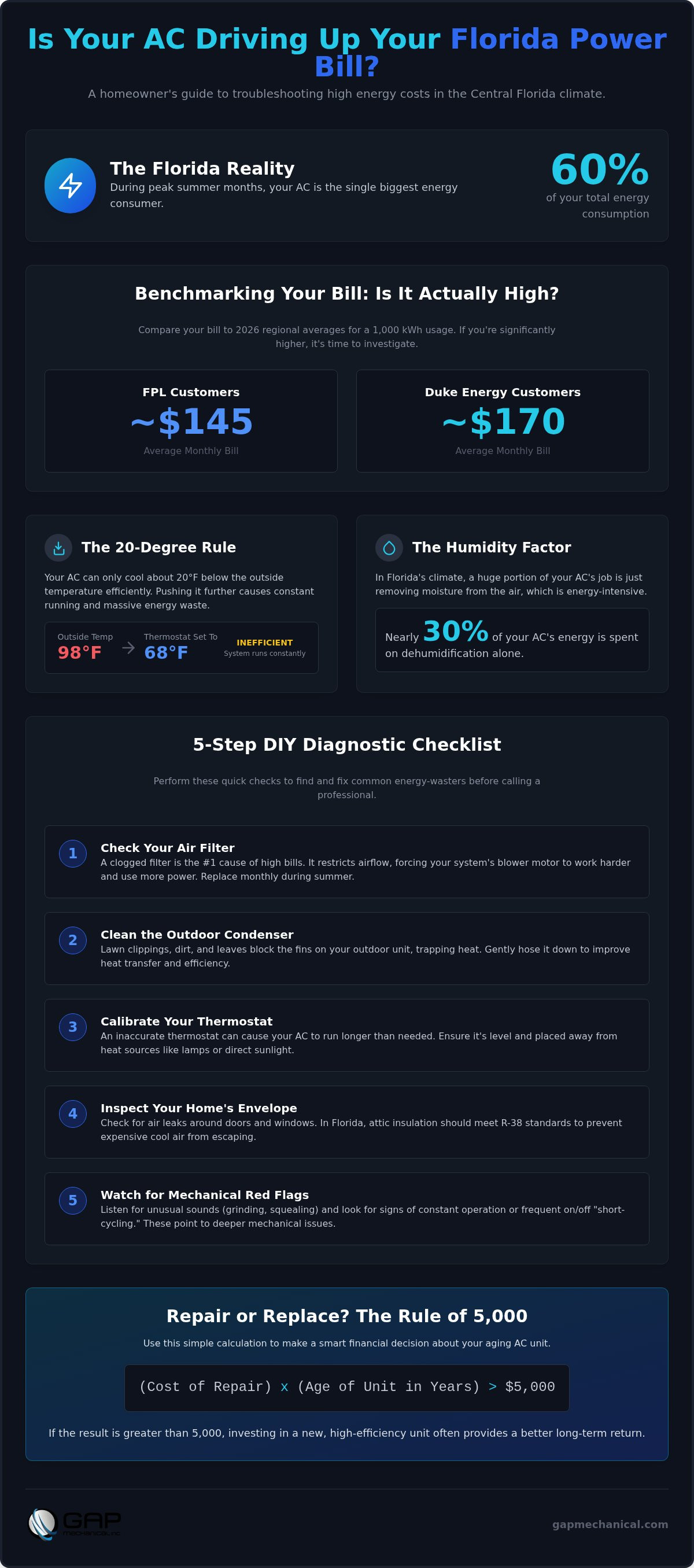
A high electric bill from your air conditioning in Central Florida is often a symptom of inefficiency caused by the extreme heat load of the region rather than a fault in the unit itself. In Orlando, managing high energy usage requires a deep understanding of how your system interacts with intense humidity, relentless 90°+ summer heat, and the unique architectural challenges of older Florida homes.
The Central Florida Climate Challenge: Why AC Works Harder Here
Living in Central Florida means dealing with a climate that is fundamentally different from most places in the country. We don't just battle high temperatures; we battle extreme humidity. This combination creates a massive and constant 'heat load' on your HVAC system.
The primary job of a standard AC unit is to lower the temperature. However, in places like Winter Park or parts of Kissimmee, the primary job is often dehumidification. When the air is saturated with moisture, the system must work significantly harder—running longer and consuming more energy—to pull that moisture out of the air and maintain a comfortable setting.
If you are noticing sudden spikes in your electric usage, especially during the hottest parts of the afternoon, it is likely that your system is constantly fighting a high moisture load. This is especially true in older homes built before modern energy efficiency standards were implemented, where air leakage and thermal bridging are common issues.
Understanding this climate reality is the first step in diagnosing a high electric bill. It shifts the focus from simply "fixing" the unit to optimizing its performance against the intense pressure of the Florida environment.
Hidden Energy Drain: When Your AC Struggles Against Orlando's Heat
It is a common misconception that a high bill means something is fundamentally broken. Often, it means the system is working exactly as designed—but because it is being inefficiently operated or is nearing the end of its functional life.
Several subtle factors can dramatically increase your energy consumption without causing a noticeable failure. These issues often accumulate over years of exposure to Orlando’s harsh weather.
Signs of Inefficient Operation
- The System Runs Constantly: If the compressor never seems to cycle off, your system is likely struggling to meet the required cooling capacity, often due to inadequate airflow or refrigerant issues.
- Uneven Temperatures: If you have cold spots in some rooms and excessively cold spots in others, your ductwork might be leaky, or your unit might not be distributing the cooling evenly, forcing the system to run longer overall.
- Excessive Condensation/Ice Formation: If you see ice forming on the evaporator coils during peak summer use, the system is severely undersized or has a refrigerant charge problem, leading to massive energy waste.
- High Fan Noise and Rattling: While this sounds like a mechanical problem, internal strain on the fan motor often indicates the unit is overworking to compensate for poor insulation or high external temperatures.
If you suspect these signs, a professional diagnostic approach is necessary. You can review the AC Repair Orlando: Professional Troubleshooting Checklist to understand the steps experts take to diagnose these issues.
System Health vs. System Age: The Lifespan of Efficiency
The components of your HVAC system—the compressor, the outdoor condenser, and the internal coils—are subjected to relentless stress in Central Florida. They must handle extreme heat fluctuations, high humidity, and the corrosive effects of prolonged exposure to the elements.
Over time, efficiency degrades. A unit that was highly efficient when newly installed may lose significant performance over a decade simply due to wear and tear, dirt buildup, and mineral deposits from the water used in the cooling process.
The Impact of Neglect on Energy Use
Ignoring routine maintenance is arguably the fastest way to ensure a high electric bill. A dirty filter is the simplest culprit, but the consequences extend far beyond just restricting airflow.
- Dirty Filters: These act as blockages, forcing the blower motor to pull harder, which increases electricity usage.
- Dirty Coils: Dust and grime on the evaporator and condenser coils prevent proper heat exchange. The unit has to run longer and harder to move the same amount of heat.
- Clogged Drainage: Moisture accumulation that isn't properly drained can lead to mold growth, which puts strain on the unit and compromises air quality.
Regular, comprehensive maintenance ensures that your system is operating at peak efficiency, which directly translates to lower operational demands on your power grid. A thorough tune-up addresses these hidden variables before they become major energy drains.
Optimizing Performance for the Orlando Home
Once your system is confirmed to be in good health, the next step is to optimize how you use it. Optimizing performance means matching your system's output to the actual needs of your home, rather than simply turning it on to maximum capacity every time.
Many residents in areas like Poinciana or Shingle Creek rely on constant, low-temperature settings, which forces the unit into a continuous, high-draw cycle. Smart usage involves allowing the system to run efficiently, utilizing proper temperature setbacks, and managing humidity levels proactively.
Operational Strategies for High-Humidity Climates
- Manage Expectations: Accept that in 90°+ heat, achieving a cool 70°F might require significant energy. Instead, aim for a comfortable temperature that balances comfort with energy conservation.
- Utilize Fans Strategically: Ceiling fans circulate air, allowing you to set your thermostat a few degrees higher while still feeling comfortable. This is a significant passive energy saver.
- Seal the Envelope: In older Orlando homes, air leaks around windows and doors are massive energy culprits. Sealing these gaps prevents conditioned air from escaping and hot, humid air from entering.
- Manage Solar Gain: Keep blinds and curtains closed during the hottest parts of the day, especially on south and west-facing windows. This stops solar radiation from adding unnecessary heat load to your home.
These simple behavioral changes, combined with proper maintenance, significantly reduce the strain on your AC unit and contribute to a more stable, lower energy profile for your home.
The Long-Term Energy Picture: Upgrading for Future Comfort
While maintenance and usage habits are critical, sometimes the only solution to a persistently high electric bill is an upgrade. If your current system is significantly older than the recommended operational lifespan, its efficiency simply cannot compete with modern HVAC technology designed specifically for high-moisture climates.
Modern systems are built with advanced components and proprietary designs that maximize dehumidification while minimizing energy draw. Considering an upgrade is not merely a replacement of machinery; it is an commitment to long-term climate resilience and operational savings.
If your home is located in a specific neighborhood like Winter Park, understanding how modern, efficient units handle the local climate is vital. For homeowners looking into replacing aging systems with high-efficiency alternatives, exploring options for AC Installation in Winter Park can provide the detailed guidance needed to ensure optimal performance and long-term savings.
The goal is to transition from a system that is merely surviving the Central Florida heat to one that is actively optimizing energy use.
Frequently Asked Questions
Q: How does humidity specifically affect my AC’s energy usage?
A: High humidity forces the AC to work harder on dehumidification. Instead of just cooling the air, the system must also cool the moisture out of the air, which requires more energy and longer run times to achieve the same level of comfort.
Q: Should I run my AC constantly or use temperature setbacks?
A: In extremely high-humidity environments, constant, steady operation may be more efficient than drastic temperature swings. Frequent, large changes force the system to rapidly cycle between cooling and dehumidifying modes, which can be less efficient than maintaining a consistent, optimized temperature.
Q: Is simply changing my air filter enough to lower my electric bill?
A: While changing the filter is a crucial first step, it is only one piece of the puzzle. For significant savings, you must also ensure your coils are clean and that your home’s insulation and window seals are adequate to prevent the unit from cooling outside air.
Q: What is the biggest energy drain in an older Orlando home?
A: The largest hidden energy drain in older homes is often air leakage. Gaps around windows, doors, and utility penetrations allow conditioned, cooled air to escape and hot, humid air to enter, forcing the AC to constantly overcompensate.
Frequently Asked Questions
Why is my electric bill so high all of a sudden in Florida?
Sudden spikes often stem from record-breaking temperatures or mechanical failures. Florida utilities reported a 23% increase in summer demand in 2026 due to extreme heat. If the weather hasn't changed, look for a "vampire" power draw like a failing capacitor or a refrigerant leak. These issues force the compressor to run indefinitely, leading to a high electric bill from AC Florida that appears without warning.
What is a normal electric bill for a 2,000 sq ft house in Florida?
A typical 1,000-kWh bill in Florida for 2026 averages between $145 and $175, but a 2,000 sq ft home often uses more. Depending on your provider, like Duke Energy or FPL, and your home's insulation, you might see monthly totals ranging from $250 to $400 during peak summer. Rates vary by region; Northwest Florida customers see slightly higher averages near $141 per 1,000 kWh.
Can a dirty AC filter really increase my electric bill?
Yes, a clogged filter can increase your energy consumption by 5% to 15%. When airflow is restricted, the blower motor pulls more amperage to move air through the system. This increased resistance forces the AC to run longer cycles to reach your thermostat setting. Replacing a $15 filter monthly is the simplest way to prevent a high electric bill from AC Florida caused by airflow blockages.
How much does it consideration to fix an AC that is making my bill high?
repair needs vary based on the specific mechanical failure discovered during a diagnostic call. Common fixes like replacing a capacitor or clearing a condensate line are relatively practical; repairing a refrigerant leak or replacing a blower motor requires more labor and parts. We provide transparent estimates after a thorough inspection to ensure you aren't paying for unnecessary components. Every repair aims to restore factory-level efficiency.
Is it simpler to leave the AC on all day or turn it off when I leave?
It is generally simpler to leave your AC on but at a higher temperature while you are away. Turning the system completely off allows humidity to build up in your drywall and furniture. When you return, the unit must work at maximum capacity for hours to remove that moisture. We recommend raising the thermostat by 5 to 7 degrees instead of shutting the system down entirely.
What temperature should I set my AC to in Florida to save money?
The Florida Public Service Commission and local utilities recommend setting your thermostat to 78 degrees. Every degree you set below 78 can increase your cooling considerations by 6% to 8%. During the 2026 summer heat, sticking to this baseline helps manage the 40% to 60% of your bill dedicated to air conditioning. Use ceiling fans to feel cooler without actually lowering the temperature setting.
How do I know if my AC ductwork is leaking air?
You can check for leaking ductwork by looking for excessive dust around your ceiling registers or uneven temperatures between rooms. Inspect your attic for loose silver tape, collapsed flex ducts, or insulation that has been blown around near duct joints. If you feel cold air blowing into your attic space, you are paying to cool a non-living area, which significantly inflates your monthly utility statement.
Will a new AC unit actually lower my electric bill?
Upgrading to a modern SEER2 system can lower your cooling considerations by 20% to 40% compared to an older 10-SEER unit. Modern systems utilize variable-speed compressors that adjust their output to match the heat load of your home. This technology prevents the frequent, energy-heavy startups common in older models. With the 2026 tax credits and rebates, the long-term return of a high-efficiency installation often outweighs repair needs.