

Commercial HVAC Installation in Orlando: A Guide
Published June 17, 2026
Successfully implementing commercial HVAC installation in Orlando requires a detailed understanding of local climate challenges and the specific operational demands of your business. Beyond simply cooling a space, the process involves meticulously planning for high humidity, extreme heat, and the need for uninterrupted comfort to maintain productivity.
Why Commercial HVAC Systems Demand a Different Approach Than Residential Units
Many business owners mistakenly assume that the HVAC system designed for a home—even a large home—can be simply scaled up for a commercial building. This assumption is a recipe for operational failure in the demanding Central Florida environment. Commercial HVAC installation is not merely about moving air; it is about managing complex thermal loads, maintaining consistent air quality, and ensuring system reliability throughout the day.
The fundamental differences boil down to three critical factors:
- Duty Cycle: Residential systems are typically used for short bursts during peak heat. Commercial systems, however, run for extended periods, often operating continuously during 90°+ summer days. This sustained operation puts immense strain on components, requiring robust, industrial-grade equipment.
- Load Calculation: A home’s heat load is relatively static. A commercial space may have fluctuating loads based on occupancy, equipment density (servers, kitchens), and the specific building envelope (glass vs. solid walls). Accurate load calculation is the foundation of successful installation.
- Operational Uptime: For a business, HVAC failure doesn't just mean discomfort; it means lost revenue and potential health hazards. Commercial installations are designed with redundancy and fail-safes to minimize downtime, a priority residential systems do not share.
In areas across Orlando, from the high-density commercial corridors of Downtown to the sprawling industrial parks near Kissimmee, the expectation is absolute climate control. The system must be built to handle the relentless Central Florida heat while remaining energy efficient under sustained load.
Navigating the Central Florida Climate: The Humidity Factor
If you were to look at the HVAC requirements for a residential home in Orlando, you might focus primarily on cooling capacity. For a commercial installation in Central Florida, the focus must be equally, if not more, on dehumidification. The oppressive humidity that characterizes our summers is perhaps the single greatest challenge to HVAC performance and structural integrity.
High humidity doesn't just make the space feel warmer; it accelerates corrosion, compromises the efficiency of the cooling coils, and can lead to moisture damage within the building envelope. When planning a commercial HVAC installation in Orlando, the equipment must be capable of aggressive moisture removal, not just temperature reduction.
Consider these climate-specific factors before finalizing any installation plans:
- The Afternoon Storm Cycle: Central Florida is famous for its intense, rapid afternoon convective storms. These events place sudden, extreme stress on both the cooling and drainage components of the system.
- The Impact of Older Structures: Many established businesses in areas like Winter Park or parts of Dr. Phillips house older buildings with less insulated envelopes. These structures require highly specialized load assessments to prevent immediate system overload.
- Hurricane Preparedness: Commercial systems must be installed and designed to withstand severe wind loads and potential moisture infiltration associated with hurricane cycles. Resilience is a non-negotiable design parameter.
A proper assessment ensures that the system is not only powerful enough to handle the heat but is also engineered to manage the moisture and environmental stresses unique to our specific geography. If your current system is struggling, understanding the complexities of AC Repair Orlando can often reveal if the issue is capacity or simply poor maintenance.
Critical Planning Steps Before Commercial HVAC Installation Orlando
The difference between a temporary fix and a long-term, reliable solution lies entirely in the planning phase. Rushing this process often leads to costly operational inefficiencies down the line. A professional approach to commercial HVAC installation Orlando involves a systematic, multi-step evaluation of the entire operational environment.
Before any mechanical work begins, the following steps are crucial for business owners:
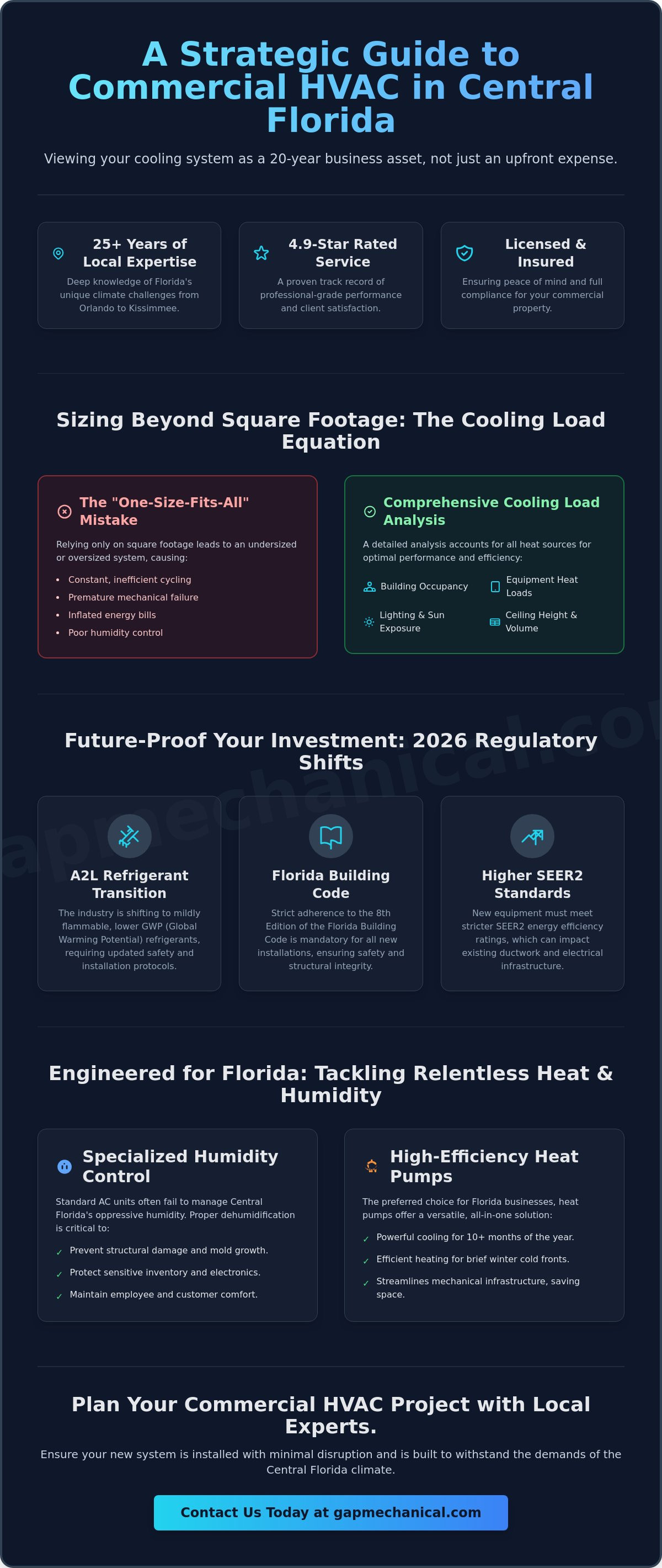
- Comprehensive Load Assessment: This goes far beyond a simple square footage calculation. It involves analyzing BTU requirements based on insulation levels, window orientation, equipment placement, and internal heat gains.
- Zoning and Air Distribution Planning: Not all areas of a commercial building have the same thermal needs. Effective installation requires strategic zoning to ensure that spaces are conditioned precisely where and when they are needed, preventing energy waste in unoccupied zones.
- System Integration Review: The new HVAC system must integrate seamlessly with existing building infrastructure, including electrical panels, ductwork, and roof mounting structures. A poorly integrated system can negate the performance benefits of high-quality equipment.
- Permitting and Code Compliance: Commercial installations are heavily regulated. Ensuring all work meets local Orlando building codes and is performed by licensed professionals is paramount for both operational safety and long-term insurance compliance.
For business owners considering a major overhaul, reviewing guides on Commercial AC Replacement in Orlando provides a deeper dive into the long-term performance metrics and efficiency gains possible with modern systems.
Selecting the Right System for Your Business Profile
The right HVAC system is not the most significant one; it is the one that precisely matches the operational requirements of your specific business. Whether you run a high-traffic retail outlet, a data center, an office complex, or a specialized manufacturing facility, the design parameters are unique.
Different commercial applications require different solutions:
- High Occupancy/Retail: These spaces require excellent air exchange rates and high cooling capacity to manage large crowds and heat generated by foot traffic.
- Data Centers/Server Rooms: These demand highly specific, consistent temperature and humidity controls, often requiring precision cooling solutions that prioritize uptime and airflow over general comfort.
- Office/Mixed Use: These benefit most from advanced zoning and variable refrigerant flow (VRF) systems, which allow for granular control over different departments or floors.
- Industrial/Manufacturing: These environments must be designed to handle dust, specific air filtration needs, and the significant heat loads generated by heavy machinery.
The evaluation process involves discussing your operational schedule, air quality needs (especially important for customer-facing businesses), and desired comfort levels. A bespoke solution, tailored to your unique needs, is always superior to a standardized installation.
The Long-Term Value of Professional HVAC Maintenance
A commercial HVAC installation is a significant undertaking, but the true measure of its success is found in its long-term, reliable operation. Even the most sophisticated system will underperform without a rigorous, proactive maintenance schedule. Maintenance shifts the focus from reactive, costly repairs to preventative, predictable upkeep.
For commercial properties in Orlando, maintenance protocols must specifically address the corrosive and humid nature of the Central Florida climate. This means more than just changing filters; it involves deep dives into coil cleaning, refrigerant levels, electrical system integrity, and drainage functionality.
Regular maintenance ensures:
- Peak Performance: Systems operate at their designed capacity, even during the most extreme heat events.
- Longevity: Components are protected from premature failure caused by environmental factors.
- Regulatory Compliance: Routine servicing helps ensure adherence to environmental and safety standards, protecting your business from potential liabilities.
Viewing maintenance as a proactive operational strategy—rather than a reactive expense—is key to maximizing the functional lifespan of your equipment and ensuring consistent business flow. We are committed to providing expert service across Central Florida, helping businesses maintain peak operational status.
Frequently Asked Questions
How long should a commercial HVAC system typically last in Orlando?
With consistent, professional maintenance and proper installation tailored to the Central Florida climate, commercial HVAC systems are designed for long operational lifespans. However, the lifespan is highly dependent on the quality of the initial installation, the type of system chosen, and the diligence of the maintenance schedule.
What is the most important factor when selecting a commercial HVAC system for a high-humidity area like Orlando?
The ability of the system to effectively manage humidity is paramount. While cooling capacity is necessary, a system that cannot aggressively pull moisture from the air will struggle to achieve true comfort, regardless of how low the temperature setting is. Dehumidification performance must be a core metric in the selection process.
Do I need different HVAC maintenance in Orlando compared to other climates?
Yes. Due to the high humidity, the intense heat, and the potential for severe storm activity, HVAC systems in Orlando require specialized maintenance protocols. These protocols focus heavily on corrosion prevention, thorough coil cleaning, and ensuring all drainage systems are clear and functioning perfectly under extreme conditions.
How do I know if my current commercial HVAC system needs a full assessment?
Look for signs like inconsistent temperatures across the building, excessive noise that suggests component stress, or if your utility bills seem disproportionately high despite low usage. These are signs that the system may not be operating at peak efficiency or may be struggling with the load.
Frequently Asked Questions
Square Footage vs. Cooling Load Capacity
Floor space is only one part of the equation. An Orlando warehouse with 30-foot ceilings has a much larger volume of air to treat than a standard office. Similarly, retail boutiques with floor-to-ceiling glass windows face massive thermal gain from the Florida sun. These factors dictate the required tonnage. Cooling load is the total amount of heat energy that must be removed from a space to maintain a specific temperature and humidity level despite external weather and internal activities. Proper sizing ensures the equipment can actually manage the moisture levels that lead to mold and discomfort in places like Kissimmee and St. Cloud.
Existing Infrastructure and Retrofitting
The age of your current building significantly influences the complexity of a new installation. Modern, high-efficiency equipment often requires more robust support than older units. We evaluate whether your current ductwork can handle the higher static pressure of new SEER2 compliant systems. Electrical panels in older Altamonte Springs facilities might lack the capacity for modern high-performance compressors. Structural considerations are also paramount. If you're moving from a ground-level unit to a rooftop unit, the logistics of crane permits and structural reinforcements must be planned carefully to avoid business downtime. GAP Mechanical leverages over 25 years of local experience to identify these infrastructure hurdles before the project begins, ensuring a seamless transition for your commercial property. Selecting the right equipment is the most critical decision in managing your long-term commercial HVAC installation consideration Orlando. In Central Florida, the goal is to balance immediate capital expenditure with a system that won't bleed your operating planning dry through energy waste. For 2026, the industry has narrowed its focus to high-efficiency technologies that handle our unique latent heat loads. Heat pumps have become the preferred choice for many Orlando businesses. They offer a dual-purpose solution that provides high-capacity cooling for ten months of the year and efficient heating during our brief winter cold fronts. This versatility eliminates the need for separate heating infrastructure, simplifying your building's mechanical footprint. Zoning is another essential factor for large Central Florida commercial spaces. Cooling an entire 10,000-square-foot facility to the same temperature is rarely efficient. Modern systems allow you to direct cooling only where it's needed, such as occupied offices or server rooms, while keeping less-used storage areas at a higher set point. This targeted approach reduces the strain on your compressors and extends the lifespan of your asset. If you are evaluating a new system for your facility, our team can help you identify a commercial HVAC solution tailored to your specific operational needs.
Packaged Rooftop Units (RTUs)
Packaged Rooftop Units are the dependable workhorses for retail centers in Kissimmee and industrial warehouses in Lakeland. These all-in-one cabinets house all components, which saves valuable interior floor space and simplifies the installation process. Because they sit on the roof, they are easily accessible for routine maintenance without disrupting your customers or employees. However, rooftop placement in Florida requires specific precautions. These units must be securely anchored to meet hurricane wind-load requirements. They also face constant exposure to intense UV rays and salt-laden air, making high-quality protective coatings a necessity for equipment longevity.
Split Systems and VRF Technology
For multi-office complexes in Winter Park or Altamonte Springs, Variable Refrigerant Flow (VRF) technology offers unparalleled precision. VRF systems can vary the amount of refrigerant flowing to multiple indoor evaporators, allowing different zones to operate at different temperatures simultaneously. This is highly efficient for buildings with varying occupancy levels throughout the day. All multi-zone installations should be designed according to ASHRAE ventilation standards to ensure proper air exchange and humidity removal. Split systems remain a flexible alternative for businesses in Clermont with limited roof space, as the condenser can be placed at ground level while the air handler is tucked away indoors. Both options now utilize SEER2 efficiency ratings, which provide a more accurate reflection of how the system will perform under the actual pressure of a Florida summer. Humidity is the silent profit killer for Central Florida businesses. While it's easy to focus solely on the upfront commercial HVAC installation consideration Orlando contractors provide, the real expense often lies in poor moisture management. In our region, an air conditioner acts as a massive dehumidifier. If your system fails to control latent heat, you aren't just losing comfort; you're losing money through structural decay and equipment strain. Evaluating the Total consideration of Ownership (TCO) means looking at how your system will perform over the next fifteen years in the face of 90% humidity levels. Many businesses suffer from oversized systems. These units reach the target temperature quickly and shut off. They don't run long enough to pull moisture from the air. This results in a clammy environment that breeds mold and forces the system to cycle too often. Short-cycling is the primary cause of premature mechanical failure in Orlando. A correctly sized system runs longer, more steady cycles to ensure the air is both cool and dry. This precision prevents the frequent breakdowns caused by the relentless Florida heat.
Dehumidification and Air Quality
Controlling moisture is vital for protecting business assets. Inventory in a Lakeland warehouse or sensitive electronics in an Altamonte Springs office can be ruined by sustained high humidity. Integrated dehumidification solutions are often more efficient than relying on standalone units that clutter your floor space. Failing to manage these levels often leads to significant mold remediation projects that disrupt your operations. Proper air quality management isn't a luxury; it's a defensive strategy for your physical property and your employees' health.
Energy Efficiency and Seasonal Performance
The 2026 efficiency standards place a high premium on how systems handle the Florida climate. With ten or more months of cooling required annually, the return of high-SEER2 equipment becomes clear very quickly. Choosing a system with advanced modulation allows it to adapt to the specific heat load of the day. This prevents energy spikes and lowers monthly overhead. For a deeper look at how efficiency impacts your bottom line, read our guide on Commercial AC Replacement in Orlando. Investing in precision technology today prevents the hidden considerations of inefficiency from draining your planning tomorrow. Planning a commercial project in Central Florida requires more than just picking a high-efficiency unit. You have to manage city regulations and property logistics simultaneously to keep your project on schedule. This stage is where a professional installation either stays on track or faces significant delays due to oversight. A comprehensive plan accounts for every variable from the initial permit application to the final system commissioning. When calculating your commercial HVAC installation consideration Orlando business owners must include the value of regulatory compliance and logistical management to avoid hidden setbacks. Navigating the local permitting process in Orlando or Winter Park is a specialized task that requires local expertise. Every municipality has distinct requirements for commercial mechanical work. Since the 8th Edition of the Florida Building Code became effective on January 1, 2024, standards for energy performance and structural integrity have become much stricter. Working with a licensed and insured contractor isn't just about quality; it's about protecting your business from liability. If a contractor lacks proper credentials, you risk being held responsible for site accidents or code violations that could shut down your operations.
Permitting and Code Compliance
We handle the coordination with local building departments across Orlando, Kissimmee, and Winter Park to secure all necessary approvals. Most commercial installs require a series of inspections covering mechanical, electrical, and structural work to ensure the system meets safety standards. Hurricane strapping is a mandatory structural requirement in Central Florida that involves using heavy-duty metal fasteners to secure the HVAC unit to the building's structure, preventing it from becoming a projectile during high-wind events. Adherence to these codes isn't optional; it's a vital part of protecting your facility and your neighbors during storm season.
Installation Logistics and Scheduling
Replacing a large system shouldn't mean closing your doors to customers. We coordinate crane services for rooftop unit placements to ensure the heavy lifting happens during off-peak hours or weekends. For larger facilities, we often recommend phased installations. This approach allows us to upgrade one zone at a time, keeping the rest of your building operational while we work. Once the hardware is set, we perform rigorous system commissioning. This is a testing phase where we verify that every component meets its design intent and efficiency targets before we hand over the controls. To ensure your next project is handled with this level of precision, you can contact our commercial HVAC team for a professional site evaluation. Choosing the right contractor is just as important as selecting the hardware itself. A commercial cooling system is a sophisticated piece of machinery that requires a long-term partnership for success. When you evaluate the total commercial HVAC installation consideration Orlando project managers must account for the reliability of the team behind the machine. You need a partner who understands that a system failure isn't just an inconvenience; it's a direct threat to your revenue and reputation. We bridge the gap between technical authority and the neighborly service you expect from a local Central Florida business. Experience matters in a climate as aggressive as ours. With over 25 years of history in the region, we've seen how Florida’s environmental shifts affect different building types. Our 4.9-star reputation across the community is built on a foundation of transparency and consistent performance. We don't just drop a unit on your roof and walk away. We ensure every connection is verified and every setting is optimized for the specific heat load of your facility. This level of discipline is what separates a standard install from a high-performance mechanical asset.
The GAP Mechanical Advantage
Our status as a licensed and insured HVAC/R contractor provides the peace of mind your business requires for major infrastructure upgrades. We have a deep understanding of the unique challenges found in cities like Winter Park and Altamonte Springs, where older infrastructure meets modern efficiency requirements. We prioritize professional authority in every project. This means we provide straightforward answers and technical expertise without the marketing fluff. Our technicians are trained to handle the complexities of commercial-grade equipment, ensuring your installation meets every safety and performance standard required in 2026.
Protecting Your asset Post-Installation
The day of installation is only the beginning of your system's lifecycle. Routine maintenance is the only way to protect your capital asset from the premature wear caused by the Florida sun. A comprehensive plan catches small issues before they turn into catastrophic failures that disrupt your business. If you notice unusual sounds or a sudden drop in cooling performance, it's vital to act quickly. You can review our AC Repair Orlando guide for a checklist of signs that your system needs professional attention. Keeping your equipment in peak condition ensures your monthly operating demands stay predictable and your indoor environment remains comfortable year-round. To start your next project with a team you can trust, contact GAP Mechanical for a professional commercial consultation today. Managing a commercial facility in Central Florida requires a proactive approach to mechanical infrastructure. You've seen how humidity control and precise system sizing dictate the long-term value of your equipment. By choosing technology that meets the 8th Edition of the Florida Building Code, you protect your building from moisture damage and energy waste. When you weigh the commercial HVAC installation consideration Orlando business owners face, the most important factor remains the reliability of the system over its entire lifespan. GAP Mechanical stands as a trusted local guide with over 25 years of experience in our community. Our 4.9-star Google rating reflects our commitment to transparency and technical excellence. As licensed and insured HVAC/R experts, we ensure your project is completed with professional authority and minimal disruption to your daily operations. Don't leave your cooling needs to chance. Schedule Your Professional Commercial HVAC Consultation with GAP Mechanical to secure a cooling solution built for the specific demands of the Florida climate. We look forward to helping your business thrive in a perfectly controlled environment.
How long does a commercial HVAC installation take in Orlando?
Standard commercial replacements typically take between one and three days to complete. The exact timeline depends on the complexity of the building's infrastructure and the need for crane services to place rooftop units. For large facilities in Orlando or Kissimmee, we often schedule work in phases to ensure your business remains operational throughout the project.
What is the average lifespan of a commercial HVAC unit in Florida?
Commercial systems in Central Florida generally last between 10 and 15 years. The relentless heat and high humidity levels mean units here run significantly more hours than those in northern climates. Regular maintenance is the most effective way to reach the upper end of this lifespan and avoid the premature mechanical failure caused by the aggressive local environment.
Do I need to replace my ductwork when installing a new commercial system?
You don't always need to replace ductwork, but it must be evaluated for compatibility with modern high-efficiency equipment. New systems often require different airflow patterns and lower static pressure than older units. If your existing ducts are undersized or leaking, they will prevent you from seeing the full energy savings of your new asset.
What are the specific permitting requirements for commercial HVAC in Orange County?
Orange County requires a mechanical permit for all commercial HVAC installations. The application must include detailed plans that comply with the 8th Edition of the Florida Building Code. After the hardware is set, local inspectors must verify the mechanical connections, electrical wiring, and structural hurricane strapping before the permit is finalized and closed.
How does a VRF system differ from a traditional rooftop unit for office buildings?
A Variable Refrigerant Flow (VRF) system provides precise, independent temperature control for different offices, while a rooftop unit (RTU) typically serves a larger open area with a single set point. VRF technology is highly efficient for multi-tenant buildings in Winter Park. It varies the refrigerant flow to meet the exact cooling load of each room simultaneously.
Is it better to repair an old commercial AC or replace it?
Replacement is often the superior choice if your system is over 10 years old or requires a major component like a compressor. When evaluating the commercial HVAC installation consideration Orlando businesses should consider that newer units use modern refrigerants and offer much higher efficiency. Repairing an obsolete unit often leads to a cycle of frequent breakdowns and inflated utility bills.
What SEER2 rating is recommended for businesses in Central Florida?
For Central Florida businesses, we recommend a SEER2 rating of at least 16 to maximize long-term savings. While the legal minimum for 2026 is 13.4 for many commercial applications, the extreme heat in Orlando means higher-rated systems pay for themselves much faster through reduced energy consumption. This asset ensures your monthly overhead remains predictable even during record-breaking summer months.
Can a new HVAC system help with humidity problems in my Orlando warehouse?
A correctly sized HVAC system is the most effective tool for controlling humidity in an Orlando warehouse. Modern units feature advanced dehumidification cycles that pull moisture from the air without over-cooling the space. This prevents the mold growth and inventory damage that often plague facilities with older, poorly calibrated equipment that cannot handle the local latent heat load.