← Back to Blog
Air Conditioner Stopped Working in Orlando? Your Emergency Troubleshooting Checklist

Air Conditioner Stopped Working in Orlando? Your Emergency Troubleshooting Checklist

Published July 22, 2026

It’s mid-afternoon in Central Florida, the humidity is climbing toward 90 percent, and you’ve just realized the vents in your home are blowing lukewarm air. You know that in Orlando, a broken air conditioner isn't just an inconvenience. It’s a legitimate health risk for your pets and elderly family members. For pet owners who want to explore holistic ways to support their animal's physical comfort beyond climate control, you can find out more about specialized therapies. The immediate fear of a massive repair bill can be just as stifling as the heat itself.

We understand the stress of a sudden cooling failure. That’s why we’ve designed this guide to help you troubleshoot AC not working Orlando issues systematically. You'll learn how to identify common faults like a tripped breaker or a clogged condensation drain line. This systematic approach helps you determine if you can restore cooling yourself or if you need a dependable local technician to step in. We will walk through five critical checks that solve the majority of cooling emergencies before you have to worry about the cost of a service call.

Key Takeaways

  • Learn how to quickly verify power and thermostat settings to rule out simple electrical oversights before calling for help.
  • Follow a systematic checklist to troubleshoot AC not working Orlando issues caused by high humidity, such as clogged condensate drain lines.
  • Understand how to safely identify and defrost frozen evaporator coils to prevent permanent damage to your compressor.
  • Apply the "5,000 Rule" to determine if a repair is cost-effective or if it's time to upgrade to a modern SEER2 compliant system.
  • Discover why local expertise matters when navigating Central Florida's unique building codes and extreme weather demands.

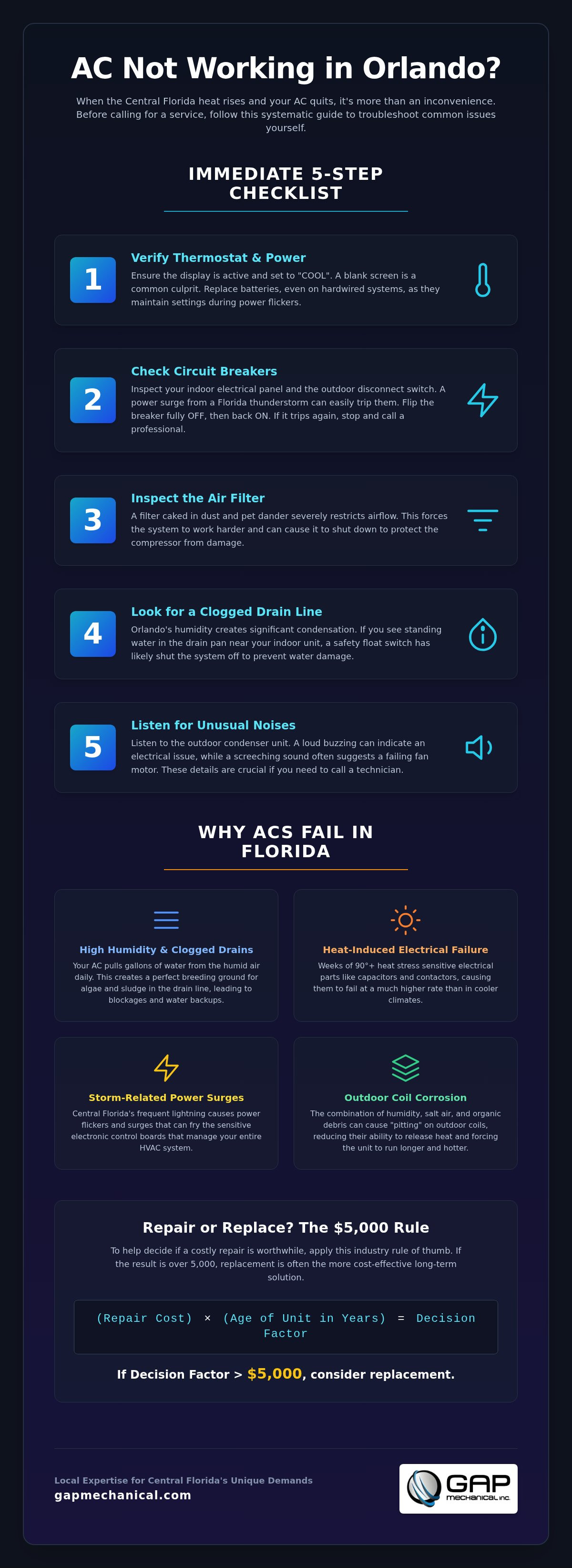
Immediate Checklist: 5 Things to Do When Your AC Stops

When the air stops moving in your home, the Central Florida heat takes over within minutes. You don't have time to wait for a technician if the fix is something you can handle yourself. Before you panic, follow this prioritized order of operations to troubleshoot AC not working Orlando issues. Many emergency calls are actually caused by simple power or airflow obstructions that take only moments to resolve.

  • Verify the thermostat and power: Ensure the display is active and set to the correct mode. A blank screen or an incorrect setting is the most common culprit.
  • Check your circuit breakers: Inspect both the indoor electrical panel and the outdoor disconnect switch. A power surge during a typical afternoon thunderstorm can easily trip these safety switches.
  • Inspect the air filter: A filter caked in dust and pet dander restricts airflow. This forces the system to work harder until it eventually shuts down to protect the compressor.
  • Look for water in the drain pan: Orlando's high humidity creates significant condensation. If you see standing water around your indoor unit, a safety float switch has likely triggered to prevent water damage.
  • Listen for unusual noises: Go outside and stand near the condenser. A loud buzzing often indicates an electrical issue, while a screeching sound suggests a failing fan motor.

Understanding how HVAC systems work helps you identify these signs quickly. By following this sequence, you can provide a technician with specific details if a professional repair becomes necessary.

Checking Your Power Supply

Locate your main electrical panel, usually found in the garage or on an exterior wall. A tripped breaker won't always be flipped completely to the "off" position; it may look like it's slightly out of alignment. Flip the HVAC breaker fully to off, then back to on. We recommend the one-time reset rule. If the breaker trips again immediately, stop. This indicates a serious electrical fault that requires professional attention to avoid a fire hazard. Don't forget to check the outdoor disconnect switch located in a small box near your condenser unit to ensure it hasn't been pulled or switched off.

Thermostat Basics for Orlando Homeowners

Extreme heat can sometimes glitch digital controls. Ensure your thermostat is firmly set to "Cool" and the fan is on "Auto" rather than "On" to manage humidity effectively. If the screen is blank, replace the batteries immediately. Even systems that are hardwired into your home's electricity often use batteries to maintain settings during a power flicker. If you're unsure about your unit's settings or compatibility, you can explore our residential services for more information. For a complete look at maintaining your system against the Florida elements, see our guide on AC Repair Orlando.

Common Causes for AC Failure in the Orlando Climate

Orlando's climate is uniquely aggressive toward HVAC systems. High humidity and relentless heat create specific failure points that homeowners in cooler regions rarely face. If you need to troubleshoot AC not working Orlando systems, you must account for how our local environment impacts mechanical components. These factors often turn minor maintenance needs into full-blown cooling emergencies.

  • Humidity and drainage: Our air is thick with moisture. Your unit pulls gallons of water from the air daily, which can lead to rapid biological growth in drain lines.
  • Heat-induced electrical failure: Capacitors are sensitive to high temperatures. When it stays above 90 degrees for weeks, these components often reach their breaking point.
  • Storm-related surges: Central Florida is the lightning capital of the country. Frequent power flickers and surges can damage the sensitive control boards that manage your cooling cycles.
  • Coil corrosion: The combination of humidity and organic debris can lead to "pitting" or corrosion on your outdoor coils. This reduces the unit's ability to release heat, forcing it to run longer and hotter.

While these issues are prevalent in Orlando, they are common in most year-round cooling markets. For example, homeowners in Southern California looking for a guide to specific brands like Carrier can find expert resources at aroundclock.com.

The Humidity Factor: Clogged Drain Lines

In Central Florida, humidity levels often exceed 70 percent. Your air conditioner acts as a powerful dehumidifier, pulling moisture from the air and funneling it into a condensate drain line. The warm, dark environment inside these pipes is a perfect breeding ground for algae and sludge. Over time, this biological buildup creates a solid blockage. When water can't flow out, it backs up into the drain pan. Most modern systems use a float switch as a safety shut-off. If this switch detects rising water, it cuts power to the system to prevent a flood in your home. You can sometimes clear these lines by using a wet/dry vac on the exterior exit point to pull the obstruction through.

Electrical Strain During Florida Summers

System failures happen most often during 95-degree afternoons. This is when the outdoor condenser unit faces the highest electrical load as it struggles to reject heat. The start and run capacitors are usually the first parts to fail under this strain. These components act like temporary batteries, providing the torque needed to start the compressor and fan. Considering the cost to repair an air conditioner, replacing a failing capacitor early is a smart investment that prevents expensive compressor damage. Check our FAQ page for common symptoms of electrical wear. If these steps don't restore your cooling, it may be time to consult a local expert who understands the specific demands of the Orlando heat.

Advanced DIY Troubleshooting: When the Basics Are Not Enough

If the power is on but your home still feels like a sauna, it's time to look deeper into the system's physical state. To effectively troubleshoot AC not working Orlando units, you must move beyond the thermostat and examine the internal components for signs of mechanical distress. These steps require patience but can often save you the cost of an emergency dispatch if the issue is a simple physical obstruction.

Managing a Frozen AC Unit

Ice formation on your indoor evaporator coil is a sign of a serious airflow or refrigerant issue. If you see frost on the copper lines or notice a significant drop in airflow, you must act immediately to prevent compressor failure. Turn the system to "Off" at the thermostat and switch the fan setting to "On." This allows the indoor blower to circulate room-temperature air over the ice, melting it gradually.

Avoid the temptation to pick or scrape at the ice. The aluminum fins on your coil are extremely delicate and easily damaged. A single layer of dust on a dirty filter is often the primary cause of ice formation; it restricts air movement enough to let the coil temperature drop below the freezing point. Wait at least three to four hours for a full defrost before attempting to restart the cooling cycle.

Outdoor Unit Inspection

Your outdoor condenser unit needs to breathe to release the heat it pulls from your home. In the lush Orlando landscape, vegetation can quickly overtake the unit. Ensure there is at least a two-foot clearance around all sides of the equipment. If the metal fins are "blanketed" with pollen, dust, or grass clippings, the system can't transfer heat effectively, leading to a total shutdown.

While you're outside, inspect the visible wiring. Central Florida's wildlife, including squirrels and lizards, can sometimes chew through the low-voltage wires or nest inside the electrical compartment. A severed wire is a common reason for a system that has power but won't kick on. If your attempt to troubleshoot AC not working Orlando systems uncovers chewed wires, don't attempt to tape them yourself. Electrical issues like these require a professional to ensure the connection is safe and weather-tight.

Ductwork and System Resets

If you have safe access to your attic or crawlspace, perform a visual sweep of the ductwork. Look for large disconnects or tears where cold air might be escaping into unconditioned spaces. Finally, try a full system reset. Turn off the AC at the thermostat and flip the dedicated service switch near the indoor unit to "Off." Wait 60 seconds before restoring power. This allows the control board to clear temporary logic errors that might be preventing a start-up.

Troubleshoot AC not working Orlando

AC Repair vs. Replacement: Making the Call in 2026

Deciding whether to sink money into a repair or invest in a new system is a high-stakes choice during an Orlando summer. Even after you attempt to troubleshoot AC not working Orlando issues, you might find a component failure that costs thousands to fix. In 2026, the decision involves more than just the immediate bill. You must account for rising refrigerant costs and new efficiency standards that drastically change the long-term return on investment.

A reliable industry benchmark we use is the "5,000 Rule." You multiply the age of your unit by the quoted repair cost. If the total exceeds $5,000, replacement is usually the more stable financial path. For example, a $600 repair on a 10-year-old unit equals $6,000, suggesting your money is better spent on an upgrade. Additionally, systems using R-410A refrigerant are becoming increasingly expensive to service as that gas is phased down. If your older unit has a leak, the cost of the refrigerant alone could make the repair illogical compared to a new system using modern R-454B.

The Age Factor in Central Florida

Air conditioners in Orlando work twice as hard as those in northern states. While a unit in Ohio might last 20 years, a Central Florida system is often nearing the end of its reliable life by year 10 or 12. Constant operation and high humidity lead to accelerated wear on the compressor and fan motors. If your system requires more than two non-routine repairs in a single season, it's likely becoming a money pit. You can learn more about choosing the right hardware for our region in our guide to AC Installation in Winter Park.

Efficiency and Long-Term Savings

Modern units must meet a minimum efficiency of 15.2 SEER2 in Florida as of 2026. Upgrading from an old 10-SEER unit can reduce your cooling-related electricity costs significantly. These new systems aren't just about lower bills; they offer superior humidity control. Variable-speed compressors run at lower speeds for longer periods, which pulls more moisture out of your indoor air than older, single-stage units. This prevents that "clammy" feeling often found in older Florida homes. We offer flexible HVAC financing options to help homeowners move toward these high-efficiency standards without the stress of a large upfront payment. If you're tired of throwing money at a failing unit, request a transparent replacement quote today.

Why Orlando Trusts GAP Mechanical for Fast AC Recovery

Attempting to troubleshoot AC not working Orlando units is a proactive way to manage your home's comfort. However, when the systematic checks we've discussed don't restore your cooling, you need a steady hand you can trust. GAP Mechanical has served Central Florida for over 25 years. We've navigated the unique challenges of our region, from the corrosive humidity of the coast to the extreme heat of the inland suburbs. Our experience ensures that we identify the root cause of your failure quickly, preventing unnecessary parts replacement and saving you time.

  • Transparency in pricing: We provide upfront costs with no hidden fees. You'll know exactly what the repair requires before we begin.
  • Proven reliability: Our family-owned business maintains a 4.9-star Google rating. This reflects our commitment to honest, high-quality workmanship.
  • Local specialization: We understand Central Florida building codes and the specific engineering required for homes in Orlando, Winter Park, and Apopka.
  • Military support: We take pride in our community. We offer dedicated discounts for local veterans and active-duty military personnel.

The GAP Mechanical Difference

Choosing a licensed and insured HVAC contractor is vital for protecting your property. We don't just fix a symptom; we ensure your entire system is stable for the long term. Our technicians are factory-trained to handle the complex electrical components and high-pressure refrigerants found in modern units. For local business owners, we also provide specialized commercial HVAC services. We understand that a cooling failure in a commercial space can lead to lost revenue and inventory. We bring the same level of discipline and technical expertise to every job, regardless of the size.

Schedule Your Orlando AC Service Today

Don't let a minor fault turn into a permanent system failure. We handle all major brands and models, ensuring your equipment operates at peak efficiency. If your DIY troubleshooting has reached its limit, it's time for professional intervention. We prioritize clear communication and technical accuracy in every service call. Contact GAP Mechanical for reliable AC repair and restore the comfort of your home today. Our team is ready to provide the dependable service that has made us a pillar of the Orlando community for over two decades.

Taking Control of Your Home Comfort

Managing a sudden cooling failure requires a calm, methodical approach. By following this guide, you now have the practical tools to troubleshoot AC not working Orlando systems, from verifying electrical resets to identifying frozen coils. You also understand when the mechanical complexity or safety risks mean it's time to stop and call for professional assistance. Whether your system needs a minor component fix or a full high-efficiency upgrade to meet 2026 standards, making an informed decision is the only way to ensure long-term stability in the Florida heat.

GAP Mechanical brings over 25 years of local experience and a 4.9-star Google rating to every home we visit. As a licensed and insured professional team, we prioritize technical accuracy and transparent pricing over high-pressure sales. Don't let the oppressive humidity compromise your family's health or your peace of mind. Restore your comfort today; Schedule your Orlando AC repair with GAP Mechanical. You've done the hard work of investigating the problem. Now, let us provide the steady hand and permanent solution you deserve.

Frequently Asked Questions

Why is my AC running but the house isn’t getting cooler?

This issue often stems from a dirty evaporator coil or a failing capacitor that lets the fan spin but prevents the compressor from engaging. In Central Florida, a severely clogged air filter can also restrict airflow enough to stop the cooling process entirely. Check your filter first. If the air coming from the vents is still lukewarm, the system likely has a refrigerant leak or a mechanical failure that requires professional gauges to diagnose.

How long does an AC unit typically last in Orlando, Florida?

The average lifespan for a residential system in Orlando is 10 to 12 years. Our extreme humidity and nearly year-round cooling demands put significantly more strain on components than in northern climates. While regular maintenance can sometimes extend a unit's life to 15 years, most homeowners notice a sharp decline in efficiency and reliability after a decade of service in the Florida heat.

Is it worth repairing a 12-year-old air conditioner?

Rarely. A 12-year-old system in our region is already at the end of its projected life cycle. Major repairs like a compressor replacement or a new evaporator coil can cost thousands. When you apply the "5,000 Rule," the math usually favors replacement. Modern SEER2 units offer much better humidity control and lower monthly power bills, making them a more stable long-term investment than fixing an obsolete unit.

Can I pour bleach down my AC drain line to clear a clog?

We don't recommend using bleach because it is corrosive and can damage the plastic PVC pipes or the metal drain pan over time. A better alternative is a mixture of warm water and white vinegar or a specialized HVAC drain cleaner. If you need to troubleshoot AC not working Orlando issues related to a backup, using a wet/dry vac on the exterior exit line is the safest way to pull through a stubborn algae clog.

What should I do if my AC is leaking water inside the house?

Turn the system off immediately at the thermostat to prevent water damage to your drywall and flooring. This leak is usually the result of a clogged primary drain line or a safety float switch that failed to trigger. Once the system is off, check the drain pan for standing water. You'll need to clear the obstruction before restarting the unit to avoid further indoor flooding and potential mold growth.

Why does my AC breaker keep tripping after I reset it?

A breaker that trips repeatedly is a warning sign of a serious electrical fault, such as a short circuit or a grounded compressor. You should never reset a breaker more than once. If it flips back to the "off" position immediately, it means the system is drawing too much current. Forcing it to run can lead to a fire or permanent motor damage. This is a common way to troubleshoot AC not working Orlando problems that require an expert's electrical diagnostic tools.

How much does a typical AC service call cost in Orlando?

Diagnostic fees in the Orlando area typically range from $79 to $250 during standard business hours. This fee covers the technician’s travel and the time required to perform a comprehensive system analysis. Keep in mind that this initial charge usually doesn't include the price of parts or the labor needed for the actual repair. Always ask for a clear breakdown of the diagnostic rate before the technician arrives at your home.

Do I need to turn off my AC if it starts making a loud screeching noise?

Yes, you must shut the unit down right away. A loud screeching sound often indicates that the bearings in your condenser fan motor are failing or that the compressor is operating under dangerously high pressure. Continuing to run the system in this state can cause the motor to seize or result in a total compressor blowout. Turning it off immediately can prevent a minor motor repair from turning into a full system replacement.

Call NowGet Quote
Air Conditioner Stopped Working in Orlando? Your Emergency Troubleshooting Checklist | GAP Mechanical