

AC Thermostat Not Working in Orlando? Troubleshooting
Published August 17, 2026
If your AC thermostat in Orlando is unresponsive, the issue is rarely just the thermostat itself; it is often caused by power interruptions, environmental stress, or complex wiring failures within the HVAC system. To restore cooling, you must first systematically diagnose whether the problem lies with the thermostat, the control board, or the electrical service feeding your unit.
Understanding the Climate Impact on Thermostat Performance in Central Florida
Central Florida presents unique challenges for residential HVAC systems, far beyond just the high summer temperatures. Our region is defined by relentless humidity, sudden afternoon thunderstorms, and the persistent threat of tropical weather events. These conditions place tremendous strain on all electrical components in a home, and the thermostat—the "brain" of your cooling system—is highly susceptible to these environmental stressors.
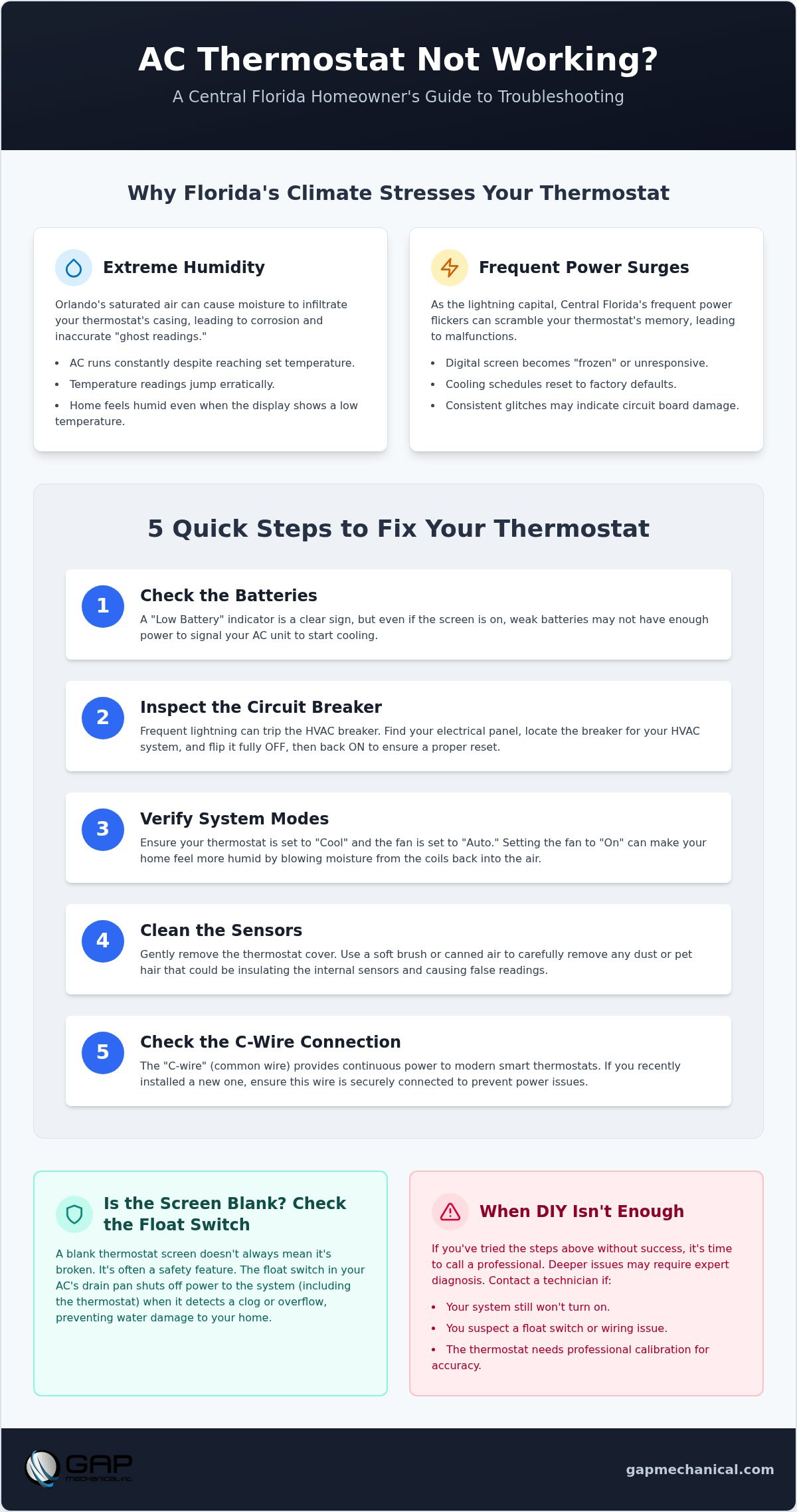
For residents in areas like Winter Park, Lake Nona, or even older neighborhoods throughout Orlando, the combination of extreme heat (90°+ summer days) and high moisture levels can lead to premature component failure. Humidity doesn't just make things feel hotter; it can cause condensation, corrosion, and electrical shorts within wall cavities and control boards. When your AC thermostat isn't working, you must consider if it is malfunctioning due to a simple battery issue, or if it is failing due to moisture infiltration or voltage fluctuation caused by a nearby electrical surge.
Ignoring subtle signs of thermostat trouble can lead to inefficient operation, higher energy usage, and eventual complete system failure. Proper diagnosis requires looking at the entire loop, not just the faceplate of the thermostat itself.
Phase One: Simple User-Level Troubleshooting Checks
Before assuming a major system failure, always begin with the simplest, most accessible checks. These steps often resolve the issue without needing a specialized technician. However, these initial checks are designed to rule out easy fixes so that subsequent, more detailed diagnostics can proceed accurately.
1. Power and Battery Inspection
The most common cause of a non-responsive thermostat is a power supply failure. Even if the unit is hardwired, many modern thermostats utilize batteries for backup or auxiliary functions. Always check the batteries first.
- Replace batteries with fresh, high-quality alkaline batteries, even if you believe the current ones have charge remaining.
- Ensure the thermostat is seated firmly on its mounting plate, making sure no wires have become loose during a recent vibration or storm.
2. Inspect the Circuit Breaker
If you have hardwired thermostat power, the issue may be upstream. Locate your home's main electrical panel and find the breaker assigned to your HVAC system. Sometimes, a surge or overload can trip this breaker, cutting power to the entire cooling system, including the thermostat.
- Visually inspect the breaker to ensure it is in the "ON" position.
- If it is tripped, do not simply flip it back on immediately. Turn it completely off first, wait 30 seconds, and then flip it back to the ON position.
3. Check the System Switch
Many homes have a dedicated switch near the furnace or air handler that controls power to the HVAC unit. Ensure this switch has not been accidentally flipped to the "OFF" position, especially if maintenance was recently performed.
Phase Two: Diagnosing Deeper Electrical Failures
If the simple checks above do not resolve the issue, the problem has moved beyond the thermostat’s immediate power source. The fault is likely rooted in the communication between the thermostat and the main HVAC unit, or within the control components themselves. This requires careful inspection of the wiring and internal components.
The Role of the C-Wire (Common Wire)
One of the most frequent, yet often overlooked, causes of thermostat failure is the lack of a continuous power source, known as the C-wire. Many older or simpler thermostat installations only utilize the R (power) and W (heat) wires. Modern, smart, or complex systems require a dedicated C-wire to provide continuous 24-volt power to the thermostat. If this wire is missing, disconnected, or damaged—perhaps pulled loose behind the wall during a renovation—the thermostat may appear dead or behave erratically.
- Locate your thermostat's wiring terminal plate.
- Verify that all wires are securely fastened and that a C-wire is present and connected.
- If the wiring is complex or if you suspect a missing wire, professional diagnostic tools are required to trace the correct power path.
Internal Component Failure
Even if power reaches the thermostat, the internal components—such as the circuit board or the display screen—can fail due to age or environmental stress. In Central Florida’s humid climate, internal corrosion is a serious possibility. If the unit powers on but the screen is blank, or if the unit powers on but the A/C does not engage, the control board is a primary suspect.
- Look for any signs of physical damage to the thermostat housing.
- Check if the unit is experiencing unusual buzzing or clicking sounds when power is applied, which may indicate a failing relay or capacitor.
Phase Three: When to Transition to Professional Service
While basic troubleshooting is an essential first step, certain symptoms or complexities signal that the issue requires professional intervention. These are not simple fixes; they require specific knowledge of low-voltage electrical systems and high-voltage HVAC components.
Signs Requiring Expert Attention
If you encounter any of the following, stop troubleshooting and call a licensed expert. Attempting advanced diagnostics without proper training can lead to electrical hazards or further damage to your equipment.
- Tripped Breakers or Fuses: If the HVAC breaker keeps tripping even after ensuring the thermostat is off, there is a severe electrical fault in the system that must be addressed by a licensed technician.
- Visible Water or Corrosion: If you notice condensation, water pooling near the thermostat, or significant signs of rust on the wiring or control panel, the system integrity is compromised and needs immediate assessment.
- Complex Wiring Diagrams: If your system uses multiple control boards, zone dampers, or specialized wiring that you cannot easily trace, a professional with the necessary diagnostic tools is essential.
At GAP Mechanical, we understand the intricacies of HVAC systems in the Orlando area. As a licensed entity (CAC 1813597) and EPA-certified professionals, we have navigated the unique electrical challenges presented by Central Florida homes since 2003. We can provide expert guidance through the entire diagnostic process, ensuring the root cause of your AC thermostat issue is found and resolved safely.
If your AC thermostat is not working in Orlando, our team is equipped to handle the complexities of both basic repairs and advanced component replacements. We prioritize thoroughness, using our extensive experience and 4.9 Google rating to ensure every diagnostic step is precise. For a comprehensive review of these potential failures, we recommend reviewing our guide on AC Repair Orlando: Professional Troubleshooting and Service Checklist.
Long-Term Prevention: Keeping Your Orlando HVAC System Healthy
Once your system is running optimally, proactive maintenance is the best defense against future thermostat failures, especially in a climate as demanding as ours. Regular care minimizes the stress on electrical components and ensures peak performance during the hottest months.
Annual System Tune-Ups
Schedule a full HVAC tune-up every spring. A professional maintenance visit goes beyond simply changing filters; it involves checking the voltage across all terminals, inspecting the control board for signs of stress, and ensuring the wiring insulation is intact and free of moisture damage. This preventative care catches minor issues before they escalate into full system outages.
Filter Maintenance
A clogged air filter forces the system to work harder, placing undue strain on the compressor and the control board. In the high-humidity environment of Orlando, dust and mold can accumulate quickly, necessitating very frequent filter changes.
Seal Your Home
While this doesn't directly affect the thermostat, improving the overall air seal and insulation of your home reduces the load on the AC unit. Less strain means fewer electrical spikes and less constant demand placed on the thermostat and control systems.
Frequently Asked Questions
Q: Can humidity cause my thermostat to fail?
Yes. High humidity in Central Florida can lead to condensation and corrosion inside the thermostat housing or within the wall wiring. This corrosion can create electrical resistance or short circuits, causing the unit to malfunction or fail completely.
Q: Is it always a wiring issue when the AC thermostat is not working in Orlando?
No. While wiring and C-wire issues are very common, the failure could also be the thermostat's internal control board, a tripped circuit breaker, or a failed power supply to the unit. A professional diagnosis is required to isolate the exact component failure.
Q: How often should I have my HVAC system checked in Orlando?
It is highly recommended to have a professional tune-up annually, ideally before the cooling season begins. This proactive maintenance ensures that the system is operating efficiently and that electrical components are functioning correctly before the extreme heat sets in.
Q: Should I replace my thermostat if it is old, even if it seems to work?
If your thermostat is more than a decade old, it may be nearing the end of its operational life. Older units are more prone to failure, and replacing it with a modern, energy-efficient model can provide improved reliability and better climate control for your home.
Frequently Asked Questions
Why Choose a Licensed Orlando HVAC Contractor?
The risks of improper thermostat wiring are significant. A single crossed wire can blow the main control board in your furnace or air handler. This turns a simple repair into an significant replacement. Choosing a licensed contractor protects your asset and ensures all work meets the current Florida Building Code. We are proud of our 4.9-star reputation for solving complex cooling issues across Orlando and Winter Park. For a more detailed look at what our technicians inspect during a visit, read our AC Repair Orlando: Professional Troubleshooting and Service Checklist. This resource provides transparency into our methodology and high standards of service.
Why is my thermostat screen blank even after changing the batteries?
Your thermostat screen remains blank when the power source is interrupted beyond the batteries. Check your electrical panel for a tripped breaker labeled for the HVAC system. If the breaker is fine, the issue might be a blown 3-amp or 5-amp fuse on the air handler's control board. This often happens after a momentary power flicker during a typical Orlando afternoon thunderstorm.
Can a bad thermostat cause my AC to run constantly in Orlando?
A faulty thermostat can cause constant running if the internal sensor is uncalibrated or stuck. In Florida, "heat-soak" from an uninsulated wall can make the device believe the room is hotter than it actually is. This prevents the system from reaching the set point. If your AC thermostat not working Orlando residents might notice the compressor never cycles off, leading to high humidity.
How do I know if my thermostat or my AC unit is the problem?
You can test the connection by switching the fan setting from "Auto" to "On." If the blower motor starts immediately, the thermostat is successfully communicating with the indoor unit. However, if the fan works but the outdoor condenser fails to kick in, the problem is likely a capacitor or contactor in the AC unit itself. A professional diagnostic is the safest way to isolate these faults.
Is it worth upgrading to a smart thermostat in Florida?
Upgrading is highly beneficial due to the potential for 10-15% savings on cooling considerations. Modern units offer advanced humidity management, which is vital for preventing mold in Central Florida homes. Duke Energy and OUC often provide rebates of up to $75 for these upgrades. These devices allow you to monitor your home remotely during hurricane season, providing an extra layer of security and peace of mind.
Why does my thermostat say it is 75 degrees when it feels much hotter?
High indoor humidity often makes 75 degrees feel like 80 degrees or higher. If your thermostat lacks a hygrometer, it won't account for the moisture in the air. Additionally, if the unit is mounted near a heat source or a drafty window, the reading will be inaccurate. Proper calibration ensures the device "feels" the same temperature you do, preventing discomfort and unnecessary system strain during the summer.
What is the best thermostat setting for Orlando summers to save money?
The Florida Building Code and local utilities recommend setting your thermostat to 78°F while you are home. For every degree you raise the temperature above this point, you can save roughly 6-8% on your cooling considerations. When you are away, avoid turning the system off entirely. Keeping it at 82°F ensures the AC continues to pull humidity from the air, protecting your home from moisture damage.
Can a power surge in Orlando damage my thermostat?
Lightning strikes and power surges are common in the Orlando area and can easily fry the delicate circuit board inside a digital thermostat. A surge can cause the screen to freeze, lose its programming, or stop sending signals to the condenser. Installing a dedicated surge protector for your HVAC system is the best way to prevent these sudden failures and protect your significant cooling equipment from electrical damage.
How often should I have my thermostat calibrated by a professional?
You should have your thermostat checked and calibrated once a year during your standard maintenance visit. Over time, dust accumulation and electrical drift can cause the sensors to lose accuracy. A professional technician will verify that the temperature reading matches a certified thermometer. This ensures your system runs efficiently throughout the peak heat of an Orlando summer without wasting electricity on inaccurate "ghost" readings.