

AC Repair Orlando: Professional Service Guide
Published August 7, 2026
When your air conditioning system in Orlando begins to underperform, the process of AC repair Orlando starts with systematic troubleshooting to pinpoint the exact failure. Professionals approach this issue not with guesswork, but by methodically inspecting the entire system—from simple electrical faults to complex refrigerant leaks—to ensure a long-term fix that can withstand Central Florida’s intense heat and humidity.
Why AC Systems in Orlando Struggle
Living in Central Florida means living with a unique set of environmental challenges that put constant stress on your home's HVAC unit. Unlike climates where the primary concern is extreme cold, Orlando homeowners battle relentless humidity, soaring summer temperatures often exceeding 90 degrees, and sudden, intense afternoon thunderstorms. These factors don't just make the AC work harder; they cause components to age faster and push systems past their operational limits.
In neighborhoods like Winter Park, Lake Nona, or even older, established communities in Kissimmee, the combination of high moisture content and continuous thermal load creates a perfect storm for HVAC issues. The system isn't just fighting the temperature; it’s fighting the saturation of the air, which requires far more energy and puts greater strain on the compressor and evaporator coils.
The most common culprit in this environment is often moisture-related. Condensation buildup, clogged drainage lines, and high humidity can lead to inefficient cooling, ice formation on the coils, and eventually, complete system failure. Understanding how the climate impacts your unit is the first step in understanding why the unit might be acting up.
Initial Owner Troubleshooting: What You Can Check Today
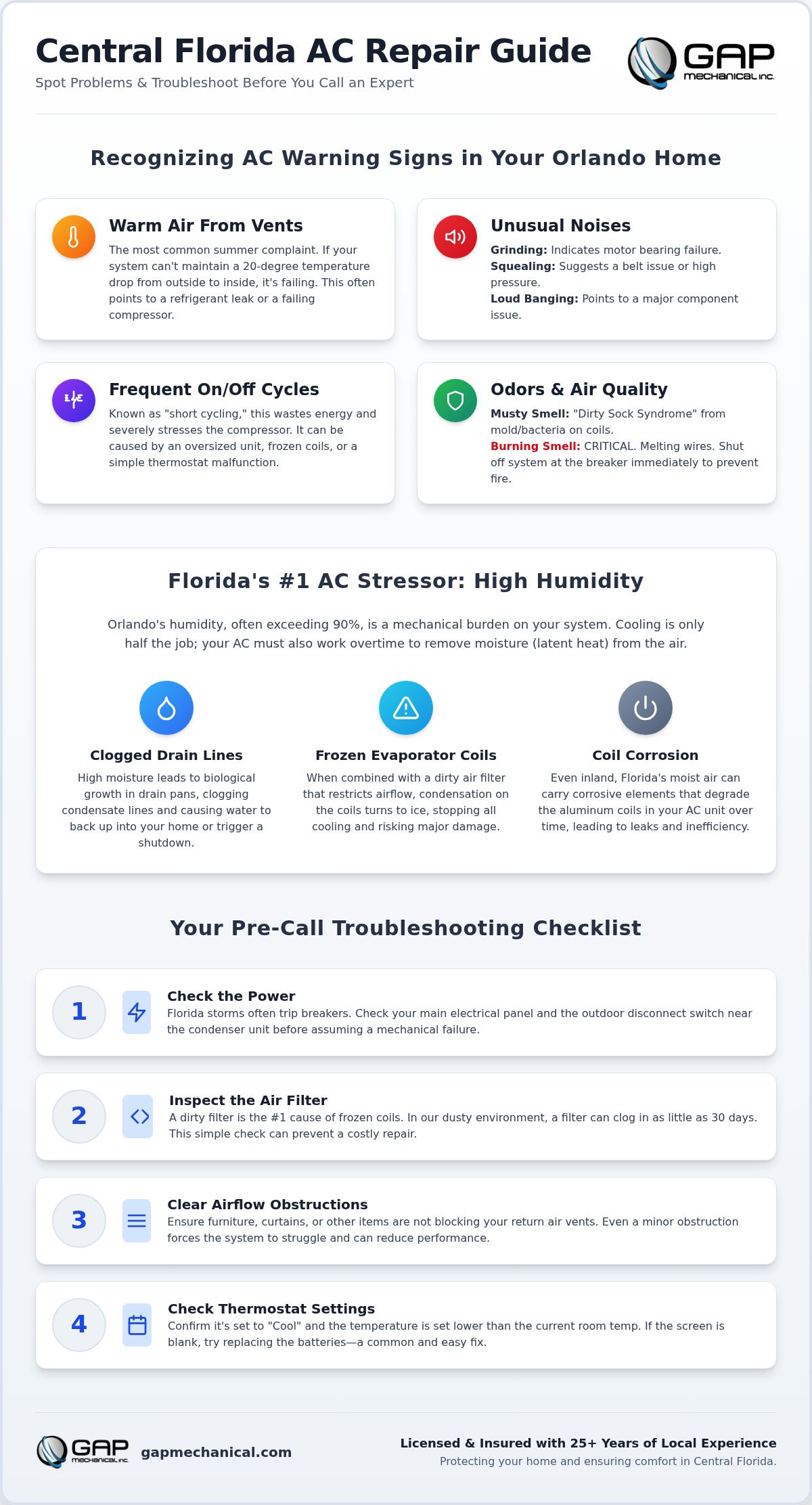
Before assuming a major component has failed, there are several simple, non-invasive checks that every homeowner can perform. These initial steps often solve minor performance dips and can prevent an unnecessary service call. Think of these steps as the preliminary data collection phase before a professional diagnosis.
Before you do anything, ensure the power is stable. Fluctuations in power quality are common in older sections of Orlando and can confuse the unit's control board. Always check the obvious exterior and interior elements first.
Here are the initial checks you can perform on your system:
- Check the Thermostat Settings: Ensure the thermostat is set to "Cool" and not "Heat," and that the fan mode is set to "Auto" or "On," depending on your needs.
- Examine Airflow Vents: Walk through your home and ensure all supply vents are open and unobstructed by furniture or rugs. Blocked vents severely restrict airflow, causing the unit to overheat and lose efficiency.
- Inspect the Air Filter: This is perhaps the most crucial step. A clogged filter acts like a blanket, choking the system and making the unit work exponentially harder. If the filter looks gray or heavily coated, replace it immediately.
- Look at the Condensate Drain Line: Check the exterior drain line for visible clogs or blockages. If water is pooling near the outdoor unit, the drainage system may be compromised.
If these simple checks do not restore proper function, it indicates that the issue lies deeper within the mechanical components, requiring specialized tools and expertise. This is where professional troubleshooting becomes essential.
The Professional Diagnostic Process of AC Repair Orlando
When you call for AC repair Orlando, you are engaging a professional who follows a structured, scientific process, not a random set of fixes. A qualified technician will treat your unit like a complex machine that requires a detailed audit. They begin with a comprehensive assessment to identify the root cause, not just the symptom.
A professional technician will not simply replace the first part they suspect. They will employ electrical meters, pressure gauges, and specialized thermal cameras to gather definitive evidence of the failure. This methodical approach ensures that the repair is comprehensive and durable.
The initial diagnostic phase involves several key steps that a technician must perform. These steps go far beyond what can be checked by the average homeowner:
- Electrical Load Testing: Measuring voltage and amperage across all circuits (compressor, fan motors, etc.) to detect electrical resistance or shorts.
- System Pressure Readings: Testing the refrigerant pressures (high side and low side) to determine if the system is leaking, overcharged, or functioning within optimal limits.
- Component Testing: Specifically testing the capacitors, relays, and contactors that initiate the electrical flow to the major components.
- Airflow Measurement (BTU Audit): Measuring the actual cooling output (BTU/hr) relative to the heat load of the space to ensure the unit is performing according to its specifications.
To fully understand the scope of a repair and the necessary steps for your specific system, it is highly recommended that homeowners review a detailed guide on AC Repair Orlando: Professional Troubleshooting and Service Checklist. This resource outlines the exact methodical steps taken by experienced professionals.
Common Failure Points and What They Mean
While the diagnosis is highly specific to your unit, certain components are statistically more prone to failure, especially given the demanding environment of Central Florida. Knowing these common failure points helps you understand the nature of the repair.
The Compressor: This is the heart of your system. It pumps the refrigerant. If it fails, the unit will generally not cool, and you might hear loud noises or feel the unit shutting down abruptly. High heat and age are the main adversaries here.
The Capacitor: This component provides the necessary burst of electricity to start the compressor and fan motors. If it fails, the unit may hum but won't start, or it might start and then immediately shut off. Capacitors are consumable items that degrade over time, regardless of how well the unit is maintained.
Refrigerant Leaks: Refrigerant is the substance that absorbs heat and moves it out of your home. Leaks are often microscopic and difficult to find, but they are the primary cause of low cooling performance. Once a leak occurs, the system will not maintain the necessary pressure to cool effectively, regardless of how healthy the compressor is.
Drainage Issues: As mentioned, the high humidity in areas like Orlando can overwhelm standard drainage. Clogged condensate lines can cause the unit to shut down automatically to prevent water damage, leading to intermittent cooling cycles.
When a technician identifies these issues, they will not just fix the symptom (e.g., replacing a noisy compressor); they will determine if the underlying cause (e.g., electrical overload, poor airflow, or refrigerant leak) needs to be addressed to prevent immediate reoccurrence.
Long-Term Health of Your System: Proactive Care
The best defense against AC failure is proactive maintenance. In Central Florida, relying on your system only when it breaks down is a reactive strategy that often leads to more severe, costly issues. A proactive approach focuses on extending the lifespan of your equipment and maintaining peak performance throughout the brutal summer months.
Regular maintenance ensures that the system operates at its designed efficiency, which not only keeps your home comfortable but also reduces the overall strain on the components. This is especially true for homes built in older parts of Orlando where insulation and ductwork may have deteriorated over decades.
Proper seasonal tune-ups address issues before they become emergencies. A technician can perform deep diagnostics, clean coils, check refrigerant levels, and ensure the electrical connections are sound, all before the heat index hits its peak.
To make informed decisions about your maintenance schedule and service needs, it is crucial to understand the questions that should be guiding your search for reliable service. Reviewing Questions to Ask an HVAC Contractor in Orlando provides an essential framework for evaluating potential service providers.
Ultimately, the goal of professional AC repair Orlando is not just to get the unit working again, but to optimize its performance for the challenging Central Florida climate, ensuring maximum comfort and longevity for your asset.
Frequently Asked Questions
How long should my AC last in Orlando’s heat?
The lifespan of an AC system is heavily dependent on its maintenance history and the quality of the installation. With the high operational demands of Central Florida's climate, diligent regular maintenance is required to maximize the system's operational life.
What is the difference between a clogged filter and a blocked vent?
A clogged filter blocks the air as it enters the system, restricting airflow across the evaporator coils. A blocked vent blocks the air as it exits the system into your home, preventing the cooled air from reaching the living spaces.
When should I call a professional for AC repair Orlando?
You should call a professional when the system exhibits signs beyond simple filter clogging, such as strange noises, visible ice buildup on the lines, a significant drop in airflow despite a clean filter, or if the unit shuts down unexpectedly.
Can high humidity cause my AC to fail?
Yes, high humidity forces the AC to work much harder to dehumidify the air, increasing the strain on the compressor and other components, which accelerates wear and tear and can lead to system failure if maintenance is neglected.
Frequently Asked Questions
How much does AC repair typically consideration in Orlando?
The total consideration for a repair depends on the complexity of the component failure and the specific type of refrigerant your system uses. Minor issues like a clogged drain line or a faulty capacitor are less significant than major mechanical failures involving the compressor or evaporator coils. We provide a transparent, written estimate after the diagnostic phase so you understand the scope of work before any repairs begin.
How long does a standard AC repair service call take?
Most standard service calls are completed within 60 to 90 minutes once the technician is on-site. This timeframe includes the initial diagnostic testing and the replacement of common electrical components like contactors or fan motors. More complex scenarios, such as detecting microscopic refrigerant leaks or performing deep coil cleanings, may require several hours to ensure the system is restored to peak efficiency.
Is it better to repair or replace my air conditioner in Florida?
We recommend using the "5,000 rule" to determine if a replacement is a better asset than a repair. Multiply the age of your unit by the estimated repair consideration; if the total exceeds $5,000, a new system is usually the more efficient choice. Given Florida's extreme heat, upgrading to a modern SEER2 compliant unit can also significantly reduce your monthly operational considerations compared to keeping an aging, inefficient system.
Can I run my AC if it is making a loud banging noise?
You should shut your system off immediately if you hear loud banging or metal-on-metal grinding sounds. These noises typically indicate that a mechanical part has come loose, such as a blower fan blade or a compressor mount. Continuing to operate the unit in this condition can lead to catastrophic damage to other significant components, turning a simple repair into a total system failure.
Why is my AC running but the house is not getting cooler?
This issue is often caused by a frozen evaporator coil or a refrigerant leak that prevents the system from absorbing heat effectively. When the airflow is restricted by a dirty filter or low refrigerant levels, the air coming from your vents will feel room-temperature rather than cold. Check your air filter first. If the filter is clean and the house remains warm, a professional diagnostic is required to find the underlying mechanical fault.
What is the most common reason for AC failure in Central Florida?
Clogged condensate drain lines are the leading cause of unexpected system shutdowns in our region. High humidity levels lead to rapid biological growth in the drain pan, which eventually blocks the line and triggers the safety float switch. This switch is designed to cut power to the unit to prevent water damage to your home. Regular maintenance and drain line flushing are the best ways to prevent this common failure.
Does GAP Mechanical offer emergency AC repair in Winter Park?
We provide prompt residential AC repair Orlando and Winter Park homeowners can depend on during our standard business hours. While we don't offer 24/7 emergency service, our 25 years of local experience allows us to prioritize urgent cooling failures for our neighbors. We focus on fast restoration of cooling and transparent details to ensure your home remains livable during the most intense summer months.
How can I lower my Orlando energy bills through AC repair?
Professional AC repair Orlando services can lower your energy bills by 5% to 15% by restoring the system's mechanical efficiency. When components like the capacitor or fan motor are failing, the system must work harder and run longer to reach your desired temperature. Fixing small refrigerant leaks and ensuring your thermostat is properly calibrated reduces the load on your compressor, which directly impacts your monthly utility considerations.