

How to Check an HVAC License in Florida
Published July 23, 2026
To verify an HVAC contractor's license in Florida, you must consult the Florida Department of Business and Professional Regulation (DBPR) registry, ensuring the contractor holds the proper state-issued certifications for the specific work required. A licensed professional ensures that installations and repairs meet stringent state safety standards, which is especially critical when dealing with the high humidity and intense heat of Central Florida.
The Critical Importance of Certified HVAC Professionals in Central Florida
Living in Central Florida means navigating a unique set of environmental challenges that put immense strain on your home’s climate control system. We aren't just dealing with standard seasonal changes; we are contending with sustained, oppressive heat that frequently pushes past 90 degrees, coupled with intense humidity. When the air feels heavy and stagnant, your HVAC system is working overtime, and the stakes for professional installation and repair are incredibly high.
The systems used in older Orlando homes, particularly those built before modern energy codes were strictly enforced, require specialized knowledge. These older units may have complex ductwork or insulation issues that a novice would overlook. A licensed professional doesn't just fix a broken unit; they diagnose systemic issues related to moisture control, airflow efficiency, and the structural integrity of the system within your home.
When you hire an unlicensed individual, you are not just risking a faulty repair; you are risking safety, efficiency, and potential long-term damage. Improperly installed components can lead to mold growth in humid environments, inefficient energy use that spikes utility bills, or, in worst-case scenarios, electrical hazards.
The Official Process: How to Check an HVAC License in Florida
The process for verifying a contractor's credentials is straightforward, but it requires diligence. Do not rely solely on verbal assurances or pictures on a business card. You must verify the status through the official state channels.
The primary resource for verifying licenses and registrations in Florida is the Florida Department of Business and Professional Regulation (DBPR). This department oversees various trades, including HVAC, ensuring that the individuals working on your property meet the necessary educational and examination requirements.
Here is the step-by-step process for conducting an official verification:
- Identify the Service Needed: Determine exactly what type of HVAC service you require (e.g., installation, routine maintenance, emergency repair).
- Locate the Regulatory Body: Navigate to the official DBPR website.
- Search the Registry: Use the search function on the DBPR site, inputting the contractor’s full legal name or business name.
- Verify Status: Check the results for active registration, proper licensing classifications, and any noted disciplinary actions.
- Confirm Specializations: Some licenses are specialized. Ensure the license covers the specific type of work the contractor intends to perform (e.g., commercial vs. residential, or specific refrigerant handling).
This verification process is your primary defense against hiring unqualified labor. It confirms that the individual has met the legal and educational bar set by the State of Florida.
Beyond the License: Evaluating Credentials and Experience
While the state license is the legal baseline, a truly excellent HVAC professional brings additional layers of expertise that go beyond the minimum requirements. In the complex climate of Orlando, where systems are constantly battling high heat and moisture, supplemental certifications speak volumes about a contractor's commitment to best practices.
Look for specific certifications that demonstrate knowledge of environmental concerns and modern technology:
- EPA Certification: This is non-negotiable. It confirms the contractor is trained in the safe handling and disposal of refrigerants. Given the environmental regulations in Florida, this certification is a fundamental requirement for any HVAC work.
- NATE Certification: While not required by the state, National Air Conditioning and Heating Technicians (NATE) certification is an industry benchmark. It indicates a contractor has passed rigorous examinations in various aspects of HVAC technology and best practices.
- Manufacturer Training: High-end or complex systems often require specific training from the manufacturer (e.g., Carrier, Trane). This shows the contractor can handle advanced diagnostics and proprietary equipment.
Furthermore, check the company's history. A long-standing reputation in the Orlando area suggests they have weathered various Central Florida seasons—from sweltering July afternoons to the unpredictable storms and potential hurricane prep needs of the region. A proven track record in communities like Dr. Phillips, Winter Park, or Kissimmee is valuable insight into their local competence.
Red Flags to Watch For When Hiring HVAC Help in Orlando
The HVAC industry, like any service industry, has its share of unqualified individuals looking to capitalize on the desperate need for cool air. Being proactive in your research is the best way to protect your home and your finances. If a situation feels rushed, overly complicated, or too good to be true, it likely is.
Be wary of the following red flags:
- Lack of Documentation: If the contractor refuses to provide proof of licensing or insurance upon request, walk away. This is the single biggest warning sign.
- High-Pressure Sales Tactics: Reputable professionals allow you time to consider the scope of work. If they push for an immediate, comprehensive overhaul without a proper diagnostic assessment, they may be pushing unnecessary services.
- Unclear Scope of Work: A genuine estimate should be detailed, outlining exactly what is being replaced, what is being installed, and what the expected outcome is.
- No Local Presence: While some companies operate remotely, a true local expert understands the specific architectural challenges and climate demands of the Orlando area.
When you are evaluating multiple options, remember that the initial consultation is purely informational. You should feel empowered to ask detailed questions about the process and the specific credentials of the team you are considering. For a comprehensive guide on what to expect during the hiring process, you can review the information found in our guide on Questions to Ask an HVAC Contractor in Orlando.
Preparing Your Home for Central Florida's Unique HVAC Challenges
An HVAC system is only as good as the home it is supporting. In Central Florida, the primary enemies of a healthy home are humidity and poor air circulation. Simply having a licensed unit installed is not enough; the entire system—ductwork, vents, insulation, and air handlers—must be optimized for moisture management.
Consider these points when having an inspection or service performed:
- Ductwork Integrity: In high humidity, leaky or poorly sealed ductwork can allow massive amounts of conditioned air to escape, while simultaneously drawing unconditioned, humid air into the vents. Look for contractors who prioritize sealing and insulation.
- Addressing Older Home Issues: Older homes, especially those in neighborhoods that were built before modern humidity controls were a factor, often require more sophisticated dehumidification strategies integrated into the HVAC system.
- Storm Resilience: Given the risk of severe weather and potential hurricanes, a thorough inspection should also address the exterior components, ensuring that condensers and outdoor units are placed and secured to withstand extreme conditions.
Proactive maintenance, performed by a professional who understands the local climate, transforms your HVAC system from a reactive repair service into a reliable climate control asset, safeguarding your comfort and your property asset.
Frequently Asked Questions
Q: Is it necessary to check the license every single time I call for service?
A: While you don't need to check the license for every minor maintenance call, it is highly recommended that you confirm the contractor’s active registration and insurance status before any significant repair or installation begins. This protects you from issues related to unqualified labor or unforeseen liability.
Q: How long should an HVAC contractor's license be valid in Florida?
A: HVAC licenses in Florida generally require periodic renewal and adherence to continuing education requirements. The specific validity period and renewal process are dictated by the Florida Department of Business and Professional Regulation (DBPR), and the contractor must maintain an active status to legally perform work.
Q: Does a valid HVAC license guarantee the system will run efficiently?
A: A valid license guarantees that the contractor is legally qualified and trained to perform the work to state standards. However, efficiency relies on proper diagnosis and appropriate system sizing for your home's unique climate and structural needs, which is why checking for additional certifications (like NATE) is also beneficial.
Q: Can an unlicensed contractor perform simple maintenance tasks legally in Florida?
A: While some basic, non-invasive maintenance might seem simple, the scope of HVAC work is heavily regulated due to the handling of refrigerants, electrical components, and gas lines. Unlicensed work can void warranties, compromise safety, and violate state codes, regardless of how minor the task appears.
Frequently Asked Questions
Licensing vs. Certification: What’s the Difference?
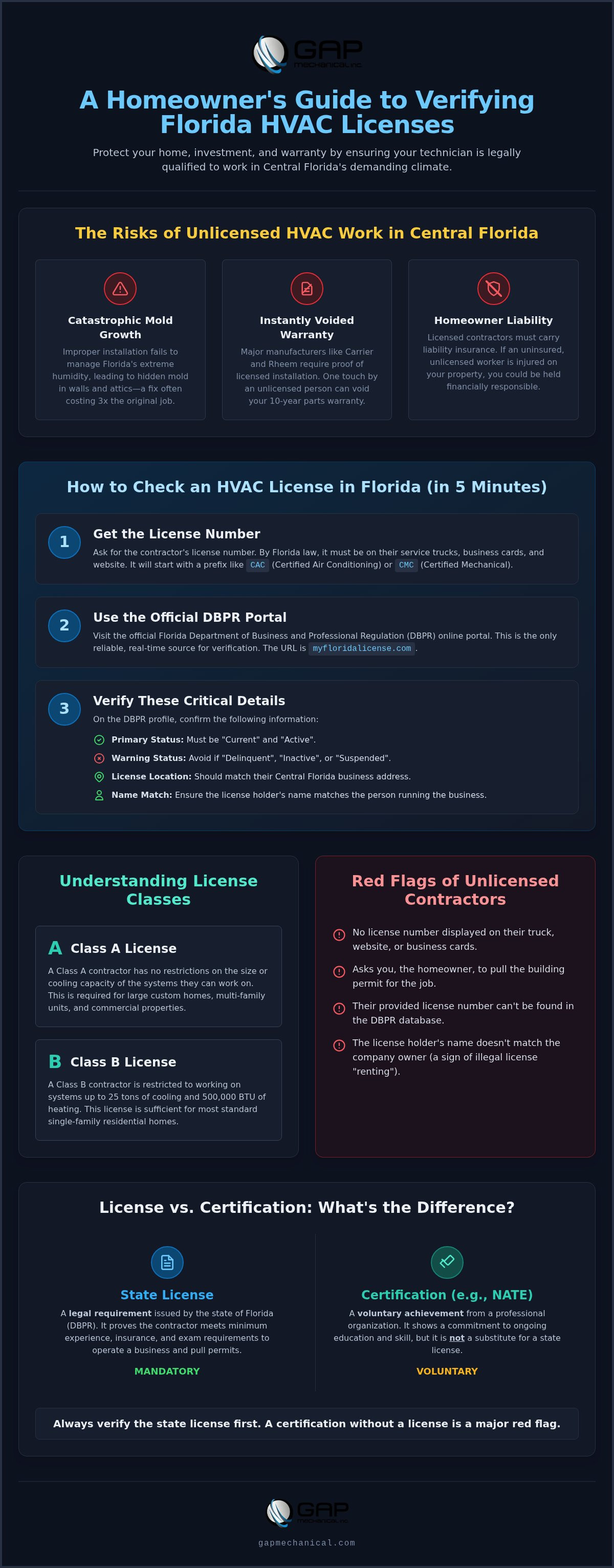
It is easy to get confused by the logos on a technician’s shirt. A state-issued license is a legal permit that allows a person to operate a business and pull permits. Certifications, such as NATE (North American Technician Excellence), are voluntary professional achievements. While certifications show a commitment to learning, they do not replace a license. Always verify the state license first. You can find more information about our standards on our residential services page. Verifying a contractor's status takes less than five minutes. It is the most important five minutes of your entire project. The most reliable method for verification is using the official Florida DBPR license verification portal. This live database provides real-time information on every licensed professional in the state. By checking this portal, you ensure you aren't falling victim to "tailgate" contractors who operate without the required state oversight. When you access the portal, you must verify that the "Primary Status" is listed as "Current" and "Active." If a status shows as "Delinquent" or "Inactive," the contractor cannot legally perform work or pull the necessary permits for your home. You should also check the "License Location." Florida is a large state; ensure the business address matches the contractor's local presence in Central Florida. Cross-referencing the license holder's name with the person running the business is another critical step. If the names don't match, the company might be "renting" a license, which is a major legal red flag. If you want to see what a properly documented team looks like, contact our team to discuss your next project.
Which Class Do You Need for Your Home?
Most residential air conditioners in Central Florida range from 2 to 5 tons. Because 25 tons is a massive amount of cooling power, a Class B license is perfectly suitable for 99% of residential AC repairs and installations. You don't necessarily need a Class A contractor for a standard home, but you must ensure they hold at least a valid Class B. At GAP Mechanical, we maintain the highest levels of licensing to ensure we can handle any project, from a small guest house to a large-scale commercial facility. If you are dealing with a large commercial building, you should specifically look for a Class A or a Certified Mechanical Contractor (CMC) to ensure the scope of work is legally covered.
Can a handyman install an AC unit in Florida?
No, handymen cannot legally install AC units in Florida. State law requires a specific HVAC license for any work involving the refrigerant circuit or structural components. Handymen are limited to basic maintenance tasks that do not require a permit. If you hire an unlicensed individual for an installation, you risk catastrophic property damage and the immediate loss of your manufacturer's warranty. Always verify credentials through the DBPR before any major project begins.
What is a CAC license in Florida?
A CAC license stands for Certified Air Conditioning Contractor. This designation is issued by the Florida Department of Business and Professional Regulation to individuals who have passed the rigorous state trade exam. When you are researching how to check HVAC license Florida databases, look for the "C" prefix in the license number. This indicates the contractor has met statewide standards for experience, financial responsibility, and technical competence.
How do I know if an HVAC company is insured?
Verify insurance coverage by asking the contractor for a current Certificate of Insurance (COI). This document provides proof of general liability and workers' compensation coverage. It should list the policy limits and the insurance carrier's contact information. Don't rely on a verbal promise. Call the agent listed on the certificate to confirm the policy is active and covers the specific type of HVAC work being performed on your Orlando home.
What happens if I hire an unlicensed contractor in Florida?
Hiring an unlicensed contractor exposes you to significant financial and legal risks. You become personally liable for any injuries that occur on your property, as unlicensed workers rarely carry workers' compensation. Additionally, unpermitted work will be flagged during a home inspection, which can delay or cancel a property sale. You also lose the ability to file a claim with the state's homeowner recovery fund if the work is abandoned or faulty.
How long does a Florida HVAC license stay active?
Florida HVAC licenses remain active for two years and must be renewed by August 31 of every even-numbered year. For 2026, contractors must complete 14 hours of continuing education and pay the renewal fee to maintain their status. If they miss this deadline, their license becomes delinquent and they can no longer legally pull permits. Always use the DBPR portal to confirm the contractor's status is listed as "Current" and "Active" before signing a contract.
Do I need a permit for AC repair in Orlando?
A permit is mandatory for any AC installation or major component replacement in Orlando. While simple repairs like clearing a drain line or replacing a capacitor don't require one, replacing an air handler or condenser unit does. Knowing how to check HVAC license Florida records ensures you hire a professional who can legally pull these permits. This step is crucial for ensuring the installation meets local safety codes and passes a final city inspection.
What is the difference between a Certified and Registered contractor?
A Certified contractor has passed a state-level exam and can operate anywhere in Florida. A Registered contractor is limited to specific local counties or cities where they have met local requirements. Certified licenses start with a "C" and generally represent a more rigorous testing process. We recommend hiring a Certified contractor for your Orlando home to ensure they meet the highest statewide standards for technical skill and professional conduct.
How can I check if an HVAC technician has a criminal record?
The DBPR performs background checks on the primary license holder, but you should ask the company about their specific technician screening process. Reputable HVAC companies in Central Florida conduct their own criminal background checks and drug tests on every field employee. This ensures that the person entering your home is trustworthy and professional. Always choose a company that is transparent about their hiring standards and prioritizes the safety of your household.