Heat Pump Installation in Orlando: The Complete 2026 Homeowner’s Guide
Published July 19, 2026
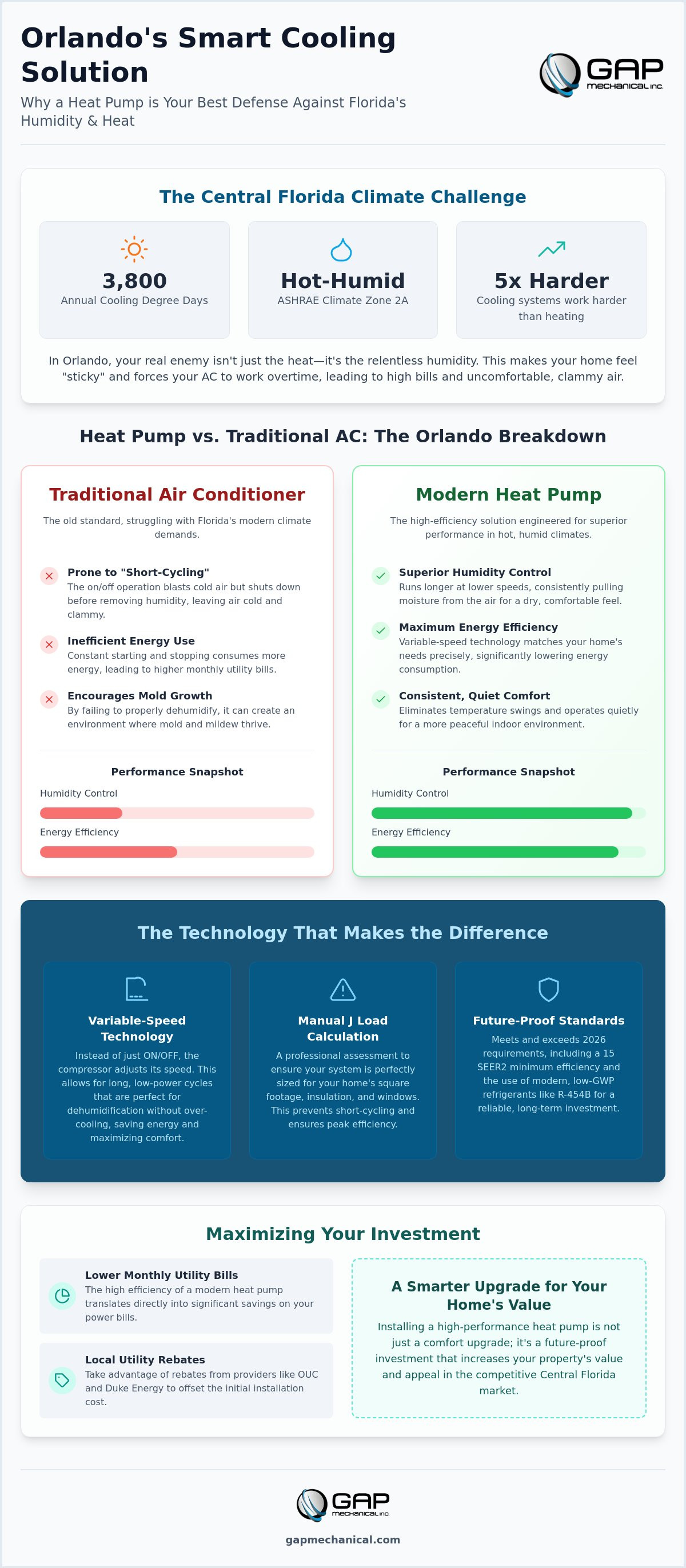
In Orlando, your air conditioner isn't actually your most important cooling tool; your dehumidifier is. While traditional AC units often struggle with Central Florida's extreme humidity, a modern heat pump thrives by pulling moisture out of the air more effectively than a standard system. For a professional heat pump installation Orlando residents are now choosing 2026 technology that handles our 3,800 annual cooling degree days with significantly less energy waste.
You probably already know the frustration of "sticky" indoor air and monthly power bills that climb alongside the summer thermostat. It's a common challenge in older Florida homes where traditional cooling just can't keep up with the tropical climate. This guide will show you how to solve those issues while lowering your long-term operating costs. We'll break down the 2026 SEER2 requirements and explain why the shift to new refrigerants like R-454B matters for your home's future value.
You'll also learn about available OUC and Duke Energy rebates that can offset your initial investment. From understanding local mechanical permit fees to choosing a system that fits your square footage, we've outlined the exact steps to ensure your next HVAC upgrade is a reliable, high-performance solution built for the local heat.
Key Takeaways
- Learn how variable-speed heat pumps provide superior humidity control compared to traditional AC units in the unique Orlando climate.
- Discover why a professional heat pump installation Orlando homeowners choose in 2026 offers better long-term efficiency and lower monthly utility bills.
- Understand the importance of a Manual J load calculation to prevent short-cycling and ensure your system matches your home's specific cooling needs.
- Identify the 2026 SEER2 requirements and new refrigerant standards that impact your choice of a reliable, future-proof HVAC solution.
- Learn how to maximize your savings by leveraging local utility rebates from providers like OUC and Duke Energy.
Why Heat Pumps are the Secret to Efficient Cooling in Orlando
For most Orlando homeowners, the word "heat" in a heat pump is a bit of a misnomer. In a climate where we face 3,800 cooling degree days annually, you aren't looking for a heater; you're looking for an elite cooling system that can handle the occasional January frost. A modern heat pump is exactly that. It's a high-efficiency cooling system equipped with a reversing valve. This single component allows the system to change the direction of refrigerant flow, making it a versatile tool for our unique environment. Understanding How Heat Pumps Work is essential for anyone planning a heat pump installation Orlando residents can rely on for the next decade. Unlike traditional heaters that create warmth through combustion or electric strips, these systems move heat from one place to another. In the summer, they pull heat out of your home and dump it outside. In our short winters, they reverse the process.
How Heat Pumps Outperform Traditional AC in the Florida Heat
Traditional air conditioners and heat pumps both use the vapor compression cycle, but heat pumps are built for higher efficiency standards. As of 2026, all new split-system installations in Florida must meet a minimum of 15 SEER2. Heat pumps frequently exceed this baseline, offering better performance during our 300+ days of intense sun. Because they move heat rather than generate it, they use significantly less electricity. This is why they've become the standard for new high-efficiency homes across Winter Park and Central Orlando. Our team has seen these standards evolve over 25 years; we know exactly how to calibrate these units for the local grid and the 2026 transition to low-GWP refrigerants like R-454B.
The "Cooling-First" Mindset for Central Florida Residents
In Central Florida, cooling systems work over five times harder than heating systems. We prioritize dehumidification because the Orlando humidity is relentless. A heat pump excels here by running longer, more consistent cycles that pull moisture out of the air without over-cooling the room. This prevents that "clammy" feeling often found in homes with oversized, traditional AC units. When those few chilly January nights finally arrive, the system simply flips its reversing valve to provide the most cost-effective warmth available. A heat pump is a dual-purpose climate solution optimized for the Southeast. It eliminates the need for inefficient electric strip heat, which approximately 90% of Florida households still use, and replaces it with a steady, reliable comfort source.
Advanced Humidity Control and Comfort Features
Comfort in Central Florida isn't just about the temperature on your thermostat. It's about how much water is hanging in the air inside your living room. Orlando sits in ASHRAE Climate Zone 2A, a region defined as "Hot-Humid." In this environment, relative humidity frequently spikes, making 75 degrees feel like 80. Traditional air conditioners often "short-cycle," meaning they turn on, blast cold air, and turn off before they have a chance to remove moisture. This leaves you with cold, clammy air that encourages mold growth and physical discomfort. A professional heat pump installation Orlando homeowners invest in today prioritizes moisture removal as much as cooling.
Modern systems use modulating technology to address this. To understand the technical side of how heat pumps work to manage this moisture, you have to look at the compressor. Unlike older units that only have two settings, on or off, modern heat pumps adjust their speed to match the exact cooling load of your home. This precision allows the system to run for longer periods at a lower power level. These extended run times are the secret to a dry, comfortable home. As air passes over the cold evaporator coil more slowly and consistently, more water vapor condenses and drains away.
The Power of Variable-Speed Technology
Variable-speed compressors are the gold standard for Florida comfort. By avoiding the constant "start-stop" cycle of standard units, they maintain a steady indoor environment without the temperature swings. This technology reduces the "sticky" feeling that often leads people to crank their thermostats down to 68 degrees just to feel dry. Instead, you can stay comfortable at 74 or 75 degrees because the humidity is kept in check. This efficiency is a core reason why heat pumps are now the preferred choice for high-performance residential cooling.
Indoor Air Quality and Filtration Benefits
Consistent airflow does more than just control humidity; it protects your home's health. In a humid climate like ours, stagnant air in ductwork is an invitation for mold and mildew. A modulating heat pump keeps air moving, which prevents moisture from settling in your vents. These systems are also designed to work with high-MERV filters and advanced air purification setups. This is vital during Orlando's heavy pollen seasons. If you're tired of uneven cooling or high indoor humidity, it's a good idea to discuss your home's specific layout with a local expert who understands these environmental pressures.
Heat Pump vs. Traditional AC: The Orlando Efficiency Breakdown
Traditional air conditioning units are one-way streets. They move heat out of your home using a refrigerant cycle that only operates in a single direction. While this works for our 95-degree July afternoons, it leaves homeowners relying on expensive electric resistance "strip heat" when the temperature drops in January. Approximately 90% of Florida households use this inefficient heating method. A modern heat pump installation Orlando families choose in 2026 replaces that outdated setup with a system that is significantly more efficient year-round. Because a heat pump can reverse its cycle, it provides cooling during the summer and high-efficiency warmth during our few chilly weeks without the massive power spikes associated with heat strips.
Maintenance for these systems is similar to a standard AC, but the components work harder. In our corrosive, high-humidity environment, you can expect a well-maintained system to last between 10 and 15 years. Regular coil cleanings are essential to combat the salt air and biological growth common in Central Florida. While the mechanics are more advanced, the reliability is proven. Modern systems using R-454B or R-32 refrigerants are designed for the extreme thermal loads of the Southeast.
Understanding the ROI of a Heat Pump Installation
The financial benefits of switching to a heat pump are immediate. For a typical Orlando home, converting from electric strip heat to a heat pump can drastically reduce winter utility bills. Local utility providers offer incentives to help with the transition. OUC provides rebates ranging from $45 to $1,150 based on system efficiency. Duke Energy Florida customers can receive up to $1,000 when converting from strip heat. Remember that the federal tax credit for heat pumps expired at the end of 2025. This makes local rebates and proper system sizing through Residential Services even more critical for maximizing your return on investment.
Common Myths About Heat Pump Reliability
A common misconception is that heat pumps can't keep up when Orlando temperatures hit triple digits. This is a myth. Modern heat pumps are engineered to provide full cooling capacity even in extreme heat. They utilize the same vapor compression technology as traditional AC units. Another myth suggests they don't work during a "Florida freeze." In reality, today's systems provide effective heat at temperatures far below anything we experience in Central Florida. These units are built for our climate; they handle the transition from a humid 90-degree afternoon to a 40-degree night with a simple flip of a valve.

Preparing Your Orlando Home for Professional Installation
Preparing your home for a new system starts with a technical assessment; not a sales pitch. In older neighborhoods like Winter Park or Thornton Park, electrical capacity is often the biggest hurdle for a modern heat pump installation Orlando homeowners want. Many mid-century homes still operate on 100-amp panels. A high-efficiency heat pump might require a dedicated circuit or a panel upgrade to handle the load safely. We also perform a Manual J load calculation to determine the exact tonnage your home requires. This calculation considers your roof type, window orientation, and insulation levels. Eyeballing the size based on square footage alone is a red flag that leads to short-cycling and high humidity.
Your existing ductwork also needs a thorough inspection. High-efficiency systems move air at different pressures than older units. If your ducts are undersized or leaky, you'll lose the energy savings you're paying for. Finally, we must select the optimal location for the outdoor condenser. It needs at least 12 to 18 inches of clearance for proper airflow. We aim for a spot that avoids the brutal afternoon sun and ensures proper drainage during our frequent summer downpours.
For homes with unique architectural features or non-standard duct requirements, you can explore Custom sheet metal fabrication and HVAC ductwork production from Velocity Sheet Metal to guarantee a precision fit that supports your new heat pump's performance.
The GAP Mechanical Installation Process
Our team follows a disciplined, four-step process to ensure long-term reliability. We start with a comprehensive site assessment and energy audit to identify potential efficiency leaks. Next, we handle the removal of your old system, including the environmentally safe disposal of old refrigerants. The third step is the precision installation of your new indoor and outdoor components, ensuring every connection is airtight. We conclude with a full system calibration and a homeowner orientation. We'll show you how to maximize your new technology and set your thermostat for the best moisture removal. If you have specific questions about what to expect, you can browse our FAQ for more details.
Local Permits and Compliance in Winter Park and Orlando
Navigating the Florida Building Code is a mandatory part of any HVAC project. A mechanical permit is required for all heat pump installations in the City of Orlando. As of 2026, the permit fee is $64.94 for projects up to $1,000, plus $10.81 for each additional $1,000 in value. Skipping this step is a major risk. Unpermitted work can lead to fines and may even void your homeowner's insurance if a claim arises. Our team handles the entire permitting process to ensure your installation meets every local safety standard. To get started with a professional site assessment, you can contact our local experts today.
Choosing the Right Heat Pump Contractor in Central Florida
Selecting a contractor for your HVAC upgrade isn't just about finding the lowest bid; it's about finding a team that understands how to calibrate a system for the specific thermal loads of a Florida home. A heat pump installation Orlando homeowners can trust requires a contractor who knows how to navigate local building codes and the strict 2026 efficiency standards. Similar standards of care are vital in any climate where cooling is essential; for instance, those in the Temecula area often rely on Advanced Heating & Air Conditioning for high-performance cooling solutions. With over 25 years of experience in Central Florida, we've seen how improper installation leads to premature compressor failure or chronic humidity issues. Working with a licensed and insured team protects your investment and ensures that your manufacturer warranty remains valid. These credentials are proof of a contractor's commitment to safety and professional standards.
Warranties are only as good as the company backing them. We emphasize long-term maintenance support because these high-performance systems need regular attention to survive the intense Florida sun and salt air. We also believe that high-efficiency comfort should be accessible to everyone in our community. That's why we provide various financing options to help manage the initial costs of a system upgrade. By choosing a local expert, you're ensuring that your system is sized correctly for your home's specific footprint and insulation levels.
The GAP Mechanical Difference
Since 2003, we've served the Orlando and Winter Park communities with a focus on technical discipline and transparency. Our 4.9-star Google rating isn't a marketing fluke; it's the result of treating every customer like a neighbor. We take pride in our history and our standing within the local service industry. We also offer a Military Discount for active and retired personnel as a way to give back to our local heroes. When you choose us, you're choosing a steady, experienced hand that has handled thousands of heat pump installation Orlando projects with precision and care.
Next Steps: Securing Your Home’s Comfort
Transitioning to a modern heat pump is a significant step toward a more comfortable and energy-efficient home. The process begins with a professional consultation where we assess your home's unique needs. During your first service call, we'll perform a detailed site audit and provide clear, honest recommendations. You won't find hyperbolic sales pitches here. Instead, you'll get the technical facts you need to make an informed decision for your family. If you're ready for a reliable installation quote, you can Contact Us to speak with a local expert today.
Investing in Your Home's Long-Term Comfort and Efficiency
Selecting a new HVAC system is a decision that impacts your home's comfort and your utility bills for the next decade. Modern heat pumps have proven to be the most effective tool for managing Orlando's humidity while meeting the rigorous 2026 energy standards. By prioritizing precise sizing and professional calibration, you can eliminate the "clammy" indoor air and high power bills associated with outdated cooling methods. A successful heat pump installation Orlando residents can rely on requires a contractor who understands local building codes and the nuances of Central Florida's environment.
With over 25 years of local experience and a 4.9-star Google rating, we provide the technical discipline needed for a seamless transition to high-efficiency comfort. We also offer special discounts for military families as part of our commitment to the community. The right HVAC solution provides peace of mind through every tropical storm and summer heatwave. When you're ready to upgrade your home's performance, we're here to provide the expert guidance you deserve.
Request an Expert Heat Pump Installation Quote Today
Frequently Asked Questions
Do heat pumps work effectively in the extreme Orlando summer heat?
Yes, heat pumps are engineered to handle Orlando's 95-degree summer peaks with ease. They utilize the same vapor compression technology as a standard AC unit to remove heat from your home. Because many modern systems feature variable-speed compressors, they stay on longer at lower speeds. This allows for superior moisture removal in our humid climate. You won't sacrifice cooling power for efficiency.
How much can I save on my electric bill by switching to a heat pump in Florida?
You can save significantly on monthly utility bills, particularly if you're replacing old electric strip heat. Duke Energy Florida notes that converting from strip heat to a heat pump is one of the most effective energy upgrades available. Savings depend on the SEER2 rating of your system. A heat pump installation Orlando homeowners choose often pays for itself through reduced winter heating spikes and more efficient summer cooling.
Will I need to replace my existing ductwork for a new heat pump installation?
You may not need to replace your ductwork, but a professional inspection is mandatory. Existing ducts must be sized correctly to handle the airflow requirements of a high-efficiency 15 SEER2 system. Leaky or undersized ducts can cause the system to work harder, reducing its lifespan. We check for airtight seals and proper insulation to ensure your new system performs at its peak efficiency.
How long does a typical heat pump installation take for an Orlando home?
A standard replacement typically takes between four and eight hours to complete. If your home requires an electrical panel upgrade or significant ductwork repairs, the process may extend into a second day. We prioritize a clean, efficient workspace to minimize disruption to your schedule. Our team handles the removal of the old unit and the calibration of the new system during this one-day window.
Are there tax credits or rebates available for heat pump installation in 2026?
Federal tax credits for heat pumps have expired as of 2026. However, local rebates remain available through OUC and Duke Energy. OUC provides rebates between $45 and $1,150 depending on system efficiency. Duke Energy offers up to $1,000 for customers converting from electric strip heat. These incentives help offset the initial heat pump installation Orlando cost while lowering your long-term energy expenses.
What is the difference between a heat pump and a traditional central AC unit?
The primary difference is the reversing valve located inside the outdoor unit. A traditional AC only moves heat out of your home. A heat pump can reverse that process to bring heat inside during the winter. This makes it a dual-purpose system. It moves heat rather than generating it through combustion or electric resistance, which is far more efficient for Florida's specific climate.
How often does a heat pump need maintenance in the Central Florida climate?
We recommend professional maintenance twice a year in Central Florida. Our hot-humid climate causes biological growth and salt-air corrosion on outdoor coils. Regular service ensures that drains remain clear and refrigerant levels stay optimized. This proactive approach prevents the most common causes of system failure during the peak summer season when the local grid and your equipment are under the most stress.
Can a heat pump handle the occasional freezing temperatures in Orlando?
Yes, modern heat pumps can easily handle the occasional freezing temperatures we experience in Orlando. They are designed to extract heat from the outside air even when temperatures drop into the 30s. Unlike older systems, today's technology doesn't require "backup" electric heat for our typical winter nights. Your home stays warm and comfortable without the massive power surge associated with traditional electric heaters.