

Commercial AC Installation Orlando: A Business Guide
Published September 3, 2026
Selecting the right commercial AC installation in Orlando requires a comprehensive strategy that addresses the unique demands of Central Florida’s climate and the stringent operational needs of your business. A successful system goes beyond simple cooling; it is an integrated solution designed for peak efficiency, maximum reliability, and minimal disruption to your daily operations.
As a business owner navigating the intense heat and humidity of Central Florida, understanding the complexities of commercial HVAC is vital to protecting your brand, employee comfort, and bottom line. Whether you are operating in the bustling core of downtown Orlando or a sprawling industrial area near Winter Park, your climate control system is a critical piece of infrastructure, not just a convenience.
The Unique Climate Challenges of Commercial HVAC in Central Florida
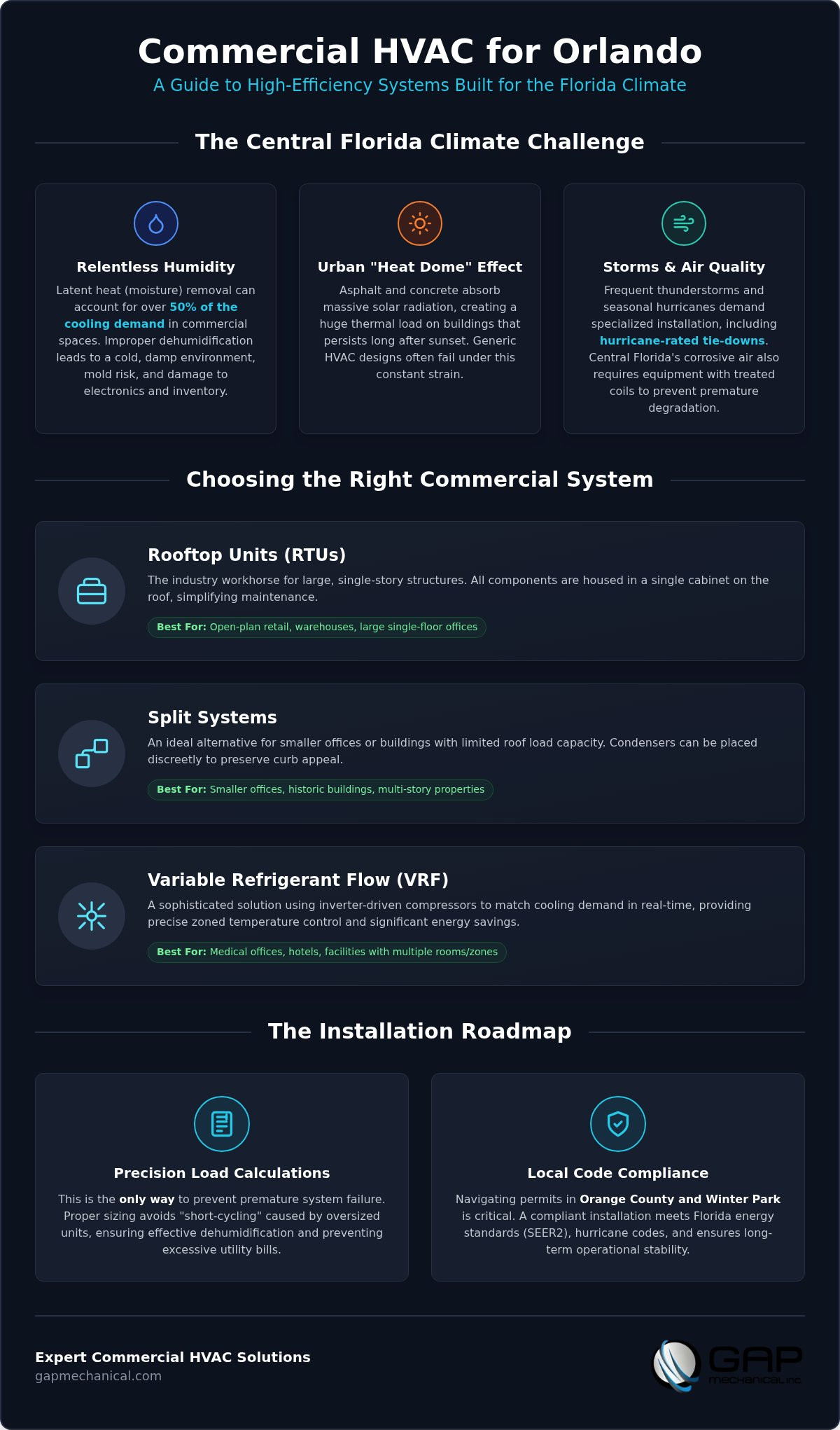
Central Florida presents a unique set of challenges for any mechanical system. Unlike climates with predictable seasonal changes, Orlando experiences extreme heat, 90°+ summer temperatures, and high humidity levels that can be relentless. This constant battle against heat and moisture puts significant strain on HVAC equipment.
Commercial properties often have vastly different needs than residential ones. A small retail store in Winter Park has different zoning and airflow requirements than a large warehouse in Kissimmee or a high-occupancy office building near the International Drive area. The air doesn't just need to be cool; it needs to be perfectly conditioned to manage the intense moisture pulled from the surrounding environment.
The constant need to handle high humidity is perhaps the biggest differentiator in the Central Florida market. If your system is struggling with dehumidification, even if the temperature seems acceptable, the indoor air quality suffers, leading to discomfort, productivity loss, and potential mold growth in older commercial structures common around Orlando.
- High Heat Load: Orlando’s intense sun and high ambient temperatures require massive cooling capacity.
- Humidity Management: The constant influx of moisture necessitates specialized dehumidification strategies.
- Operational Continuity: Commercial systems cannot afford downtime; even a few hours of insufficient cooling can lead to significant revenue loss.
- Storm Resilience: Systems must be robust enough to handle the extreme weather events typical of Central Florida, including afternoon thunderstorms and hurricane prep requirements.
Differentiating Commercial AC Installation from Residential Projects
Many business owners mistakenly believe that the installation process for their office or retail space is the same as a standard residential setup. This is a critical oversight. Commercial AC installation is a sophisticated engineering project, not a simple swap-out.
The primary difference lies in the scale, zoning, and complexity of the load calculation. Residential systems are designed for single-zone comfort; commercial systems must manage diverse, high-density, and often fluctuating thermal loads across multiple distinct areas.
Here is how the approach differs:
Scale and Capacity: Residential systems are sized for a home; commercial systems are engineered for occupancy density. A large open-plan office in Orlando requires exponentially more capacity and different ductwork than a standard suburban home.
Zoning and Control: Commercial HVAC requires advanced zoning capabilities. Different areas of a building—such as a server room, a high-traffic lobby, or a back office—have vastly different temperature and airflow needs. A sophisticated commercial system allows you to target specific zones for optimal performance.
Durability and Redundancy: Commercial units are built to operate continuously, often 24/7. The installation must prioritize durability and may require redundancy—backup systems or components—to ensure that the business never suffers from a complete cooling failure.
Optimizing Your Commercial asset for Long-Term Value
When undertaking a commercial AC replacement in Orlando, the focus should always be on the total lifecycle performance of the system. This means looking beyond the initial installation and considering the long-term operational efficiency, energy management, and system longevity.
Choosing a system that is oversized or undersized is a common mistake that leads to rapid wear, excessive energy consumption, and frequent maintenance calls. A proper commercial installation is built on detailed load calculations and the selection of equipment specifically matched to the square footage, ceiling height, and heat-producing equipment of your facility.
Understanding how to maximize the return on your HVAC asset is crucial for sustained business health. For a deeper look into the strategic planning behind efficient commercial systems, review this resource: Commercial AC Replacement in Orlando: The Business Owner’s Guide to ROI.
The goal is not just to lower the temperature, but to lower the long-term operational burden. This requires moving away from reactive repairs and toward a proactive, engineered approach to climate control.
The Critical Role of Professional Execution in Orlando
The quality of the installation is as important as the quality of the equipment itself. A highly efficient unit installed incorrectly—with improper refrigerant charging, poor insulation, or incorrect duct sizing—will perform poorly and waste energy. This is especially true in Orlando, where the thermal stresses are intense.
When selecting a contractor for a complex commercial project, you must vet their experience with large-scale commercial builds, not just residential homes. You need a company that understands the intricacies of the Central Florida building code, the unique demands of high humidity, and the operational needs of a business.
A professional, licensed contractor will conduct a thorough assessment of your existing infrastructure. This assessment includes checking the structural integrity of the roof, assessing the insulation levels, and calculating the precise BTU load required for every zone of your property. This level of detail prevents costly surprises down the line.
It is also essential to understand the contractor’s commitment to maintenance and preventative care. The most efficient commercial system is useless if it is not regularly serviced to handle the aggressive climate. A professional partnership ensures that your system is maintained according to industry best practices for Orlando's heat and humidity.
If you are in the process of evaluating potential partners, it is wise to have a foundational understanding of the questions that truly matter. While some guides focus on homeowners, the principles of rigorous contractor vetting apply universally. Consider reviewing these Questions to Ask an HVAC Contractor in Orlando to ensure your selected partner meets the high standards required for a complex commercial deployment.
Mitigating Operational Risks Through Strategic Planning
For a business owner, the failure of a primary AC system is a major operational crisis. Depending on your industry—whether it is a food service establishment, a data center, or a high-end office—a cooling failure can lead to massive health code violations, product spoilage, or total business interruption.
Strategic planning involves designing a system with fail-safes. This might mean implementing dual-zone control systems, ensuring adequate backup power options, or installing sensors that can automatically detect temperature anomalies and trigger alerts before a situation becomes critical.
In the context of Central Florida, where the threat of severe weather is always present, robust installation is your primary defense. Proper sealing, durable materials, and expertly calibrated airflow ensure that the system can withstand extreme environmental conditions while delivering consistent comfort and climate control.
The difference between a successful commercial installation and a recurring maintenance nightmare lies in the initial design phase. It requires an expert who understands that your business relies on consistent performance, regardless of whether it is a sweltering July afternoon or a humid May morning.
By prioritizing comprehensive assessments, strategic zoning, and reliable long-term maintenance protocols, you transform your HVAC system from an expense into a reliable operational asset.
Frequently Asked Questions
How is commercial AC installation different from residential AC installation?
Commercial installations involve significantly higher capacity, complex zoning to manage different areas of a large building, and a requirement for continuous operation and durability that residential systems do not typically require. Commercial systems are engineered for high-density occupancy and specialized thermal loads.
What is the primary challenge with HVAC in Orlando, Florida?
The primary challenges in Orlando are the intense heat load combined with extremely high humidity. These factors require advanced cooling and, more importantly, sophisticated dehumidification strategies to ensure indoor air quality remains high and comfort is maintained.
A business owner should always focus on long-term efficiency and total lifecycle value. An initially "simpler" system may lack the capacity, durability, or zoning controls needed for Central Florida's climate, leading to higher energy bills and more frequent, costly repairs down the line.
How does a professional HVAC company ensure system reliability?
A professional company ensures reliability through detailed load calculations, strategic zoning, the use of durable commercial-grade components, and a commitment to preventative maintenance schedules. This proactive approach minimizes the risk of system failure during critical operating hours.
Frequently Asked Questions
Ready to Upgrade Your Commercial Comfort?
Upgrading your HVAC system is a major capital expenditure. We help you manage this through flexible financing options designed for business owners. We also offer military discounts to eligible owners as part of our commitment to the local community. Our process begins with a professional site evaluation. During a commercial AC installation Orlando project, we don't just look at the model number of the old unit. We analyze your entire building envelope, including window orientation and insulation levels. This ensures your new system is sized for maximum efficiency and long-term return. When you're ready to secure your building’s climate, we're here to help. Our team provides comprehensive support from the initial engineering phase through long-term maintenance contracts. These contracts are essential for preserving manufacturer warranties and preventing unexpected breakdowns during the hottest months. We take pride in our history and our standing within the community. Schedule your commercial AC consultation today to protect your infrastructure and your bottom line. Navigating the complexities of commercial cooling in Central Florida requires a balance of engineering precision and local insight. You've learned how managing latent heat loads is just as critical as lowering the temperature. By selecting the right system and ensuring a code-compliant installation, you protect your business from high utility bills and premature mechanical failure. A professional commercial AC installation Orlando project represents a strategic commitment to your building’s infrastructure. GAP Mechanical brings 25+ years of local experience to every project. As a licensed and insured Orlando contractor with a 4.9-star Google rating, we prioritize transparency and technical competence. We focus on getting the job done right the first time so your operations stay cool and uninterrupted. Don't let an aging or inefficient system drain your profits during the next heatwave. Request a Commercial AC Installation Quote to begin your site evaluation. We're ready to help you build a more reliable and efficient climate for your employees and customers.
How long does a commercial AC installation usually take in Orlando?
A standard rooftop unit swap often takes one business day, while complex projects involving a full commercial AC installation Orlando might require three to five days. The timeline depends on the structural modifications needed and the results of the site assessment. We prioritize scheduling crane lifts during off-hours to minimize business interruption. Every project includes a specific logistics plan to keep your facility operational throughout the process.
What is the average lifespan of a commercial HVAC unit in Florida's humidity?
Commercial units in Central Florida typically last between 10 and 15 years. The relentless heat and high humidity levels force systems to run longer cycles, which accelerates mechanical wear on compressors and motors. Atmospheric moisture also promotes coil corrosion. Regular professional maintenance is the most effective way to reach the upper end of this life expectancy and protect your capital asset.
Do I need to replace my ductwork when installing a new commercial AC unit?
Ductwork replacement isn't always mandatory but is often recommended if your current infrastructure is undersized for modern high-efficiency blowers. New systems require specific static pressure to operate correctly. If your ducts have significant leaks or biological growth from Orlando’s humidity, replacing them ensures the air you pay to cool actually reaches your employees. We evaluate duct integrity during our engineering load calculations.
What are the specific wind-load requirements for rooftop units in Orlando?
Rooftop units in Orlando must adhere to the Florida Building Code’s strict wind-load standards, which often require equipment to withstand gusts exceeding 140 mph. This involves using heavy-duty roof curbs and hurricane-rated tie-downs. These components prevent the unit from shifting or lifting during severe weather events. A code-compliant commercial AC installation Orlando project always includes these specific safety reinforcements to protect your building’s structural integrity.
How can I improve the energy efficiency of my current commercial AC system?
You can improve efficiency by installing smart thermostats and adhering to a strict quarterly maintenance schedule. Keeping coils clean and ensuring the refrigerant charge is precise prevents the system from overworking. Additionally, sealing any visible gaps in your building envelope reduces the thermal load. If your system is over 12 years old, upgrading to a high-efficiency unit is often the only way to see a drastic reduction in monthly utility considerations.
Does GAP Mechanical offer financing for new commercial HVAC installations?
Yes, GAP Mechanical provides flexible financing options to help business owners manage the capital expenditure of a new system. We understand that a sudden equipment failure can impact your cash flow. We also offer military discounts for eligible owners as part of our commitment to the local community. These programs allow you to invest in high-efficiency hardware that lowers your long-term operational considerations without a massive upfront burden.
What is the difference between residential and commercial AC installation?
Commercial installations involve much higher cooling capacities and often utilize three-phase power, which isn't found in residential settings. Drainage requirements are also more complex, especially for rooftop units that must shed gallons of condensate daily in our humid climate. While residential units focus on simple comfort, commercial systems are engineered to handle internal heat loads from computers, machinery, and high foot traffic.
Are there tax incentives for installing high-efficiency commercial HVAC in 2026?
Federal programs like the Section 179 deduction and the 179D energy-efficient commercial buildings deduction often apply to HVAC upgrades. These incentives allow businesses to accelerate depreciation or deduct the consideration of high-efficiency equipment. While these programs are expected to continue through 2026, you should consult with a tax professional to verify current eligibility requirements. Choosing energy-efficient hardware helps maximize these potential financial benefits.