← Back to Blog
Choosing a New AC Unit in Florida: The Complete 2026 Homeowner’s Guide

Choosing a New AC Unit in Florida: The Complete 2026 Homeowner’s Guide

Published September 1, 2026

What if your air conditioner is actually a humidity management tool first and a cooling machine second? Most homeowners focus only on the temperature, but in Central Florida, the moisture in the air is what truly drives up your costs and ruins your comfort. When you're choosing a new AC unit in Florida, picking the wrong size or efficiency rating doesn't just mean a warmer house. It often leads to short-cycling, high electricity bills, and the constant fear of mold growth in your closets and corners.

We understand the struggle of a ten-month summer and the confusion over national versus local installation costs. This guide will help you master the technical and local factors needed to select a system built to survive our unique climate. You'll learn how to secure a system that provides consistent cooling in every room, lowers your monthly utility bills, and lasts for 10 to 15 years despite the local salt and humidity. We're breaking down the 2026 standards, local rebate options, and the specific equipment requirements for Orlando homes.

Key Takeaways

  • Learn why Central Florida's 10-month summers require a system designed for humidity control rather than just raw cooling power to prevent mold growth.
  • Avoid the common "tonnage trap" by understanding why oversized systems fail early when choosing a new AC unit Florida for your home.
  • Discover why modern heat pumps are often the most cost-effective and efficient solution for Orlando's specific climate and mild winters.
  • Master the 2026 SEER2 efficiency standards and local rebate options to maximize your long-term return on investment and lower utility bills.
  • Understand how professional installation factors like refrigerant charging and airflow balancing protect your manufacturer warranty and extend system lifespan.

Understanding the Central Florida Climate Challenge

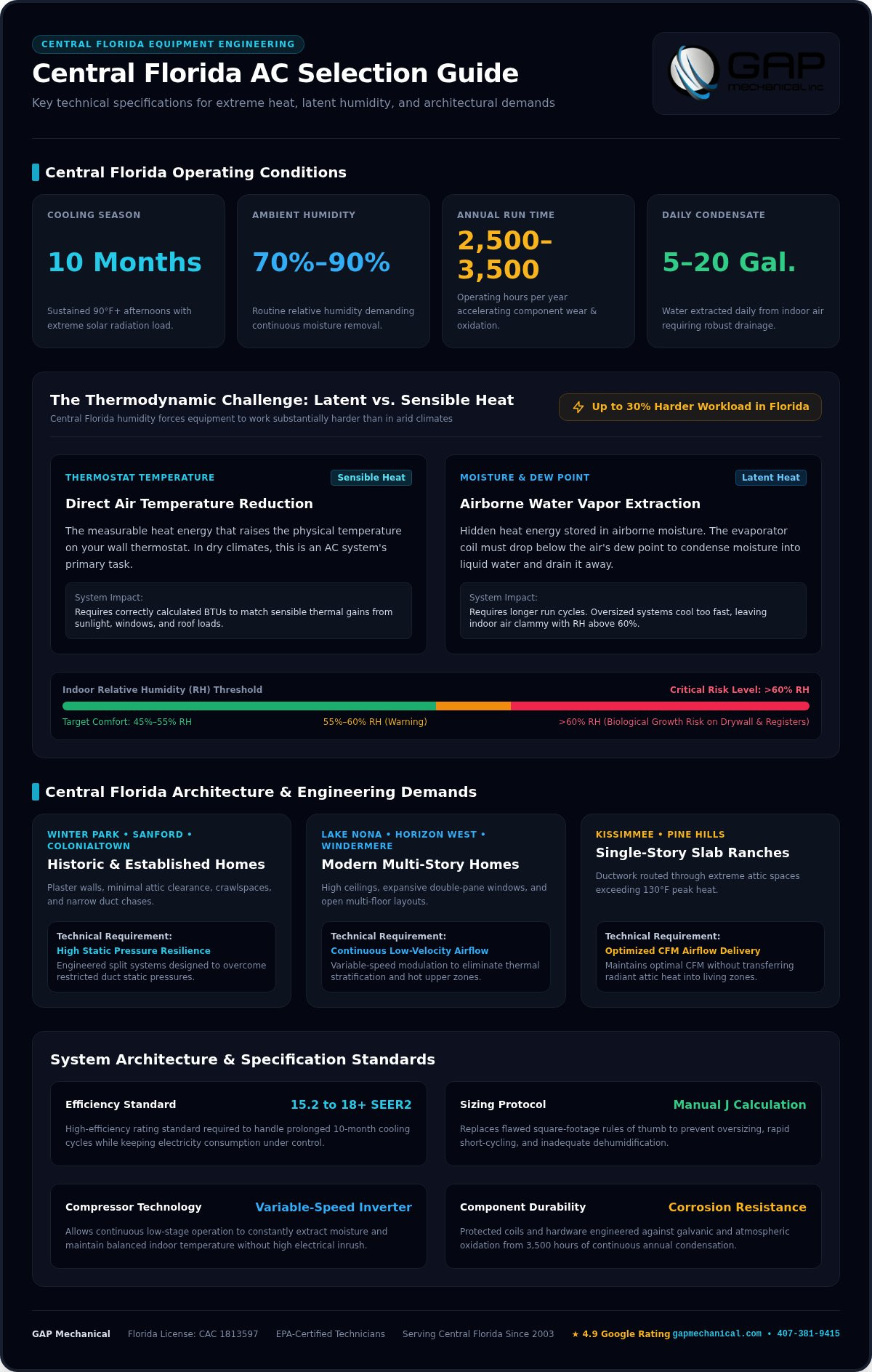
Central Florida homeowners face a unique mechanical reality: the 10-month summer. While systems in northern states rest for half the year, an Orlando air conditioner operates almost continuously from late February through November. This relentless schedule means a local unit accumulates wear and tear twice as fast as the national average. When you're choosing a new AC unit Florida, you aren't just buying a cooler. You're investing in a machine that must withstand nearly 3,000 hours of annual operation in high-moisture air.

The biggest hurdle isn't actually the heat. It's the "latent heat." While sensible heat is what moves the needle on your thermostat, latent heat represents the hidden energy trapped in water vapor. Your system spends a massive amount of power simply wringing moisture out of the air before it can even begin to lower the temperature. Florida humidity forces an AC to work 30% harder than in dry climates. If your system fails to manage this moisture, you'll end up with a home that's cold but "clammy," a condition that quickly leads to mold growth behind drywall and inside closets.

The Impact of High Humidity on System Longevity

Excessive moisture is a silent killer for HVAC components. Constant condensation on the evaporator coils can lead to formicary corrosion, causing microscopic pinhole leaks in the metal. This moisture also creates a high risk for "short-cycling." This happens when a unit cools the air too quickly without removing humidity, causing the system to turn on and off rapidly. This cycle stresses the compressor and spikes your energy bill. Proper drainage is also a non-negotiable local requirement. In Orlando, a standard unit can pull over 10 gallons of water from the air daily. Without a professionally installed, pitched drain line and a secondary safety pan, that water will eventually end up in your ceiling.

Why Central Florida Homes Need Specific Solutions

Every neighborhood in Orlando presents different challenges. Older homes in Winter Park often feature narrow ductwork designed for much smaller, less powerful fans. Installing a modern high-efficiency unit without assessing these ducts can lead to "static pressure" issues that burn out the blower motor. Conversely, newer developments often feature high ceilings and expansive windows. These designs require precise load calculations to ensure the unit can handle the afternoon sun. When you're choosing a new AC unit Florida, look for systems with dedicated dehumidification modes or variable-speed compressors. These features allow the system to run at lower speeds for longer periods, maximizing moisture removal without turning your living room into a refrigerator.

Straight AC vs. Heat Pumps: Which is Best for Orlando?

When you're choosing a new AC unit Florida, the decision usually comes down to two technologies: traditional straight AC or a modern heat pump. For decades, straight AC was the default. It cools your home all summer and relies on electric heat strips to provide warmth during the few weeks of Orlando winter. However, the market is shifting toward heat pumps as the preferred residential choice for 2026. This shift is driven by a combination of superior efficiency and new federal tax credits that help offset initial installation costs.

Heat pumps work by moving heat rather than creating it. In the summer, they pull heat out of your home. In the winter, they reverse the process to pull heat from the outside air and bring it inside. Because Central Florida rarely sees temperatures below freezing, a heat pump operates at peak efficiency nearly year-round. If you're considering a transition from an old gas furnace or an aged straight AC, you can read our guide on Replacing Your Furnace with a Heat Pump in Orlando.

Efficiency Comparison for Central Florida

Electric heat strips are essentially high-wattage heating elements inside your air handler. They consume massive amounts of electricity to generate heat. A heat pump's reversing valve allows it to heat your home using significantly less energy. During the months of December through February, this efficiency translates to lower utility bills. Heat pumps also offer a distinct advantage in moisture control. Many modern models feature variable-speed technology that allows for better year-round dehumidification, preventing the "sticky" feeling common in Florida homes during mild, humid weeks.

Ductless Mini-Splits for Specific Room Needs

A central system isn't always the right fit for every part of your property. If you've converted a garage into a workshop or added a "Florida room" with lots of glass, a ductless mini-split provides a surgical solution. These systems allow for precise zoning, meaning you can cool a specific area without taxing your main unit. While installation is less invasive than adding new ductwork, it still requires professional calibration to ensure the system is sized correctly for the space. If you're struggling to keep a specific room cool, ask a local expert about how a mini-split might bridge the gap.

Calculating Sizing and SEER2 Ratings for Maximum ROI

When you're choosing a new AC unit Florida, the most expensive mistake you can make is falling into the "Tonnage Trap." Many homeowners assume that a larger unit is always better because it cools the home faster. In Orlando, the opposite is often true. An oversized system reaches the thermostat's setpoint too quickly and shuts down before it can complete a full dehumidification cycle. This results in a home that is cold but damp, creating a breeding ground for mold in your ductwork and closets.

Accuracy starts with a professional Manual J Load Calculation. This isn't a "rule of thumb" or a generic square-footage estimate. It's a technical audit of your home's insulation, window orientation, and ceiling heights. Without this calculation, you're guessing at your home's needs, which often leads to short-cycling and high energy bills. A correctly sized unit runs longer, more consistent cycles that effectively wring moisture from the air.

Sizing Your System for Orlando Humidity

The goal of proper sizing is to find a system that runs long enough to manage humidity without overworking. For a typical Central Florida home between 1,500 and 2,500 square feet, the required capacity usually falls between 2.5 and 4 tons. However, a home in an older neighborhood with poor attic insulation will have a much higher heat load than a modern, energy-efficient build. You want a system that reaches its peak efficiency during the hottest part of the afternoon, ensuring your indoor environment stays at a consistent 50% humidity level.

Understanding SEER2 and Utility Rebates

SEER2 is the efficiency standard for 2026, replacing the old SEER rating system. It uses a more rigorous testing process that accounts for the high static pressure found in actual duct systems. While the federal minimum is now higher, jumping from a SEER2 15 to a SEER2 18 unit can reduce your monthly cooling costs significantly. When choosing a new AC unit Florida, you should weigh this higher upfront cost against the "break-even" point, which is the time it takes for energy savings to pay for the upgrade.

Local utility providers like Duke Energy and OUC provide incentives to help bridge this gap. These companies frequently offer rebates for homeowners who install high-efficiency systems that meet specific SEER2 thresholds. These rebates, combined with 2026 federal tax credits, often make a premium, high-efficiency unit more affordable than a base model over the life of the system. Always verify current rebate amounts with your provider before signing a contract to ensure your new installation qualifies for maximum savings.

Choosing a new AC unit Florida

Critical Installation Factors in Central Florida

When you're choosing a new AC unit Florida, the quality of the installation determines whether the system reaches its 15-year potential or fails within the first five. Central Florida homes, especially in established Orlando suburbs or historic areas like Winter Park, often present infrastructure hurdles that generic guides overlook. Your new high-efficiency system requires more than just a simple swap; it needs a compatible environment to operate correctly.

Ductwork inspection is the first priority. Modern air handlers often have higher static pressure requirements than the units they replace. If your existing ducts are undersized, leaking, or collapsed, a new blower motor will work significantly harder to move air. This leads to increased energy consumption and premature motor failure. Before committing to a specific model, ensure your contractor performs a thorough evaluation of your home's distribution system.

The location of your unit also dictates its lifespan. Attic installations are common in Orlando to save living space, but they subject the equipment to sweltering temperatures that stress internal electronics and insulation. Closet installs stay cooler but often limit the physical size of the unit you can choose. You may also need electrical upgrades. High-efficiency motors sometimes require specific circuit protection that older breaker panels weren't designed to support. To help you evaluate these technical needs, check our list of Questions to Ask an HVAC Contractor in Orlando.

Variable-Speed vs. Single-Stage Blowers

Variable-speed technology is the gold standard for Florida comfort. Unlike single-stage units that are either fully on or fully off, variable-speed blowers adjust their output to match the cooling demand of the moment. This constant, low-level airflow is essential for two-story homes in Central Florida, where it prevents "hot spots" on the upper floor by keeping air moving. Modern inverter-driven compressors also offer significant noise reduction, ensuring your backyard remains quiet even during the peak of a 10-month summer.

The Importance of Proper Filtration and Drainage

Managing condensation is a full-time job for an AC in our humidity. Float switches are essential safety devices that shut down the system if a condensate line clogs, preventing expensive water damage to your ceiling. While high-MERV filters improve the cleanliness of the air, they also restrict airflow. Your contractor must calibrate the blower settings to ensure the system doesn't freeze up under the added resistance. A secondary drain pan is non-negotiable in Florida attics because it serves as the final line of defense against structural water damage from overflow.

If you need a technical assessment of your home's infrastructure to ensure a successful install, schedule a professional installation consultation with our team.

Why Professional Installation is Your Best Warranty

Choosing a new AC unit Florida involves more than comparing spec sheets and price tags. The box on your concrete pad is only as good as the technician who connects it. Many homeowners consider "side-job" installations to save money upfront. This is a high-risk gamble. These installs rarely include the necessary municipal permits. Without a permit, you have no legal recourse if the work is shoddy. Most manufacturers also require proof of professional installation to honor their parts warranties. If a component fails and you can't provide a licensed contractor's invoice, you're on the hook for the full cost of the repair.

A professional installation involves a rigorous start-up procedure. Technicians don't just "dump" refrigerant into the lines. They use digital manifolds to measure subcooling and superheat. They balance the airflow at each register to eliminate the hot spots common in older Orlando homes. This technical precision ensures the system operates at the SEER2 efficiency you paid for. GAP Mechanical brings 25 years of experience to these complex tasks. We've spent decades refining our processes for the Orlando and Winter Park climate. For neighborhood-specific insights, read our guide on AC Installation in Winter Park.

Licensed vs. Unlicensed Contractors

Florida law is very clear on this topic. You must use a licensed HVAC contractor for all system replacements. This isn't just bureaucracy; it's a safety standard. Licensed contractors carry the necessary insurance to protect your property during the install. Municipal inspections serve as a final check on the work. Inspectors verify that the electrical connections are secure and the condensate drainage meets local codes. We handle every aspect of this process. Our team ensures your installation complies with all 2026 Central Florida codes, giving you total peace of mind.

Maximizing Longevity with Maintenance

Your new installation is the beginning of a 15-year commitment. Central Florida's high humidity and salt air are brutal on mechanical components. Even the best system will lose efficiency if the coils are clogged with debris or the drain lines are neglected. A consistent maintenance plan is the best way to protect your investment. We offer specialized plans designed for our local environment. We also take pride in supporting those who serve. GAP Mechanical offers military discounts for veterans and active-duty personnel in the Orlando area. We believe in providing reliable, long-term stability for every neighbor we serve.

Securing Long-Term Comfort for Your Orlando Home

Choosing a new AC unit Florida is a significant investment that requires balancing technical efficiency with the realities of the Central Florida environment. You now understand that a system's ability to manage humidity is just as critical as its cooling capacity. By prioritizing professional sizing and selecting a high-efficiency SEER2 model, you protect your home from mold and keep utility costs manageable over the next 15 years. These steps turn a standard replacement into a long-term strategy for home health and financial stability.

Success depends on a precise installation that respects local building codes and technical standards. As licensed and insured Central Florida experts with over 25 years of local experience and a 4.9-star Google rating, we are here to ensure your new system performs at its peak from day one. Don't leave your comfort to chance or unverified claims. We invite you to Get a Professional Quote for Your New AC Unit from GAP Mechanical today. We look forward to helping you build a cooler, more efficient home for your family.

Frequently Asked Questions

How much does a new AC unit cost in Orlando in 2026?

The total investment for choosing a new AC unit Florida depends on several technical variables rather than a single flat rate. Factors include the tonnage required for your home's square footage, the SEER2 efficiency rating you select, and the complexity of your existing ductwork. Modern 2026 systems often require specific electrical or structural modifications to meet updated codes. We recommend a professional on-site evaluation to determine the exact scope of work for your specific property.

What is the best SEER2 rating for a home in Central Florida?

While the federal minimum for our region is SEER2 14.3, most Orlando homeowners find the best return on investment between SEER2 16 and 18. Higher ratings provide superior dehumidification, which is essential for our 10-month summers. Choosing a unit in this range often qualifies you for higher utility rebates and federal tax credits. This helps offset the initial cost while providing significantly lower monthly power bills over the system's lifespan.

How long does an air conditioner typically last in Florida?

Air conditioners in Central Florida typically last between 10 and 15 years. This lifespan is shorter than the national average due to our relentless heat and high humidity levels. Systems here run for thousands of hours every year, which accelerates the wear on compressors and fan motors. Consistent professional maintenance is the only way to ensure your system reaches the 15-year mark despite the harsh local environment and year-round operation. If your current unit is struggling, you may want to explore Air Conditioning Repair with experts like Ultra Air Heating and Cooling to determine if a restoration is possible before committing to a full replacement.

We strongly advise against replacing only the outdoor condenser. Modern SEER2 standards require the indoor air handler and outdoor unit to be a matched set to achieve their rated efficiency. Mixing old and new components often leads to premature system failure and will likely void your manufacturer's warranty. A mismatched system also struggles to manage Florida humidity effectively, which can lead to comfort issues and much higher energy consumption.

Is a heat pump better than a central AC for an Orlando home?

Heat pumps are increasingly the preferred choice for Orlando residents due to their year-round efficiency. Unlike straight AC units that use expensive electric heat strips for warmth, heat pumps move heat efficiently even during our mild winter nights. For 2026, federal incentives and local utility programs have made these systems more financially attractive. They provide the same powerful cooling in the summer while offering a more sustainable and cost-effective heating solution in January.

What size AC unit do I need for a 2,000 square foot house in Florida?

Determining the correct size requires a professional Manual J load calculation rather than a generic square-footage estimate. While a 2,000 square foot house often requires a 3.5 to 4-ton unit, factors like your home's insulation quality, window types, and ceiling heights change this requirement. An oversized unit will cool the house too fast without removing moisture. This leads to a clammy indoor environment and potential mold issues in your closets and corners.

Are there tax credits or rebates for new AC installations in 2026?

Yes, significant financial incentives are available for high-efficiency installations in 2026. Homeowners can often claim federal tax credits under the Energy Efficient Home Improvement Credit for qualifying heat pumps and AC systems. Additionally, local providers like Duke Energy and OUC offer rebates for systems that meet specific efficiency thresholds. These programs are designed to encourage the adoption of SEER2 compliant technology while reducing the upfront burden on the homeowner.

How long does a professional AC installation take in Orlando?

A standard professional AC installation in Orlando usually takes between four and eight hours to complete. This timeline assumes a straightforward swap of the indoor and outdoor components. If your home requires significant ductwork repairs, new electrical circuits, or a complex attic platform modification, the process can extend into a second day. Our goal is always to restore your cooling as quickly as possible while ensuring every connection meets strict local safety codes.

Frequently Asked Questions

How much does a new AC unit cost in Orlando in 2026?

The total investment for choosing a new AC unit Florida depends on several technical variables rather than a single flat rate. Factors include the tonnage required for your home's square footage, the SEER2 efficiency rating you select, and the complexity of your existing ductwork. Modern 2026 systems often require specific electrical or structural modifications to meet updated codes. We recommend a professional on-site evaluation to determine the exact scope of work for your specific property.

What is the best SEER2 rating for a home in Central Florida?

While the federal minimum for our region is SEER2 14.3, most Orlando homeowners find the best return on investment between SEER2 16 and 18. Higher ratings provide superior dehumidification, which is essential for our 10-month summers. Choosing a unit in this range often qualifies you for higher utility rebates and federal tax credits. This helps offset the initial cost while providing significantly lower monthly power bills over the system's lifespan.

How long does an air conditioner typically last in Florida?

Air conditioners in Central Florida typically last between 10 and 15 years. This lifespan is shorter than the national average due to our relentless heat and high humidity levels. Systems here run for thousands of hours every year, which accelerates the wear on compressors and fan motors. Consistent professional maintenance is the only way to ensure your system reaches the 15-year mark despite the harsh local environment and year-round operation.

Can I just replace the outdoor unit and keep my old indoor air handler?

We strongly advise against replacing only the outdoor condenser. Modern SEER2 standards require the indoor air handler and outdoor unit to be a matched set to achieve their rated efficiency. Mixing old and new components often leads to premature system failure and will likely void your manufacturer's warranty. A mismatched system also struggles to manage Florida humidity effectively, which can lead to comfort issues and much higher energy consumption.

Is a heat pump better than a central AC for an Orlando home?

Heat pumps are increasingly the preferred choice for Orlando residents due to their year-round efficiency. Unlike straight AC units that use expensive electric heat strips for warmth, heat pumps move heat efficiently even during our mild winter nights. For 2026, federal incentives and local utility programs have made these systems more financially attractive. They provide the same powerful cooling in the summer while offering a more sustainable and cost-effective heating solution in January.

What size AC unit do I need for a 2,000 square foot house in Florida?

Determining the correct size requires a professional Manual J load calculation rather than a generic square-footage estimate. While a 2,000 square foot house often requires a 3.5 to 4-ton unit, factors like your home's insulation quality, window types, and ceiling heights change this requirement. An oversized unit will cool the house too fast without removing moisture. This leads to a clammy indoor environment and potential mold issues in your closets and corners.

Are there tax credits or rebates for new AC installations in 2026?

Yes, significant financial incentives are available for high-efficiency installations in 2026. Homeowners can often claim federal tax credits under the Energy Efficient Home Improvement Credit for qualifying heat pumps and AC systems. Additionally, local providers like Duke Energy and OUC offer rebates for systems that meet specific efficiency thresholds. These programs are designed to encourage the adoption of SEER2 compliant technology while reducing the upfront burden on the homeowner.

How long does a professional AC installation take in Orlando?

A standard professional AC installation in Orlando usually takes between four and eight hours to complete. This timeline assumes a straightforward swap of the indoor and outdoor components. If your home requires significant ductwork repairs, new electrical circuits, or a complex attic platform modification, the process can extend into a second day. Our goal is always to restore your cooling as quickly as possible while ensuring every connection meets strict local safety codes.

Call NowGet Quote