

Best AC Filter for Allergies in Florida: Orlando Guide
Published October 5, 2026
The best AC filter for allergies in Florida is one that captures the particles you’re concerned about while allowing your HVAC system to move air as designed. MERV 11-13 filters may be an option if your equipment supports them, but check the system’s specifications before choosing a higher rating. In Orlando, where pollen and humidity can both be a concern, a filter helps with some airborne particles but won’t solve every indoor air problem.
Oak, pine, and cypress pollen can be noticeable in spring, while grass pollen and mold spores may be concerns during humid months. A filter can capture some particles as air passes through the system. It won’t remove allergens that have settled on furniture or address a separate moisture problem, whether you live near Winter Park or Lake Nona.
This guide explains how to compare filter ratings and types, check fit and airflow, and recognize when a filter isn’t the answer. If cooling or airflow remains weak after you’ve checked the filter, the AC system may need attention.
Key Takeaways
- Choose the best AC filter for allergies in Florida by balancing particle capture with the airflow your system can support.
- Use MERV ratings to compare filter efficiency. Higher ratings indicate finer particle capture, but may add airflow resistance.
- Compare basic disposable, pleated, and higher-efficiency filters according to your household’s needs and your equipment’s guidance.
- Check the filter size and system instructions before replacing it. Follow the filter guidance, household conditions, and equipment recommendations when deciding when to replace it.
- If weak airflow or inconsistent cooling continues after you check the filter, the issue may need AC repair rather than a different filter.
What can an AC filter do for allergies in Florida?
An AC filter can trap some airborne particles as they pass through your HVAC system. These may include pollen, dust, and pet dander. The best AC filter for allergies in Florida depends on the balance between the filtration you want and the airflow your equipment requires.
Filtration has limits. A filter won’t capture every allergen in your home, remove particles that have settled on furniture, or treat allergy symptoms. It also won’t fix a separate moisture problem. In Orlando, where humid conditions can coincide with long periods of AC use, it’s useful to distinguish what filtration can do from what it can’t.
Which airborne particles can an AC filter capture?
Pollen can enter through open doors and windows or other air pathways. Dust and pet dander can become airborne when people move around or disturb fabrics. When these particles pass through the HVAC filter, some may be trapped. The amount depends on the filter’s design and rating, as well as the particles themselves.
MERV, or Minimum Efficiency Reporting Value, is a common way to describe a filter’s particle-capture efficiency. A higher rating generally indicates finer particle capture, but the number alone doesn’t tell you whether a filter is suitable for your equipment. The Minimum Efficiency Reporting Value (MERV) system is a useful starting point for comparing ratings.
A filter works on particles that pass through it. It won’t remove every allergen from a home, so don’t treat it as a complete solution for allergy concerns.
Why does Florida humidity matter to filter choice?
Central Florida’s humid conditions make it important to separate moisture concerns from particle filtration. A filter catches particles in moving air. It doesn’t dehumidify a room or control moisture in a wall, ceiling, or other area. A higher-rated filter is not a substitute for addressing indoor moisture.
If you notice persistent dampness or suspect mold, changing the filter alone may not address the underlying issue. Treat recurring moisture as a separate concern rather than assuming a filter change will solve it. For an Orlando home, choose a compatible filter for airborne particles and pay attention to any ongoing moisture problem.
How do MERV ratings help you compare AC filters?
MERV gives you a standardized way to compare how effectively filters capture particles of different sizes. A higher rating generally means finer particle capture, but it doesn’t automatically make a filter the right choice for your Orlando home. Your system’s approved filter specifications and airflow requirements matter, too.
What does a MERV rating tell you?
MERV stands for Minimum Efficiency Reporting Value. ASHRAE Standard 52.2-2017 provides the test method behind the rating and groups particles into three size ranges: E1, from 0.3 to 1.0 microns; E2, from 1.0 to 3.0 microns; and E3, from 3.0 to 10.0 microns. The rating describes particle filtration, not every aspect of indoor air or humidity management.
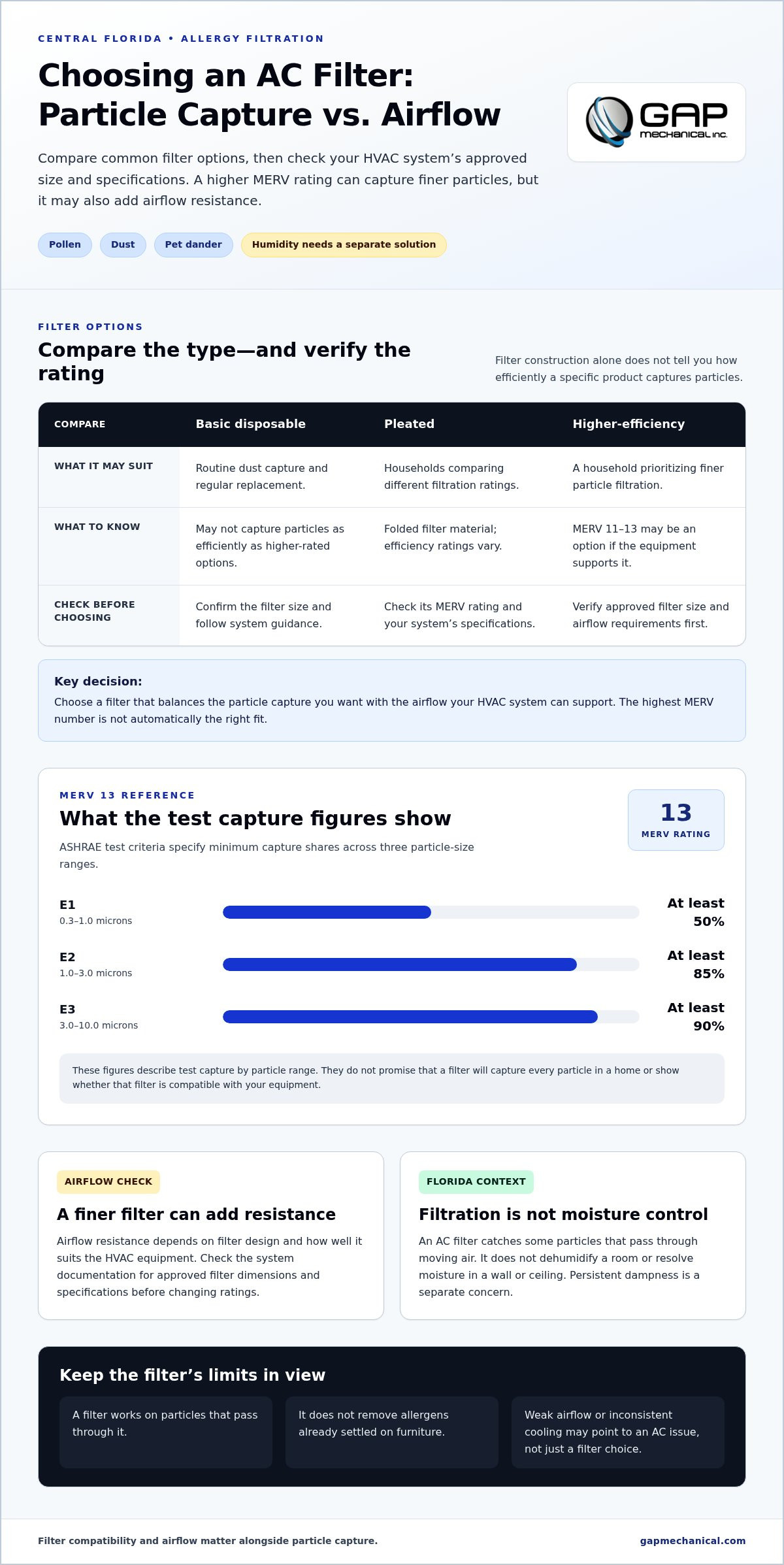
For a concrete reference, ASHRAE’s test criteria show that a MERV 13 filter captures at least the following shares of particles in each range:
| Particle range | MERV 13 capture |
|---|---|
| E1: 0.3-1.0 microns | At least 50% |
| E2: 1.0-3.0 microns | At least 85% |
| E3: 3.0-10.0 microns | At least 90% |
These figures explain what a rating measures, but they don’t promise that a filter will capture every particle in a home. The U.S. Environmental Protection Agency also explains filter selection and limitations in EPA’s Guide to Air Cleaners.
Can a higher-MERV filter restrict airflow?
It can. Airflow resistance depends on a filter’s design and how well it suits the HVAC equipment. If a filter is too restrictive for the system, airflow may suffer. There isn’t one maximum MERV rating that fits every home, so check the equipment documentation for the approved filter size and specifications before changing ratings.
Filter compatibility and airflow matter alongside particle capture. The best AC filter for allergies in Florida isn’t simply the one with the highest number. Choose one that meets your filtration needs and is compatible with your system. If airflow or cooling remains weak after you’ve checked the filter, contact GAP Mechanical about AC concerns.
Which AC filter type is the best fit for your household?
The right AC filter depends on the particles you want to capture and what your HVAC system can handle. A basic disposable filter may suit routine dust capture. Pleated or higher-efficiency options may better fit a household prioritizing finer particle filtration. No filter type is right for every system, so compare the rating with your equipment’s approved dimensions and specifications.
When might a basic or pleated filter make sense?
Basic disposable filters are a straightforward choice for routine dust capture and regular replacement. They may be a practical starting point if your household doesn’t have a particular need for finer particle filtration. They aren’t necessarily designed to capture particles as efficiently as higher-rated options.
Pleated filters use folded filter material and come in different efficiency ratings. The filter type alone doesn’t tell you how well a specific product captures particles. Check the MERV rating and system documentation instead of assuming every pleated filter performs the same way.
When should you consider a higher-efficiency option?
If pollen or pet dander is a household concern, a higher-efficiency filter may be worth considering. MERV 11-13 filters are commonly recommended for allergy-related particle capture, but a higher rating doesn’t guarantee symptom improvement. The EPA guide to air filters advises choosing filtration that your HVAC system can accommodate. Follow the equipment documentation for approved filter size and specifications.
For example, in an Orlando home with pets, compare a pleated filter with a higher MERV-rated option. Consider both particle capture and airflow. Don’t choose by rating alone.
A standalone HEPA room filter isn’t automatically a replacement for the HVAC filter. Don’t install a HEPA filter in a central system unless that system is specifically designed for it. Using one as a separate room air cleaner is different from choosing a compatible AC filter.
How should you choose and maintain an AC filter in Central Florida?
Start with the filter currently in your system. Check its size and your equipment documentation before selecting a replacement. Choose a compatible filter that meets your household’s particle-capture needs without exceeding the system’s specifications. In Central Florida, pets, household dust, and seasonal pollen can affect how quickly a filter becomes visibly loaded, so inspect it regularly rather than relying on the same schedule for every home.
What should you check before buying a replacement?
Use this process before choosing a new filter:
- Check the existing filter. Note its printed dimensions and rating, if shown. Check that it’s installed in the direction indicated by its airflow arrow.
- Read the equipment guidance. The manual or manufacturer’s instructions should identify the approved size and filter specifications. Use those details to guide your choice.
- Consider your household. Pets, visible dust, and seasonal pollen can help you decide which compatible filter type suits your needs.
- Confirm the fit. Don’t force a filter into place or substitute a specification the equipment documentation doesn’t approve. A poor fit can leave gaps or interfere with normal operation.
The best AC filter for allergies in Florida isn’t chosen by rating alone. Checking fit and system guidance helps you balance filtration with equipment operation.
How often should you inspect or replace the filter?
Inspect the filter regularly for visible buildup. Replacement timing varies with the filter, household conditions, and manufacturer guidance. A home with pets or heavier dust may load a filter differently from a home without those conditions. Follow the filter and equipment instructions, and replace it when those directions or its condition indicate it’s due. There’s no single interval that applies to every home.
For more on maintaining home comfort and equipment, review GAP Mechanical’s residential HVAC services. You can also read “How to Make Your AC More Efficient in Orlando’s Summer” for related efficiency guidance.
If airflow or cooling remains inconsistent after you’ve checked that the filter is clean, correctly sized, and properly installed, the cause may need diagnosis beyond routine filter care. Contact GAP Mechanical about persistent AC performance problems.
When is an AC filter not enough to address allergy concerns?
A filter change can help capture particles moving through your HVAC system, but it can’t identify the cause of ongoing allergy symptoms or confirm whether mold is present. If weak airflow or uneven cooling continues after you’ve checked the filter, the AC system may need attention. Filter choice alone can’t diagnose either concern.
What signs point to an AC performance issue?
Look for changes that continue after you’ve confirmed the filter is clean, correctly installed, and compatible with the system. Examples include:
- Weak airflow from one or more supply vents.
- Rooms that remain warm or cool unevenly while the AC is running.
- Cooling that doesn’t improve after you check or replace the filter according to its guidance.
- Unusual system behavior that continues rather than occurring once.
These signs don’t identify a specific fault by themselves. Note when they occur and which rooms are affected. GAP Mechanical provides residential AC repair and maintenance for home HVAC equipment concerns.
What can a professional AC visit help address?
An AC repair visit can address equipment operation when airflow or cooling remains inconsistent. GAP Mechanical is a licensed and insured HVAC contractor serving residential customers across Central Florida. A visit can help assess AC performance concerns, but choosing a filter can’t confirm whether mold is present or identify the cause of allergy symptoms.
If you suspect mold or have persistent allergy symptoms, don’t rely on a filter change or an AC performance check to determine the cause. Keep those concerns separate from signs of an equipment problem. The best AC filter for allergies in Florida can be compatible with your system and still have limits. Get AC help when airflow or cooling remains troublesome.
Contact GAP Mechanical for AC help.
Choose a filter that fits your system
The best AC filter for allergies in Florida balances particle capture with the airflow your equipment needs. Compare filters by MERV rating, then check your system’s approved size and specifications before choosing a higher-efficiency option. Inspect the filter regularly and follow its replacement guidance. Household conditions can affect how quickly it gets dirty.
Filtration has limits. An AC filter can capture some airborne particles, but it doesn’t dehumidify your Orlando home or diagnose persistent allergy symptoms or suspected mold. If weak airflow or uneven cooling continues after you’ve checked the filter, the system may need professional attention.
GAP Mechanical is a licensed and insured HVAC contractor serving Central Florida. If your AC performance remains inconsistent, contact GAP Mechanical for Central Florida AC service. A compatible filter and properly functioning equipment are practical steps toward a more comfortable home.
Frequently Asked Questions
What is the best AC filter for allergies in Florida?
There is no single best AC filter for allergies in Florida for every home. Choose a filter that captures the particles you’re concerned about and matches your system’s approved size and specifications. Compare MERV ratings, but don’t assume the highest rating suits your equipment. In humid Orlando conditions, remember that filtration captures some airborne particles. It doesn’t manage indoor humidity or solve a moisture problem.
Is a higher-MERV AC filter better for allergies?
A higher MERV rating generally indicates finer particle capture, but it doesn’t guarantee allergy relief or make a filter right for every system. Filter design and equipment compatibility matter because airflow can be affected. Check your HVAC documentation for approved filter specifications before choosing a different rating. A filter may capture some airborne particles, but it can’t address every indoor air concern or particles that aren’t passing through the system.
How often should I change my AC filter in Florida?
There’s no universal replacement schedule for every filter and household. Inspect the filter regularly, follow its instructions and your equipment manufacturer’s guidance, and replace it when its condition calls for it. Pets and household dust can affect how quickly it becomes loaded. If it’s visibly dirty or airflow changes, check the filter and its guidance rather than waiting for an arbitrary date.
Can an AC filter remove mold spores or control humidity?
An AC filter may capture some airborne mold spores, depending on its design and rating, but it doesn’t control humidity or fix a moisture source. In Florida, treat persistent dampness or suspected mold as a separate concern rather than relying on a filter change. A filter choice can’t confirm whether mold is present. Address the underlying moisture concern separately, and have AC performance concerns assessed as needed.
Frequently Asked Questions
Which airborne particles can an AC filter capture?
Pollen can enter through open doors and windows or other air pathways. Dust and pet dander can become airborne when people move around or disturb fabrics. When these particles pass through the HVAC filter, some may be trapped. The amount depends on the filter’s design and rating, as well as the particles themselves. MERV, or Minimum Efficiency Reporting Value, is a common way to describe a filter’s particle-capture efficiency. A higher rating generally indicates finer particle capture, but the number alone doesn’t tell you whether a filter is suitable for your equipment. The Minimum Efficiency Reporting Value (MERV) system is a useful starting point for comparing ratings. A filter works on particles that pass through it. It won’t remove every allergen from a home, so don’t treat it as a complete solution for allergy concerns.
Why does Florida humidity matter to filter choice?
Central Florida’s humid conditions make it important to separate moisture concerns from particle filtration. A filter catches particles in moving air. It doesn’t dehumidify a room or control moisture in a wall, ceiling, or other area. A higher-rated filter is not a substitute for addressing indoor moisture. If you notice persistent dampness or suspect mold, changing the filter alone may not address the underlying issue. Treat recurring moisture as a separate concern rather than assuming a filter change will solve it. For an Orlando home, choose a compatible filter for airborne particles and pay attention to any ongoing moisture problem. MERV gives you a standardized way to compare how effectively filters capture particles of different sizes. A higher rating generally means finer particle capture, but it doesn’t automatically make a filter the right choice for your Orlando home. Your system’s approved filter specifications and airflow requirements matter, too.
What does a MERV rating tell you?
MERV stands for Minimum Efficiency Reporting Value. ASHRAE Standard 52.2-2017 provides the test method behind the rating and groups particles into three size ranges: E1, from 0.3 to 1.0 microns; E2, from 1.0 to 3.0 microns; and E3, from 3.0 to 10.0 microns. The rating describes particle filtration, not every aspect of indoor air or humidity management. For a concrete reference, ASHRAE’s test criteria show that a MERV 13 filter captures at least the following shares of particles in each range: These figures explain what a rating measures, but they don’t promise that a filter will capture every particle in a home. The U.S. Environmental Protection Agency also explains filter selection and limitations in EPA’s Guide to Air Cleaners.
Can a higher-MERV filter restrict airflow?
It can. Airflow resistance depends on a filter’s design and how well it suits the HVAC equipment. If a filter is too restrictive for the system, airflow may suffer. There isn’t one maximum MERV rating that fits every home, so check the equipment documentation for the approved filter size and specifications before changing ratings. Filter compatibility and airflow matter alongside particle capture. The best AC filter for allergies in Florida isn’t simply the one with the highest number. Choose one that meets your filtration needs and is compatible with your system. If airflow or cooling remains weak after you’ve checked the filter, contact GAP Mechanical about AC concerns. The right AC filter depends on the particles you want to capture and what your HVAC system can handle. A basic disposable filter may suit routine dust capture. Pleated or higher-efficiency options may better fit a household prioritizing finer particle filtration. No filter type is right for every system, so compare the rating with your equipment’s approved dimensions and specifications.
When might a basic or pleated filter make sense?
Basic disposable filters are a straightforward choice for routine dust capture and regular replacement. They may be a practical starting point if your household doesn’t have a particular need for finer particle filtration. They aren’t necessarily designed to capture particles as efficiently as higher-rated options. Pleated filters use folded filter material and come in different efficiency ratings. The filter type alone doesn’t tell you how well a specific product captures particles. Check the MERV rating and system documentation instead of assuming every pleated filter performs the same way.
When should you consider a higher-efficiency option?
If pollen or pet dander is a household concern, a higher-efficiency filter may be worth considering. MERV 11–13 filters are commonly recommended for allergy-related particle capture, but a higher rating doesn’t guarantee symptom improvement. The EPA guide to air filters advises choosing filtration that your HVAC system can accommodate. Follow the equipment documentation for approved filter size and specifications. For example, in an Orlando home with pets, compare a pleated filter with a higher MERV-rated option. Consider both particle capture and airflow. Don’t choose by rating alone. A standalone HEPA room filter isn’t automatically a replacement for the HVAC filter. Don’t install a HEPA filter in a central system unless that system is specifically designed for it. Using one as a separate room air cleaner is different from choosing a compatible AC filter. Start with the filter currently in your system. Check its size and your equipment documentation before selecting a replacement. Choose a compatible filter that meets your household’s particle-capture needs without exceeding the system’s specifications. In Central Florida, pets, household dust, and seasonal pollen can affect how quickly a filter becomes visibly loaded, so inspect it regularly rather than relying on the same schedule for every home.
What should you check before buying a replacement?
Use this process before choosing a new filter: The best AC filter for allergies in Florida isn’t chosen by rating alone. Checking fit and system guidance helps you balance filtration with equipment operation.
How often should you inspect or replace the filter?
Inspect the filter regularly for visible buildup. Replacement timing varies with the filter, household conditions, and manufacturer guidance. A home with pets or heavier dust may load a filter differently from a home without those conditions. Follow the filter and equipment instructions, and replace it when those directions or its condition indicate it’s due. There’s no single interval that applies to every home. For more on maintaining home comfort and equipment, review GAP Mechanical’s residential HVAC services. You can also read “How to Make Your AC More Efficient in Orlando’s Summer” for related efficiency guidance. If airflow or cooling remains inconsistent after you’ve checked that the filter is clean, correctly sized, and properly installed, the cause may need diagnosis beyond routine filter care. Contact GAP Mechanical about persistent AC performance problems. A filter change can help capture particles moving through your HVAC system, but it can’t identify the cause of ongoing allergy symptoms or confirm whether mold is present. If weak airflow or uneven cooling continues after you’ve checked the filter, the AC system may need attention. Filter choice alone can’t diagnose either concern.
What signs point to an AC performance issue?
Look for changes that continue after you’ve confirmed the filter is clean, correctly installed, and compatible with the system. Examples include: These signs don’t identify a specific fault by themselves. Note when they occur and which rooms are affected. GAP Mechanical provides residential AC repair and maintenance for home HVAC equipment concerns.
What can a professional AC visit help address?
An AC repair visit can address equipment operation when airflow or cooling remains inconsistent. GAP Mechanical is a licensed and insured HVAC contractor serving residential customers across Central Florida. A visit can help assess AC performance concerns, but choosing a filter can’t confirm whether mold is present or identify the cause of allergy symptoms. If you suspect mold or have persistent allergy symptoms, don’t rely on a filter change or an AC performance check to determine the cause. Keep those concerns separate from signs of an equipment problem. The best AC filter for allergies in Florida can be compatible with your system and still have limits. Get AC help when airflow or cooling remains troublesome. Contact GAP Mechanical for AC help. The best AC filter for allergies in Florida balances particle capture with the airflow your equipment needs. Compare filters by MERV rating, then check your system’s approved size and specifications before choosing a higher-efficiency option. Inspect the filter regularly and follow its replacement guidance. Household conditions can affect how quickly it gets dirty. Filtration has limits. An AC filter can capture some airborne particles, but it doesn’t dehumidify your Orlando home or diagnose persistent allergy symptoms or suspected mold. If weak airflow or uneven cooling continues after you’ve checked the filter, the system may need professional attention. GAP Mechanical is a licensed and insured HVAC contractor serving Central Florida. If your AC performance remains inconsistent, contact GAP Mechanical for Central Florida AC service. A compatible filter and properly functioning equipment are practical steps toward a more comfortable home.
What is the best AC filter for allergies in Florida?
There is no single best AC filter for allergies in Florida for every home. Choose a filter that captures the particles you’re concerned about and matches your system’s approved size and specifications. Compare MERV ratings, but don’t assume the highest rating suits your equipment. In humid Orlando conditions, remember that filtration captures some airborne particles. It doesn’t manage indoor humidity or solve a moisture problem.
Is a higher-MERV AC filter better for allergies?
A higher MERV rating generally indicates finer particle capture, but it doesn’t guarantee allergy relief or make a filter right for every system. Filter design and equipment compatibility matter because airflow can be affected. Check your HVAC documentation for approved filter specifications before choosing a different rating. A filter may capture some airborne particles, but it can’t address every indoor air concern or particles that aren’t passing through the system.
How often should I change my AC filter in Florida?
There’s no universal replacement schedule for every filter and household. Inspect the filter regularly, follow its instructions and your equipment manufacturer’s guidance, and replace it when its condition calls for it. Pets and household dust can affect how quickly it becomes loaded. If it’s visibly dirty or airflow changes, check the filter and its guidance rather than waiting for an arbitrary date.
Can an AC filter remove mold spores or control humidity?
An AC filter may capture some airborne mold spores, depending on its design and rating, but it doesn’t control humidity or fix a moisture source. In Florida, treat persistent dampness or suspected mold as a separate concern rather than relying on a filter change. A filter choice can’t confirm whether mold is present. Address the underlying moisture concern separately, and have AC performance concerns assessed as needed.